Showing posts with label 1970. Show all posts

Friday, November 26, 2021

Bad Rice - Ron Nagle


Bad Rice
Ron Nagle
Warner Bros. WS 1902
1970

My obsession with the San Francisco Sound led me to Ron Nagle's mid-1960s group the Mystery Trend.  For many years they were a mystery to me, a trippy name I encountered on old concert posters or histories of the San Francisco rock scene.  Eventually I heard their excellent 1967 single "Johnny Was a Good Boy" which whetted my appetite to hear more.  Finally I got the Big Beat CD compilation of their unreleased recordings and was enormously impressed.  Their music was of astonishingly high quality and deserved an actual album back when they were still active.  Unfortunately they were totally out of touch with the hippie zeitgeist of that era with their commitment to well-crafted songs and chamber pop along with their total disdain for the psychedelic scene.  I figured I had satisfied my curiosity about the Mystery Trend but then several years ago I came across this album while flipping through a record bin.  I had no idea what it was, I was just struck by how weird and ugly it was.  As I examined it I remembered who Nagle was and eagerly bought it.  It sounds nothing like the Mystery Trend but I was not disappointed I bought it.  The album gets off to an exciting start with "61 Clay" which is a Chuck Berry style rocker that reminds me that Nagle was an rhythm and blues/rock and roll fanatic when he first got into music.  There is a smoking guitar solo from Ry Cooder that kicks out the jams and puts the song over the top.  The lyrics are pure teen rebellion with a little matricide thrown in.  It is easily my favorite track on the album.  The record's momentum continues with the rollicking boogie "Marijuana Hell" which Nagle co-wrote with John Blakeley.  The song outlines the evils of marijuana with all the fervor of "Reefer Madness."  I assume it is a joke although Nagle's drug of choice was alcohol and he never hid his contempt for hippie culture so who knows.  The album abruptly shifts direction with the melancholy "Frank's Store" which is driven by Nagle on piano and a poignant string arrangement by the album's producer Jack Nitzsche.  Nagle's vocal is full of emotion and puts across the sadness in the lyrics very effectively.  The album returns to boogie with "Party in L.A." although this is not an ode to partying down with some Angelenos.  The party of the title is the Communist Party (or some like-minded variant) and the song describes a child custody dispute between a leftist activist mom and a centrist father.  Just your typical pop song.  Side one concludes with "That's What Friends Are For" which returns to singer-songwriter melancholy.  Nagle croons the lyrics about the nature of a relationship while accompanying himself on piano.  Side two starts with "Dolores" which is lushly orchestrated by Nitzsche.  It sounds like something by Nagle's idol Burt Bacharach until I listen to the lyrics which I interpret as an older woman teaching a boy the ways of love.  "Capricorn Queen" is a  raucous rocker about Nagle's addiction to alcohol.   It features a frenetic rockabilly style vocal from Nagle and is another one of my favorite tracks.  "Sister Cora" is a wonderful riff-driven banger about the title character's ability to cure folks' ills and solve their problems.  The album settles down with "Somethin's Gotta Give Now" which has a country feel to it and displays some of the pop craftsmanship Nagle exhibited with the Mystery Trend.  The country sound continues with the lumbering "Family Style" which features mildly vulgar and humorous lyrics about a disorderly family.  The record concludes with "House of Mandia" which manages to combine the two musical directions on the album.  The verses are powered by a heavy riff over which Nagle bellows about a working class man's misery while the choruses are silky smooth pop with Nagle crooning a description of a tropical paradise supported by Nitzsche's sugary string arrangement.  Normally I would have a problem with such a schizophrenic record.  The abrupt shifts between rock and singer/songwriter pop are definitely jarring to me, but the consistency of tone and overall intelligence of the record smooth it over somewhat.  I definitely prefer the rock side though.  Nagle's career was primarily teaching art and creating ceramic art with a lot more success than he had as a musician.  However he was no dilettante, he had genuine chops and great integrity as a musical artist and certainly deserved a better fate.  He is often compared to Randy Newman because they both value musical craftsmanship and display a dark sense of humor.  Nagle is far less cynical than Newman though and he likes rock a lot more than him as well.  He is also a better singer.  This album is well worth seeking out.  You rarely find such a stimulating combination of intelligence and sincere love of rock and roll.  Recommended to people who think it would be cool if Randy Newman jammed with Creedence Clearwater Revival.

Monday, August 10, 2020

The End of the Game - Peter Green


The End of the Game
Peter Green
Reprise 6346
1970 

I was very sorry to see that Peter Green had died.  He was one of my favorite guitarists in rock.  My admiration was entirely based on his work with the band he founded, Fleetwood Mac.  I have a few of his solo albums (mostly on CD) which are fine but uninspired for the most part.  This is my favorite of his solo records.  It was his first solo album and sounds little like his recordings with Fleetwood Mac.  I was extremely disappointed when I first bought it but I've since come to admire it.  I was expecting more of blues/hard rock sound like his previous work, but the album consists of a series of jazzy instrumental jams with a dash of funk.  It reminds me of late period Jimi Hendrix and I would not be surprised if that was an influence on Green's approach to the record.  The record gets off to a strong start with "Bottoms Up" which is my favorite track.  Supported by a heavy bass riff from Alex Dmochowski, Greens cuts loose with smoking hot guitar runs.  The jam lacks direction but it is full of energy and I find it extremely stimulating.  The track goes on for slightly over nine minutes but I still think it fades out too soon.  "Timeless Time" is far more subdued.  Green's solo is lovely although it sounds tentative.  Side one concludes with "Descending Scale" which sounds like jazz fusion.  The song opens with Dmochowski laying down staccato bass riffs while Zoot Money delivers bursts of kinetic piano riffs as Green unleashes a noisy almost discordant guitar frenzy, before the song slows down for an extended interlude of interwoven bass and guitar noodling reminiscent of the Grateful Dead that is moderately engaging to me if I am in the right mood.  The song picks up steam near the end as the piano rejoins the action before the jam is clumsily cut off to end the side.  Side two opens with "Burnt Foot" which starts promisingly with a compelling riff from Dmochowski which unfortunately evolves into a drum solo from Godfrey MacLean that I find as tedious as most drum solos.  The song comes back to life with the rest of the band rejoining for some heavy riffing that produces some of the most satisfying music on the album for rock fans.  "Hidden Depth" is a meandering return to jazz fusion with lyrical guitar runs from Green that display his characteristic grace and fluidity.  Side two concludes with the title track which offers up more jazz fusion.  It opens with the most frenetic and chaotic musical passages on the record with noisy, yet majestic guitar work from Green before settling into a languorous quiet jam that drifts aimlessly before being abruptly cut off to the conclude the album.  If I wanted to demonstrate to someone the brilliance of Peter Green, this would certainly not be the album to start with (I would pick the live recordings of Fleetwood Mac at the Boston Tea Party from 1970.)  However when I heard that Green had died, this was the album I reached for.  I am generally not a big fan of recorded rock jam sessions (aside from Jimi Hendrix), I think they are more appropriate for concerts.  However this one appeals to me for a variety of reasons.  Mostly I am drawn to it because Green's playing is so vibrant and dynamic, it is often a very exciting record despite the unstructured format.  Also as much as I love the early Fleetwood Mac, it is interesting to hear Green in a different context playing with more jazz oriented musicians.  Furthermore I find the record has an immediacy and intimacy that I don't find on his more commercial records.  Finally I think it represents the final flowering of Green's genius.  He recorded it on the verge of his descent into debilitating mental illness.  I have only heard a few of his post-illness albums but none of them even approach the inspired playing on this record.  It has a poignancy and wistfulness to it because it makes me wonder what he might have achieved if he had not been damaged by drugs and mental illness.  It was this poignancy that drew me to this record when I learned that he had died.  Like his contemporary Jimi Hendrix, Green's recorded output of essential recordings was rather small but they burn all the more brightly because of the intensity of the relatively brief period that their creators flourished.  Recommended to fans of Jeff Beck's "Blow By Blow."

Saturday, December 28, 2019

The Season for Miracles - Smokey Robinson and The Miracles


The Season for Miracles
Smokey Robinson and the Miracles
Motown 5253ML
1970

This is a reissue of the second Christmas album released by Smokey Robinson and The Miracles which was originally issued on Tamla as TS307.  I put it on to trim the tree this year and found it very pleasing.  It features an engaging mix of original songs and traditional carols.  The traditional carols are given Motown style arrangements with strong rhythm sections over which the Miracles deliver typically dynamic vocal arrangements with stimulating harmonies.  I particularly like the driving performance of "Go Tell It On The Mountain."  They also offer up lovely performances of combined melodies of "Deck the Halls" with "Bring a Torch, Jeannette Isabella" and "Away in a Manger" with "Coventry Carol."  "God Rest Ye Merry Gentlemen" is given a jazzy arrangement by Wade Marcus that features terrific ensemble singing by the group.  It is one of my favorite tracks.  In contrast the sappy arrangement of Mel Torme and Robert Wells' classic "The Christmas Song" leaves me indifferent despite the gorgeous vocals.  "Jingle Bells" is basically indestructible and easily survives its Motownization.  Among the original songs the most striking one is "A Child is Waiting" by Joe Hinton and Patti Jerome.  It is not a Christmas song, but rather a song endorsing adoption, but with its generosity of spirit and heart-warming message it fits in well with the rest of the album and gives the record an uplifting finish.  The originals also include two songs by Stevie Wonder and Syreeta Wright.  "I Can Tell When Christmas is Near" is the better of the two.  It is driven by a catchy piano riff and features a lively performance by the group.  "It's Christmas Time" is also piano driven but is more sedate emphasizing Robinson's sensitive vocal.  It recounts the events around the birth of Jesus.  Robinson wrote "I Believe in Christmas Eve" which is also a religious song but has enough of a pop flavor that I still find it very appealing.  Ron and Deborah Miller's "The Day That Love Began" previously appeared on Stevie Wonder's 1967 Christmas album.  I find the song corny and don't really care for either version but I give the edge to Wonder for a more convincing vocal.  "Peace on Earth (Goodwill Toward Men)" by Jimmy and Ann Roach is the most undistinguished of the original songs but it is still pleasant to listen to.  The absence of any real standout songs keeps this album from being an essential Christmas record and I would prefer more secular Christmas songs, but this is still a very worthwhile record that should appeal to most fans of the group.  Recommended to religious Motown buffs.

Saturday, October 1, 2016

Blows Against the Empire - Paul Kantner/Jefferson Starship


Blows Against The Empire
Paul Kantner/Jefferson Starship
RCA LSP-4448
1970

My belated tribute to the late Paul Kantner.  This was his first solo album, despite the co-credit this group bares little resemblance to the group Kantner formed later in the decade that shared the moniker Jefferson Starship.  I've admired Kantner for many decades.  I became a huge fan of the Jefferson Airplane in my early teens just after the band had broken up.  I liked the first few Jefferson Starship albums as well.  I picked this record up in the early 1980s.  I didn't like it too much at first, but that has changed through the decades and now I prefer it to the post-Marty Balin Airplane and Jefferson Starship albums as well.  Kantner gets top billing on the record but it is very much a collaborative effort with musical and songwriting support from his bandmates most notably Grace Slick.  The album also features other members of the Bay Area rock aristocracy including support from the Grateful Dead and Quicksilver Messenger Service as well as David Crosby and Graham Nash.  The album begins with "Mau Mau (Amerikon)" by Kantner, Slick and Joey Covington.  It is an anti-establishment diatribe about the younger generation fighting the power with sex, drugs and rock and roll while also patting themselves on the back for being better than the previous generation, hardly the first time I heard a bunch of boomers praising themselves.  It takes pointed jabs at Reagan and Nixon and would have fit very nicely on the Airplane's "Volunteers" album.  This hard rocking raucous song is the track on the album that sounds the most like classic Jefferson Airplane.  The album makes an abrupt change in tone with a cover of Rosalie Sorrell's "The Baby Tree" which is a light-hearted song about an island where babies grow on trees.  The song just features Kantner singing and playing banjo.  Kantner's "Let's Go Together" is another anti-establishment song about hippies banding together to "wave goodbye to Amerika" and founding their own idealistic society which is the main theme of the album.  The song continues in the folkie vein of the previous tune with Jerry Garcia taking over on banjo.  The song is given extra propulsion by Slick on piano and Bill Kreutzmann on drums.  Slick duets with Kantner on the song.  It also would have fit well on "Volunteers."  Side one concludes with "A Child is Coming" by Kantner, Slick and Crosby.  The song was presumably inspired by the impending birth of Kantner and Slick's daughter China and expresses Slick's wish not to "carry the government's child."  They want to get back to nature to escape the indoctrination process of "Uncle Samuel."  This is another folk-style track with Crosby taking Marty Balin's place in the three part vocal with Slick and Kantner, which I don't consider an improvement although the results are quite pretty.  My favorite part of the song is Jack Casady's thunderous bass lines.  The second side of the album is a suite of songs entitled "Blows Against the Empire."  The first song is Slick's "Sunrise" in which she tells "civilized man" to go ahead and die since he is not needed or wanted anymore.  Slick sings the song like she is calling the faithful to prayer.  She double tracks her vocal making it more powerful.  Again Casady is the star of the song with his dazzling bass work.  "Hijack" is by Kantner, Slick, Marty Balin and Gary Blackman.  It anticipates that a starship capable of traveling through the universe will be built by 1990 and urges the counterculture rebels to hijack it and escape to another world.  Slick and Kantner duet on the song which is largely driven by Slick's dynamic piano work.  "Home" is a brief abstract instrumental attributed to Kantner, Phill Sawyer and Graham Nash (it really took 3 guys to come up with a 37 second song with no melody?)  Kantner and Crosby wrote "Have You Seen the Stars Tonite."  The song takes place on the stolen starship and is a paean to a hippie utopia.  This hypnotic and slightly trippy song is again driven by Slick's piano with additional instrumental color provided by Jerry Garcia on pedal steel guitar.  It is my favorite track on side two.  "X M" is another short abstract instrumental credited to Kantner, Sawyer, Garcia and Mickey Hart.  It sounds like a spaceship taking off.  The concluding song, "Starship," is by Kantner, Slick, Balin and Blackman and it again encourages the hippies to escape on the starship.  The song is a stirring rocker featuring some Grateful Dead-like guitar runs from Garcia and more compelling piano work from Slick.  Slick and Kantner duet on the song with harmonic support from Crosby and Nash.  The song just peters out at the end, but otherwise gives the album a dramatic finish.  Although Kantner deservedly gets top billing, Grace Slick's contribution to the album is immense.  It would be much less interesting without her.  In many respects the album can be seen as part of a counter-culture trilogy with the Airplane's "Volunteers" and Slick and Kantner's "Sunfighter" which I think represents the peak of Slick and Kantner's creative partnership.  When I first heard this album I dismissed it as hippie hokum, but I think that is unfair.  Kantner was a true believer and though I find his ideas dubious at best, I admire his passion and commitment.  The hope and innocence in this record touch me.  I think the album holds up better than a lot of the other political music from that era.  Musically it is superb, it may lack the fire of the Airplane when it was in full flight, but I still find it invigorating and captivating.  Rest in peace Paul Kantner, in my mind you will always be flying high.  Recommended to fans of "Volunteers" and "Sunfighter."

Sunday, June 7, 2015

Fire and Water - Free


Fire and Water
Free
A&M Records SP 4268
1970

A belated post for Andy Fraser who died this past March.  Fraser was the bass player and principal songwriter along with Paul Rodgers in the British band, Free.  I loved this record when I was a teenager.  I grew up listening to classic rock on the radio and when I heard "All Right Now" it blew me away and I tracked this record down.  I've always been a sucker for a good riff and this band had plenty of them.  As I grew older I lost interest in classic rock aside from the 1960s and it has been awhile since I played this.  Listening to it now, I'm impressed.  It still sounds really good, better than most of the other records that came out in the early 1970s.  My favorite track is the opening cut, "Fire and Water" which like almost the entire album was written by Fraser and Rodgers.  It is driven by a catchy power riff and an emotional vocal from Rodgers as he assails a former lover for breaking his heart.  Paul Kossoff puts the song over the top with a powerful, bluesy guitar solo.  I even dig the Simon Kirke drum solo that closes out the song.  This is smouldering hard rock at its best, sustained tension and controlled strength throughout the song.  The record lets up a bit for "Oh I Wept" which was written by Rodgers and Kossoff.  It is a moody ballad about running away from unhappiness that is largely carried by another strong vocal from Rodgers.  The band turns to slow riffing for "Remember" which looks back regretfully at a lost relationship.  Kossoff delivers another strong bluesy solo that is the highlight of the song.  The side ends with "Heavy Load" which is also constructed around a slow heavy riff.  The song is driven by Fraser on piano until the end where Kossoff's howling guitar takes over.  This dark, ominous song is another one of my favorites on the album.  Side two opens with "Mr. Big" which is a group composition.  It is a series of threats directed at the title character.  The tune is constructed around a simple heavy riff that evolves into an intense jam between Kossoff's soaring guitar runs and Fraser's energetic bass lines.  This is the most exciting musical passage on the album.  Great stuff.  They cool down for the far less charged "Don't Say You Love Me" which is a slow ballad.  It is a variation on the so-long-babe-I-got-to-ramble type song beloved of so many rockers.  I find it a little boring although it picks up energy towards the end.  The album concludes with the group's only hit, "All Right Now."  The song is a classic rock radio standard and with good reason.  The riff is extremely catchy, Rodgers' gravelly vocal is the essence of hard rock singing, Kossoff lays down some hot licks and Kirke and Fraser propel the song along relentlessly.  The song is sexy with a chorus that sticks with you long after the song is over.  Thus ends one of the best hard rock records of its era.  It is so good it makes me wonder why Free never made it really big.  They had all the tools, good songwriting, a terrific lead singer, inspired musicianship, but none of the other Free records I've heard are nearly as good as this one.  It was probably a question of band chemistry as well as Paul Kossoff's drug problems.  At least they left this one lasting classic album.  I love its stripped down sound and sustained power.  No mindless boogies or heavy metal wank sessions, it is all purposeful and deliberate.  I admire their discipline and intelligence, a rare quality in an era of self-indulgence, excess and vapidity.  Rest in peace Andy Fraser, this great album insures that you will not be forgotten. Recommended to fans of the first Jeff Beck Group.

Thursday, June 4, 2015

Fly on Strangewings - Marian Segal with Silver Jade


Fly On Strangewings
Marian Segal with Silver Jade
DJM Records DJM 9100
1971

This is the American release of the sole album by Jade originally released in England in 1970.  The group's name was altered because there was already a group in America called Jade.  Collectors might want to pursue the British version of this album which was released in a more attractive gatefold sleeve which I believe is also the case with modern reissues of the album.  I've mentioned in past posts my fondness for British folk-rock and this is an excellent example of the contemporary version of that genre.  All the songs are originals, composed by Marian Segal, but they show the influence of traditional musical styles throughout similar to the work of Richard Thompson, John Martyn and Sandy Denny.  It is a delightful album that deserves to be better known.  It opens with "Amongst Anemonies" featuring sterling work from guest performers Terry Cox on drums and guitarist James Litherland contributing to a robust instrumental sound.  The vocal interplay between Segal and her bandmates Dave Waite and Rod Edwards is quite dynamic.  The song contrasts life in the rural countryside with a dream of the sea.  Edwards drives the delicate "Raven" with his harpsichord and organ work.  It is a cryptic song with gothic imagery that examines a May-December relationship.  Waite and Segal trade verses and then duet on the final verse.  "Fly on Strangewings" reminds me of Sandy Denny, particularly "Who Knows Where The Time Goes."  This soaring song about separation is one of my favorite cuts.  The song features a lovely vocal from Segal and engaging piano work from Edwards bolstered by a tasteful string arrangement by Phil Dennys.  "Mayfly" sounds like the traditional song "The Cuckoo."  It is a jaunty country-flavored song that laments the short life span of the title insect. "Alan's Song" commemorates a childhood friend of Segal's who died in an accident as a teen.  It is a nostalgic song that looks back on the aspirations of childhood.  "Bad Magic" is a percussion heavy song that mixes rock and chamber pop courtesy of Edwards on his harpsichord.  It reminds me of Donovan or early Traffic.  The song advises the listener to avoid the witch-like woman who is the subject of the song.  Side two opens with "Clippership" which describes a woman living vicariously through the past experiences that her singer-lover recounts to her.  It is a propulsive song in the best folk-rock manner with pleasing vocal harmonies.  "Five of Us" recounts Segal's experiences sharing a rustic cottage with four friends.  It reminds me of the first Fairport Convention album but it has a chamber pop sound as well.  Segal's vocal is especially appealing to me on this track.  This is another one of my favorite songs on the record.  "Reflections on a Harbour Wall" is precisely that, a description of the experience of being in a harbor town.  It is a guitar driven track that starts slow and picks up speed as it goes along.  James Litherland has a nice lyrical guitar solo.  "Mrs. Adams" is about the death of the title character.  John Harper's violin playing and the structure of the tune create a traditional folk sound as does the repetition of the lyrics.  The song is given a forceful folk-rock push by the rhythm section of Pete Sears on bass and Mick Waller on drums.  "Fly Me to the North" is a sensitive and gentle song about running away from heartbreak and sadness.  Segal and Waite trade verses and then duet supported by another pretty string arrangement from Dennys.  The record ends with "Away From the Family" which is also about escape, this time making it on one's own away from one's family.  It is the hardest rocking song on the record with a heavy guitar riff and honky tonk piano from Rod Edwards.  This lumbering tune obtrusively departs from the sound of the rest of the record, but it does end the record with a bang.  I am a big fan of this album.  Segal is a fine songwriter.  Her lyrics are personal and intelligent with evocative imagery.  Although influenced by folk tradition, the music sounds contemporary and is eclectic in style and instrumentation.  The record is never boring and it consistently engages me emotionally and sonically.  If you are a fan of folk-rock, it is well worth seeking out.  Recommended to fans of early Fairport Convention and Trader Horne.

Sunday, December 7, 2014

Just Another Diamond Day - Vashti Bunyan


Just Another Diamond Day
Vashti Bunyan
DiCristina Step04
1970

This is the 2004 re-issue of Vashti Bunyan's debut album originally released as Philips 6308 019.  When this album was originally issued, it hardly sold at all making it a pricey collectors item when people finally came to appreciate its excellence.  I became interested in Bunyan via her connection to Joe Boyd who produced this record.  Boyd was of course the manager/producer for the Incredible String Band, Nick Drake and Fairport Convention all of whom I loved.  I was really into the British folk rock scene and was dying to hear this album but I never could find a copy I could afford.  I was delighted when it was reissued and thrilled to hear that it was just as great as I had imagined.  I think it was one of the best records Boyd was ever involved with although I guess he does not agree since he devoted only a single page of his autobiography to it.  Rob Young in his marvelous survey of British folk music, "Electric Eden" focused almost his entire first chapter on Bunyan and the remarkable story behind this album.  In the late 60s Bunyan and her boyfriend, Robert Lewis, set off from Kent in a horse and wagon they bought from a gypsy (depicted on the gatefold of the album.)  They were heading north to Scotland to the Isle of Skye in the Hebrides where their friend Donovan had purchased some land to start a hippie commune.  Their plan to join the commune did not pan out and they ended up living in a primitive cottage on the nearby island of Berneray.  Bunyan composed the songs on this record during her arduous journey and while living on the island.  She recorded it while pregnant in late 1969 and when the album flopped upon its release the following year, Bunyan abandoned the music industry.  It would be 35 years before she would make another album.  Even if this had been the only album she had ever made, it would still insure her an important place in the history of British folk music.  It is an absolute masterpiece.  The record opens with "Diamond Day" which celebrates agrarian life.  The song features a lovely recorder and string arrangement from Robert Kirby who also did some of the string arrangements on Nick Drake's "Five Leaves Left" album.  "Glow Worms" continues the celebration of a natural life as Bunyan delicately croons about the world she observed around her on her journey.  The melody of "Lily Pond" sounds like it was derived from "Twinkle, Twinkle, Little Star" which suits its fairy tale style lyrics nicely.  Robin Williamson of the Incredible String Band plays Irish harp on the song bolstering its string sound.  "Timothy Grub" recounts the beginning of Bunyan's journey.  In the song she and Lewis are forced to leave their encampment by a pair of policeman.  They get picked up by a friend in his car but the car runs out of gas.  Stranded, they encounter a gypsy with a horse and wagon which they buy to continue their trip.  The song has a charming jazziness to the melody that reminds me of Nick Drake.  "Where I Like to Stand" was co-written with John James who plays a dulcitone on the album and painted the animals on the album cover.  He was also the friend with the car that ran out of gas mentioned in "Timothy Grub."  The song celebrates life by the ocean as Bunyan sings about watching the waves and the fishermen and enjoying the natural world around her.  A pair of Fairporters play with Bunyan on this song, namely Dave Swarbrick on fiddle and Simon Nicol on banjo and they enliven the simple child-like melody.  "Swallow Song" describes the passing of summer into autumn with the usual emphasis on the natural world.  The song features another evocative string arrangement from Robert Kirby.  Side one concludes with "Window Over the Bay" co-written with Robert Lewis.  The song is traditional sounding with only minimal accompaniment and the first verse sung acappella.  The song is another paean to agrarian life that sounds like it was inspired by life on Berneray.  This lovely song is one of my favorites on the album.  Side two begins with "Rose Hip November" which is about the changing of the seasons, autumn giving way to winter.  It also anticipates the birth of her son Leif.  This haunting song is another one of my favorites.  Williamson plays whistle and harp on this song which gives it a rich instrumental texture.  "Come Wind Come Rain" returns to Bunyan and Lewis' trip across the U.K. and traveling in the wagon in the winter elements.  The sprightly tune resembles "Lord of the Dance" by Sydney Carter which in itself was derived from the 19th Century dance tune "Simple Gifts" by Joseph Brackett.  Carter's song was covered by Donovan (on "H.M.S. Donovan") so perhaps Bunyan heard him play it and the melody stuck with her.  I greatly prefer "Come Wind Come Rain" to "Lord of the Dance."  Nicol on banjo and Swarbrick on mandolin accompany the song to great effect.  Lewis co-wrote "Hebridean Sun" which looks forward to their arrival in the Hebrides and celebrates the first signs of spring.  Bunyan's intimate vocal on this song really sends me.  "Rainbow River" idealizes the life of a boy growing up on a farm enjoying home-baked bread and fresh fish from a river.  Robert Kirby's recorder arrangement enhances the idyllic feeling of the song.  "Trawlerman's Song" is another collaboration with Lewis.  It recounts the joy of a fisherman returning home to his family after being out at sea.  It has another wonderful intimate vocal from Bunyan.  "Jog Along Bess" is about Lewis and Bunyan's wagon, their horse Bess who pulled their wagon, and their dogs Blue and May who came along on their journey.  The jauntiness of the tune is bolstered by Williamson on fiddle.  The album concludes with "Iris's Song For Us" which Bunyan got from a pair of her Berneray neighbors, Iris McFarlane and Wally Dix.  It is a love song filled with images from nature.  It is very traditional sounding particularly since one of the verses is sung in Gaelic.  Swarbrick's fiddle adds to the traditional flavor of the song.  It gives the album a lovely finish.  I adore this record, but I imagine some people may find it excessively twee.  It could have easily been self-indulgent hippie hogwash, but Bunyan's immense talent and sincerity insures that it always rings true.  I'm drawn to Bunyan's sensitivity and the delicate expressiveness of her voice, it mesmerizes and relaxes me.  I find that this album sounds particularly wonderful late in the evening by candlelight or on a wintery afternoon staring out the window sipping a cup of tea.  Recommended to fans of the Incredible String Band who wish they weren't so noisy.

Monday, November 17, 2014

Sunflower - The Beach Boys


Sunflower
The Beach Boys
Brother Records/Reprise Records RS-6382
1970 

Over the summer I went with my family to the Ventura County Fair.  The price of admission to the fair included admission to the show in the evening which is how I found myself watching a concert by Mike Love and his Beach Boys imposters.  There is no way I'd ever pay money to watch Mike Love perform and I wasn't even sure I wanted to see him for free, but my wife and son insisted on staying for his performance so I went and to my surprise I enjoyed it.  If nothing else Love knows how to please a crowd and unleashed a slew of popular Beach Boys classics plus well-chosen covers like "Surf City" and "California Dreamin.'"  Love's nasal whine was in fine form and he showed impressive enthusiasm.  He had a solid back-up band which featured some good singers to take the place of Carl and Brian Wilson.  He definitely needed them because his two "Beach Boys" were basically window dressing.  Bruce Johnston can't sing anymore, his performance on "Please Let Me Wonder" was appalling and David Marks is, well, David Marks.  There were a few departures from the stream of hits such as Love's self-serving tribute to George Harrison, "Pisces Brothers."  The most notable one came from special guest John Stamos.  Stamos sat in for several numbers and had more charisma and a greater passion for the music than any of the hired guns on stage.  As a tribute to Dennis Wilson, Stamos delivered a heartfelt and moving performance of "Forever" off this album, easily the highlight of the show for me (Stamos previously recorded the song with the Beach Boys on "Summer in Paradise.")  "Sunflower" is my favorite of the Beach Boys' post-Capitol albums.  It was a flop when it came out, but I think it has aged well, in large part because of Dennis' strong contribution.  He opens the album with "Slip On Through" which is a love song.  Dennis sounded more like a rock singer than anyone in the band, his voice was gritty but still capable of delicacy.  The song is propulsive and bolstered by excellent back-up singing.  Brian delivers another strong song with "This Whole World" which is sweetly sung by Carl.  It is extremely poppy in the familiar Beach Boys' style but the vaguely hippie-ish love-is-everywhere lyrics are more characteristic of the Beach Boys in the late 1960s.  "Add Some Music to Your Day" is by Brian, Joe Knott and Mike Love.  The song is about the value of music in everyday life and its uplifting properties.  This extremely catchy and buoyant tune demonstrates this with brilliantly arranged and exhilarating vocal harmonies.  It is a classic Beach Boys song and its failure to become a hit single is more a reflection of the crappy state of pop music in 1970 than the quality of the song.  Dennis returns with "Got to Know the Woman" which has a harder rock edge than a typical Beach Boys song and a soulful flavor as well.  The song describes meeting a woman and immediately falling for her.  "Deirdre" is by Bruce Johnston with some help from Brian.  Like most of Johnston's songs it is kind of sappy and his wimpy vocal doesn't help much, but the song has some nice vocal harmonies that make it listenable and even enjoyable in the chorus section.  Side one concludes with "It's About Time" by Dennis, Al Jardine and Bob Burchman.  The song is about someone who has been creatively frustrated but who then discovers his artistic voice and seeks to make the world a better place with his work.  I always assumed it was an autobiographical song for Dennis, but then I read that the lyrics were Burchman's.  Nonetheless the song seems to have had a lot of resonance for Dennis and he set it to music with a rocked up tune that is bursting with energy befitting the ebullient lyrics.  The song features an excellent vocal from Carl that expresses the passionate nature of the song.  Side two gets off to a rocky start with Johnston's "Tears in the Morning" in which he whines about his wife leaving him to find fulfillment in Europe.  Hard to blame her listening to the stream of self-pity running through this dreary song.  It is easily the worst song on the album.  Things improve with Love and Brian's "All I Wanna Do" which is a bland love song crooned by Love.  The song benefits greatly from a strong vocal and instrumental arrangement reminiscent of "Pet Sounds" that makes it seem more distinguished than it really is.  Dennis' "Forever" which he wrote with Greg Jacobson is another album highlight for me.  It is a gorgeous love song sung by Dennis and the slight roughness in his vocal keeps it from being sappy or phony.  It feels completely sincere and I find it one of the most touching songs that the Beach Boys ever did.  It has a memorable melody and more excellent background vocals to help make it a real winner.  Brian, Carl and Jardine's "Our Sweet Love" continues in a similar vein.  It is another tender love song boasting a typically gorgeous vocal from Carl.  It uses strings and lovely background vocals to create a fabulous romantic sound that really sends me.  It is followed by Jardine and Brian's "At My Window."  The song is about seeing a sparrow outside a window and features a verse spoken in French for reasons that escape me.  Although the theme of the song is typical of the interest in nature expressed in many of the band's songs of that period, it still feels like filler to me, albeit beautifully arranged and sung filler.  The album concludes with the weirdness of Brian and Love's "Cool, Cool Water."  The song sounds like a "Smile" outtake and that is almost what it is.  It was derived from "Love to Say Dada" from the "Elements" section of that album.  The original version was largely an instrumental aside from the repeated words "water" and "wah-wah."  "Cool, Cool Water" retains most of that song's melody and expands the chant to become "have some cool, cool water."  There is also a trippy instrumental passage in the center that is followed by some new inane lyrics that sound like the work of Mike Love to me, such as "cool water is such a gas."  I still really like the song though.  The vocal arrangement is wonderful and the melody is soothing and it gives the album a mellow finish.  This record seems almost miraculous to me.  With Brian withdrawing into his own little world and only a minimal contribution from Mike Love, Dennis Wilson stepped up and filled the void magnificently.  His four songs are all terrific and are the backbone of a record that is only two mediocre Bruce Johnston songs away from being an absolute masterpiece.  I love this record and it is one of the Beach Boys albums that I play the most.  I like its maturity and the emphasis on love that permeates the record.  It sounds fabulous and is full of interesting touches that keep me from ever getting bored with it.  It was one of the best albums of 1970 and the last truly great album the Beach Boys ever made.  Recommended to people who like "Surf's Up" better than "Surfin' U.S.A."

Wednesday, August 13, 2014

Johnny Winter And - Johnny Winter And


Johnny Winter And
Johnny Winter And
Columbia C 30221
1970

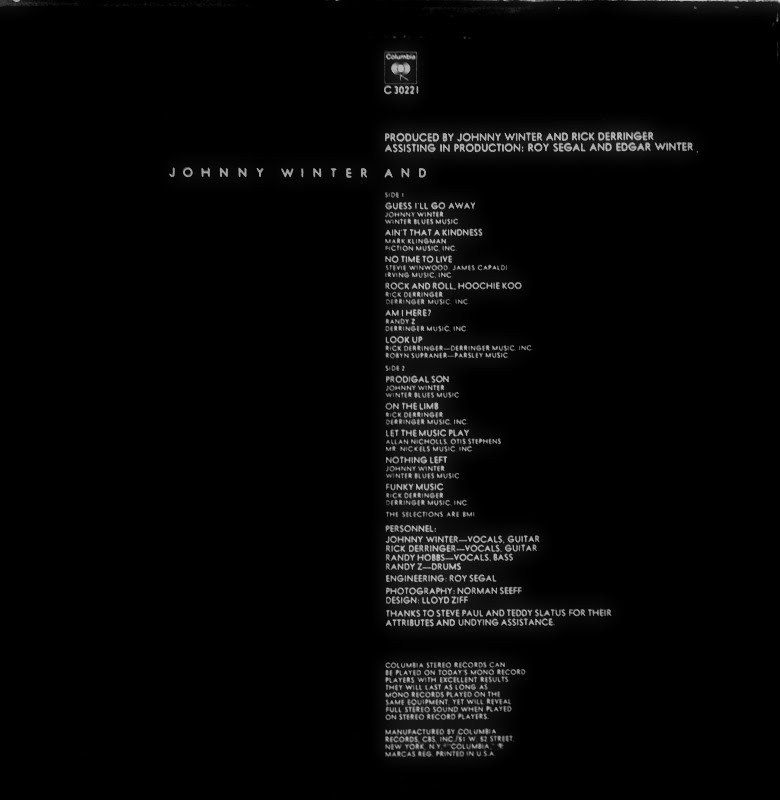
Here's a post for the late Johnny Winter.  Winter started out playing the blues and finished his career as a bluesman, but for a little while in between he was a pretty fine rocker.  I have some of his blues records and I like them fine.  The guitar work is outstanding and the singing is, well, less than outstanding.  This however is my favorite Winter record and it is pure 1970s hard rock.  It resulted when Winter joined three of the four McCoys to form Johnny Winter And.  I'm a big fan of the McCoys' two Mercury albums in the late 1960s and they bring a lot to this record both in terms of instrumental support and songwriting.  The record kicks off with Winter's hard riffing "Guess I'll Go Away" driven by the dueling guitars of Winter and Rick Derringer who rock out big time.  Fabulous!  Mark "Moogy" Klingman's "Ain't That a Kindness" is less exciting being more in a laid-back southern rock vein.  It is followed by an unlikely cover of Steve Winwood and Jim Capaldi's "No Time to Live" off of the second album by Traffic.  Thanks to the guitar interplay between Derringer and Winter it is better than one might expect, although it sounds more like the McCoys to me than Winter.  It is followed by Derringer's classic "Rock and Roll, Hoochie Koo" which would later be a hit single for Derringer when he released his own solo version of it in 1973.  I think it is one of the best hard rock songs of its era and I love both versions although I think Derringer's is more forceful.  Lots of great guitar riffing on this one and the crude lyrics are pure rock and roll.  The band's drummer, Derringer's brother Randy Z (Zehringer), provided "Am I Here?" which is another track that sounds more like the McCoys than Winter with its quasi-existential romantic lyrics and its folk-rock style.  I really like the song, it would have fit great on "Infinite McCoys" and it makes a nice change of pace for this record.  Things return to normal with Derringer and Robyn Supraner's "Look Up" which is another riff-driven rocker with a southern rock sound to it.  It is a bit generic but it rocks and features plenty of guitar action.  Side two kicks off with Winter's "Prodigal Son" which is once again another riff-driven rocker with more of a rhythm and blues feel to it and some smoking hot guitar solos.  Derringer's "On the Limb" is more southern rock with a nice dual vocal from Winter and Derringer.  Allan Nicholls and Otis Stephens' "Let the Music Play" offers another respite from the relentless rock attack of the record.  It is slow and soulful with more of a pop flavor than the rest of the record although it still boasts a killer guitar solo.  Winter's "Nothing Left" is a generic blues rocker distinguished only by the quality of the playing which I have to admit is pretty high.  The album concludes with Derringer's "Funky Music" which is not very funky, but rather another southern rock guitar workout.  The song is ordinary but the guitar work is some of the best on the album and this is an album with a lot of great guitar on it.  Unfortunately it fades out with the boys still jamming up a storm much to my annoyance.  That's a minor complaint for an otherwise first rate record.  The songwriting isn't quite strong enough for it to be a truly great record, but as far as hard rock goes in the 1970s, there are not a lot of albums better than this.  The playing is fantastic, an aural orgy for connoisseurs of guitar noise.  The partnership between Winter and the McCoys benefited both parties.  The McCoys brought their pop sensibility and a strong second guitarist for Winter to engage with and Winter gave them a grittier sound and a stronger rock identity.  Winter was one of the greatest guitarists in rock history and this album is a magnificent example of the talent we have lost with his passing.  Recommended to fans of Lynyrd Skynyrd.

Sunday, November 24, 2013

American Woman - The Guess Who


American Woman
The Guess Who
RCA LSP-4266
1970

As a teenager I was a fan of these guys, I even liked "Clap For The Wolfman," a song that now makes me wince.  This was my favorite of their studio albums although I rarely listen to it (or any of their other records) anymore.  I can't remember why I liked them so much back then but I've always been a sucker for a good riff which was guitarist Randy Bachman's forte.  He left after this album eventually forming the riff-happy Bachman-Turner Overdrive another band I really liked back then.  The album kicks off with the title track which was a massive hit.  I loved the song as a kid, such a compelling riff, but the grown-up me has problems with its misogyny and anti-American lyrics.  As I've mentioned in past posts, I'm a huge Canadaphile.  I love it up there in the Great White North, but I still resent it when a bunch of jackasses from Winnipeg come down here and start ragging on the people buying their records and making them rich.  Furthermore blaming women for the American military industrial complex and institutionalized poverty makes as much sense as blaming Haiti for global warming.  This is an obnoxious song that makes the band sound like a bunch of sexist yokels.  Unfortunately it is also insanely catchy and powerful which has kept it on classic rock radio for more than 40 years.  The entire band gets songwriting credit for "American Woman," but the next song "No Time" is written by Bachman and lead vocalist Burton Cummings who paired up to write all the rest of the songs on the album except "Humpty's Blues" which is another group composition.  "No Time" is less offensive than "American Woman" but just as obnoxious.  It is a callous kiss off to a lover of the so-long-babe-I-gotta-ramble variety only crueler.  Despite its vicious tone the song is melodic and musically pleasant with another catchy riff that helped make it the second hit single off the album.  "Talisman" is a respite from riffs and misogyny.  It is a slow moody song played on an acoustic guitar with a piano emerging at the end playing some lovely lines.  Its trippy lyrics represent the point of view of Native Americans.  Bachman's "No Sugar Tonight" is blended with Cummings' "New Mother Nature" to close out the first side.  This is my favorite part of the album.  I've always liked the little acoustic guitar run that opens the song and reappears in the segue between the two songs.  The rest of the tune is driven by hard rock riffing.  The sugar in Bachman's song refers to sex and Cummings' tune is more about dope than ecology.  Side two kicks off with Bachman's "969 (The Oldest Man)" which is an instrumental.  It starts out rocking with plenty of bluesy guitar runs and then slows down for a flute solo from Cummings.  It is kind of weird but I like it and at least there are no dumb lyrics to annoy me.  "When Friends Fall Out" has the same heavy/light dichotomy.  Most of the song is driven by a ponderous riff played on a fuzz guitar but the center and end of the song revert to a very poppy and melodic passage reminiscent of the Association.  "8:15" is a fast tempo song with a hard driving guitar line and a percussion-based instrumental break in the center and at the end.  The song's alluring mixture of rock power and pop accessibility provide me with a clue of why I liked these guys so much back in the 1970s.  "Proper Stranger" features a return to heaviness with a sluggish fuzzy riff and a get-down growling vocal from Cummings as he intones feelings of alienation and confusion living in the big city.  Time to get back to Winnipeg, kid.  The album ends with the heaviest tune of all "Humpty's Blues" which is a straight blues dominated by Cummings' screechy vocal and harmonica playing supported by a lethargic guitar solo.  At the end of the song there is a brief reprise of the acoustic part of "American Woman" from the beginning of the song which has a nice bookend effect for the album.   I'm starting to remember why I used to like this record and this group, they definitely knew how to rock a riff and had enough pop smarts to stand out among the bland hard rock of the early 1970s.  If the lyrics on this record were smarter (or nicer) I'd probably still be playing it.  Recommended to Steppenwolf fans who have issues with their girlfriends.

Saturday, March 9, 2013

Déjà Vu - Crosby, Stills, Nash & Young


Déjà Vu
Crosby, Stills, Nash & Young
Atlantic SD 7200
1970

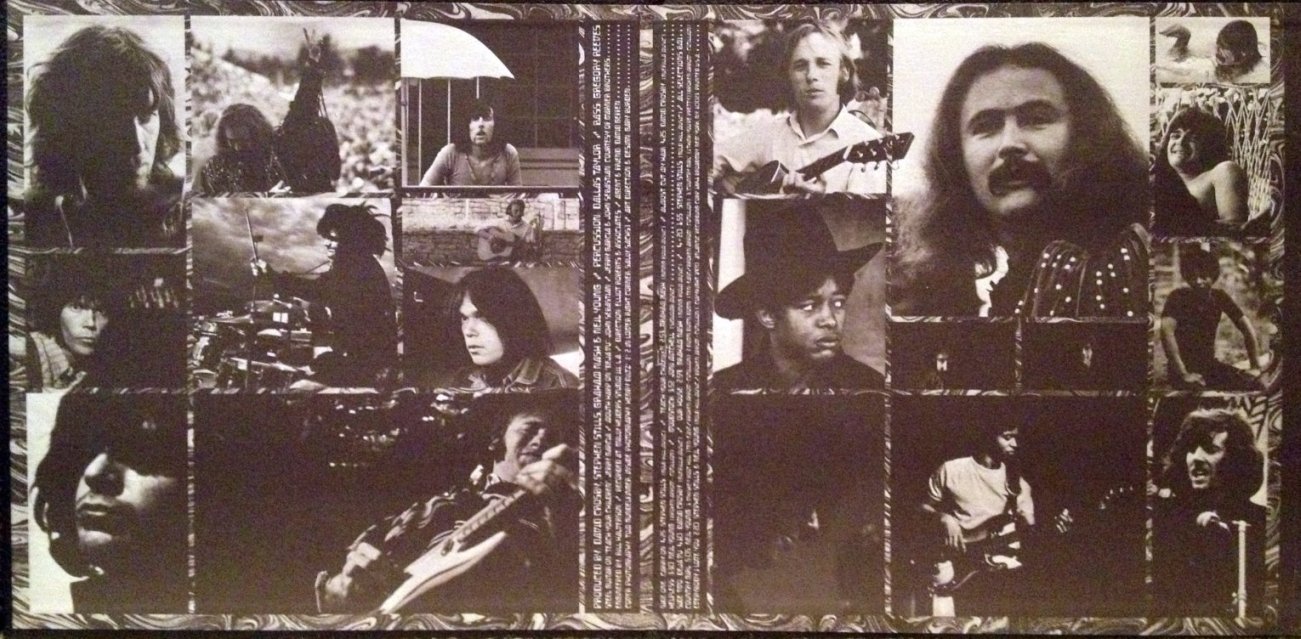
I have been reading Jimmy McDonough's excellent biography of Neil Young, "Shakey."  Through it I've learned more about CSN&Y than I ever wanted to know.  They all come off pretty badly in the book which confirms what I always suspected about them.  I figured they were all about the money and the egos although I'm not sure that applied to Young.  Even after reading the book, I don't understand why Young got mixed up with these guys nor can I figure out the love/hate thing he had with Stephen Stills.  When I was a budding young record collector growing up in the San Francisco Bay Area, these guys were like rock royalty there.  They were always on the radio and their tours were major events.  I remember a couple of guys in high school discussing Stephen Stills as if he were a major artist like Bob Dylan.  I didn't like them at all.  Their hits irritated me and I thought their segment in "Woodstock" was torture but I didn't have enough faith in my critical judgment yet to go against the mainstream.  I figured I must be missing something if everyone thought they were so great.  After all I loved the Byrds and the Buffalo Springfield, so how could this be bad?  So despite my misgivings I dutifully purchased a used copy of "Déjà Vu."  One look at the cover could have told me I was in for trouble.  Young is hiding in the background dressed like a gambler ready to fleece me.  Stills is wearing a Confederate army uniform - peace, man.  Graham Nash and David Crosby look like guest stars on "The Beverly Hillbillies."  The whole package with its fake leather cover and gilt lettering reeks of excess and pomposity.  The sidemen, Dallas Taylor and Greg Reeves, are given co-billing and figure prominently in the gatefold photographs like "we're all brothers, man" although according to McDonough the big four basically treated them as hired hands.  The album opens with some promise with Stills' "Carry On."  The song is a propulsive tune about bouncing back from heartbreak and benefits from Stills' biggest strengths as an artist, dynamic shifts in melody and texture and lots of stinging guitar lines.  The album takes a nosedive with Nash's country-rock "Teach Your Children."  Even Jerry Garcia on pedal steel guitar can't rescue this song from its idiocy.  This guy thought the Hollies were lightweight?  Somehow this became a top 20 hit, but I've always loathed it.  It gets worse with Crosby's "Almost Cut My Hair" - don't worry Dave it is going to fall out anyway.  Crosby boasts about being a counter-culture rebel and his smug stupidity infuriates me.  Although there is lots of invigorating guitar noise on this track, I find it practically unlistenable.  Have another snort, David, you are a real hero.  At this point I'm ready to smash this record to bits, but then Neil Young shows up to redeem it with the brilliant "Helpless."  This slow, mournful autobiographical song is one of the best things Young ever wrote and it easily trumps every song CSN&Y ever did.  The side ends with a rocking version of Joni Mitchell's "Woodstock" which I think is the worst song she ever wrote.  CSN&Y demonstrate that if you play it fast and loud it doesn't sound as silly which I consider to be an eternally true rock and roll axiom.  Side two begins with "Déjà Vu" which is Crosby's second contribution to the album.  It is a big improvement over his first one, but then again 4 minutes of silence would have been an improvement too.  It is kind of a trippy tune in which Crosby wonders what's going on, probably a common problem for a guy with a big league dope habit.  Graham Nash demonstrates his consistency with his second tune, the incredibly inane "Our House."  The song was supposedly inspired by his domestic bliss living with Joni Mitchell.  I'll never understand how a genius like Mitchell ever hooked up with this vapid guy, I guess it is true that opposites attract.  The song is insidiously catchy and annoying.  Stills restores the album's dignity with the acoustic "4 + 20" which finds him solemnly feeling sorry for himself.  You can tell he's serious because he doesn't let Crosby and Nash sing with him.  Once again it is up to Young to lift the album above the navel contemplations of his partners.  "Country Girl" is a suite of 4 songs that describe his attraction to the title character although the song covers a lot more territory than that thanks to whole bunch of enigmatic yet evocative metaphors that Young sprinkles throughout his narrative.  The song is overproduced but I still find it just as enthralling as I did when I was a teen.  Young is so much more talented than his three partners, it is like Willie Mays playing on a beer league softball team.  The album finishes with the only collaboration on the album, Stills and Young's "Everybody I Love You."  It is little more than a throwaway about opening yourself up to love but it is still better than most of the rest of the record.  Stills supposedly wanted Young in the group so he would have someone to play with since Nash and Crosby weren't real musicians.  When I listen to the dueling guitars and soaring vocals on this hard rocking cut I do finally get a sense of why they might have thought this band was a good idea.  Still it is pretty slim pickings for a record that is supposedly a classic album - 2 great Neil Young songs, 1 good Stephen Stills song, 1 fun Stills-Young song and a whole bunch of hippie hogwash.  Recommended for people looking for something to play to annoy their roommates, sure worked on my family. 

Monday, December 10, 2012

Magic Christian Music - Badfinger


Magic Christian Music
Badfinger
Apple ST-3364
1970 

This was the debut album by Badfinger unless you want to count "Maybe Tomorrow" which they made under the name, The Iveys, in 1969.  Six of the tracks on this album were actually lifted from that earlier album although arguably they didn't select the right six.  "I've Been Waiting" in particular is better than nearly all the tracks they selected.  The British version of this album contains two extra tracks - what's up with that?  Apple records taking a page from the Capitol Records playbook and screwing American music fans?  You'd think after the way Capitol butchered the Beatles' albums that they'd be sensitive to that sort of tampering.  It was probably Allen Klein's idea.  Anyway if you can find an import copy of this album, that is probably the way to go, particularly since the two missing tracks, "Angelique" and especially "Give It a Try" are better than many of the tracks remaining on the album.  Another curious element to this album, is that although the band was a quartet only three of the members are depicted on the back cover.  The reason for that is probably that founding member Ron Griffiths had left the band after this record was recorded (to be replaced by Joey Molland).  Molland is mentioned in the text on the back but does not actually play on the record.  The only mention of Griffiths is in the song credit for his song "Dear Angie."  The most notable cut on the record is the opening track "Come and Get It" which was written and produced by Paul McCartney for the film "The Magic Christian."  It was a hit single for the band and fully displays McCartney's knack for writing insanely catchy pop fluff.  His original demo version was released on the Beatles' "Anthology 3" album and is practically identical to the Badfinger version, vocalist Tom Evans even sounds like Sir Paul.  It has the crispness and drive of McCartney's power pop songs with the Beatles.  It is followed by Evans and Pete Ham's "Crimson Ship" which also has a very McCartneyesque sound, particularly in the chorus, although it sounds more like Paul's solo work than the Beatles.  "Dear Angie" comes from the Iveys' album.  It is sung by Ron Griffiths and is a slow love song with a slightly retro feeling.  The pace increases with Pete Ham's rocking "Midnight Sun" which is driven by crunchy guitar lines.  Evans' majestic "Beautiful and Blue" with its strings and lush singing reminds me of the Bee Gees.  It is another Iveys cut.  The aptly named "Rock of All Ages" comes from "The Magic Christian" soundtrack and was written by Evans, Ham and drummer Mike Gibbins.  It is an all-out rocker with a 1950s influence that resembles McCartney's own efforts in that vein.  It is arguably the hardest rocker in Badfinger's Apple catalog and one of my favorite songs on the album.  Side two opens with "Carry On Till Tomorrow" which is another one of my favorites.  It is also from the movie soundtrack and was written by Evans and Ham.  It is a delicate song with a lovely string arrangement and pretty vocal harmonies but it also features a couple of noisy guitar breaks that disrupt its tranquil feeling.  The song is about always moving forward and not giving up, a rather noble message for an obnoxious film that is mostly about greed and degradation.  Ham's "I'm In Love" is an Iveys song with a bubblegum quality to it.  Ham also wrote the gentle and melodic "Walk Out In the Rain" which is about heartbreak.  Evans' "Fisherman" comes from the Iveys album.  It is a folk flavored song with charming pop flourishes.  Ham's "Knocking Down Our Home" sounds like it should be a rocker, but instead is a retro song with a fussy band arrangement over a bossa nova type rhythm.  It sounds like something you'd hear some guy croon in a music hall, the worst song on the album.  The album's final song, Evans' "Maybe Tomorrow," was the best song on the Iveys album.  It has a classic pop melody married to lyrics about surviving heartbreak.  It also reminds me a bit of the Bee Gees minus their sappiness.  Would have been a great song for Dusty Springfield to cover.  Despite its hodge podge construction this is an impressive debut album with several first rate songs.  Ham and Evans were both quality songwriters and the band's lush pop sound is very appealing to me.  The knock on Badfinger was that they sounded too much like the Beatles, but I don't consider that a knock, that's a virtue.  Recommended to people whose favorite Beatle was Paul.

Tuesday, October 23, 2012

Colours of the Dawn - The Johnstons


Colours of the Dawn
The Johnstons 
Vanguard VSD 6572
1970

I bought this about a year ago in a Pasadena record store.  This is the 1971 American release of the 1970 British album on Transatlantic Records that features a different cover, a different running order and one less song than the Vanguard version.  This was their fifth album overall and their second American release.  This group's career trajectory is emblematic of the weirdness of the 1960s.  They were originally a family group performing traditional Irish folk music that gradually moved into contemporary folk and pop music ultimately recording a song supporting Angela Davis, the lead track on this album -- talk about your long, strange trips!  Along the way the band shed Johnstons until Adrienne Johnston was the only Johnston left and acquired new members  Mick Moloney and Paul Brady.  Perhaps the key figure in this album is the producer Chris McCloud, who was Adrienne's husband and who wrote or co-wrote several songs on the album including "Angela Davis."  McCloud was an American who took over the management of the group and supposedly exploited them to achieve his own financial and artistic ambitions.  He was reportedly a rather nefarious, almost sinister figure who has even been accused of being responsible for his wife's premature death in 1981.  He has been blamed for Moloney's departure from the band after this album and Brady has subsequently made disparaging remarks about him as well.  The album opens with "Angela Davis" which is a heavy handed protest song.  In his liner notes McCloud connects the song to the Irish tradition of rebellion songs, but I suspect it has more to do with McCloud seeking publicity and perhaps a connection to the radical left in the United States.  The group's vocal is very stirring though and they sing it like they mean it.  Gordon Lightfoot's "If I Could" is more satisfying to me with some enjoyable guitar picking in the solos and a wistful vocal from Moloney.  McCloud and Brady's "I'll Be Gone In the Morning" sounds very West Coast folk-rock, Brady's lead vocal and Johnston's harmony vocal reminds me a bit of the latter day Youngbloods or Moby Grape and the rich instrumental backing of the song is exactly why folk-rock was invented, it adds intensity and propulsion to the song.  The group's cover of Leonard Cohen's "Seems So Long Ago, Nancy" is faithful to the original with a lovely, muted vocal from Johnston and a dense acoustic guitar sound in the backing track. The side ends with "Aiseiri" which was not on the English version of this album.  It is another protest song co-written by Johnston, McCloud and Moloney.  The title is an Irish word meaning something like to rise again as in revival or resurrection.  McCloud says it meants "uprising" as in "a day of reckoning for The Man" and the lyrics address international revolution from Chile to Rome to Chicago with lots of pointed digs at American imperialism and the Presidency, McCloud has a pretty big axe to grind.  Although the lyrics are overtly polemical, there is some poetic imagery and Moloney's vocal is so passionate that I find the song quite powerful especially since it is coupled to an anthemic, traditional style tune.  It is one of the best songs on the record for me.  Side two opens with McCloud and Brady's "Colours of the Dawn" which is an anti-war song.  Like most of McCloud's lyrics, the song is melodramatic and heavy-handed.  It sounds like a traditional song though, particularly in Moloney's mandolin lines.  Peggy Seeger's "Hello Friend" deals with racism and labor struggles.  It is the folkiest song on the record, with its multi-part vocal harmonies it reminds me a bit of the Seekers.  Brady's "Brightness, She Came" is more in a contemporary vein.  Freed from McCloud's heaviness he delivers a jazzy, impressionistic song reminiscent of Nick Drake or Tim Buckley.  It is another one of my favorites.  Johnston sings lead on McCloud's "Crazy Anne" which is a gentle hippie anti-conformity and escapism type song.  In his notes McCloud suggests that the song is about Adrienne Johnston.  The side concludes with Ian Campbell's "The Old Man's Tale" which is another traditional sounding song which chronicles working class struggles against fascism and labor oppression through the 20th Century.  It is an impressive song with some wonderful guitar/mandolin interplay.  I'm a big believer in music that makes a statement and I value personal expression in pop music, but I have to admit that I'm not all that comfortable with the political perspective on this album.  It is not that I'm opposed to their viewpoint, it just seems forced and unnatural to me.  Part of it just may be me being weirded out by McCloud and what I've read about him which isn't really fair, but I think much of it is that I don't like getting preached to.  When Phil Ochs sings a protest song, I feel like he's communicating with me, but when the Johnstons sing "Angela Davis" I feel like I'm being lectured to.  Is this better than performing traditional songs like "The Lark in the Morning" like they did earlier in their career?  I don't know, you could probably make a case that both are equally lacking in authenticity.  I do know that this record sounds wonderful, chockful of excellent playing and singing.  If you dig Anglo-American folk rock you will probably find much to like here.  Recommended to people who think that Bob Dylan's "The Lonesome Death of Hattie Carroll" is a better song than his cover of "See That My Grave is Kept Clean." 

Sunday, January 22, 2012

The Beatles Christmas Album/The Complete Christmas Collection 1963 to 1969 - The Beatles


The Beatles Christmas Album
The Beatles
Apple SBC 100
1970
 

The Complete Christmas Collection 1963 to 1969
The Beatles
Trade Mark of Quality  BCC 104
1971

I was record shopping up in Portland over the holidays and I noticed a new bootleg of the Beatles Christmas album in the bins.  It looks like the original except that it is tinted green instead of blue and it is pressed on green vinyl.  I was tempted to buy it, but I wasn’t all that happy about the green tint and besides I already have two bootlegs of it.  I wish the Beatles would just do a legitimate reissue of it.  It has been so extensively bootlegged I don’t see why they don’t reissue it.  Admittedly it is not great, but there is more embarrassing stuff on the “Anthology” comps.  When I first got into record collecting I used to see the counterfeit copies of it in Berkeley record stores although they looked so convincing that I thought they were legitimate ones.  They had hefty price tags and I was poor so I didn’t buy them and eventually they disappeared and were replaced by obvious bootlegs like the one above.  That was my first one, it has typically crappy artwork and is an inferior pressing although not bad by bootleg standards.  I think mine is actually a bootleg of the TMOQ bootleg since the insert is missing the TMOQ logo that was on the original otherwise identical insert, but it does have the same matrix number.  I bought the counterfeit one at Boo Boo Records in San Luis Obispo (well worth checking out if you find yourself in the area.)  At first I thought it was real since the cover is pretty nice, it just has slightly more contrast than originals.  Looking at the vinyl though, I knew it was a fake.  The labels were off-center and slightly blurry, the vinyl was dimpled and the run-off groove lacked the pressing information.  It was a little worn, but I bought it anyway because it was cheap and I’ve always regretted not buying it back in Berkeley when I had the chance.  I’m never going to pay what an original costs, so it will do.  The album basically mirrors the history of the Beatles as a band.  It starts out with the zany Fabs, talking Liverpudlian slang and trying to be funny and charming, then it gets psychedelic and obscure, then after the “White Album” the Beatles do their bits separately no longer interacting as a group and John brings in Yoko, ouch.  The 1963 segment is my favorite one.  The Beatles butcher "Good King Wenceslas" and "Rudolph the Red-Nosed Reindeer", John indulges in funny word play and the band seems greatly pleased ("dead chuffed") with all their success and express affection towards their fans.  It is endearing and charming.  1964's entry is fairly similar.  The group again expresses affection towards the fans and there is a lot of humor.  The 1965 segment is zanier, less heartfelt but still very appealing.  John does a lot of weird voices and shows off his Scottish accent.  The segment has a "Goon Show" and "Monty Python" flavor.  The Beatles impersonate Barry McGuire singing "Eve of Destruction" and there are some other silly songs, including a sloppy version of "Yesterday" where "yesterday" is replaced with "Christmas day."  The segment is lots of fun.  1966 begins with the music hall style song "Everywhere It's Christmas" leading into more funny skits.  They are more funny-weird than funny ha-ha.  There is no longer any direct address to the fans, it is all performance.  It is fascinating to hear the Beatles openly acting, their performances are more elaborate here than in any of their films.  1967 opens with "Christmas Time Is Here Again" which is in the vein of the psychedelic music they recorded for "Sgt. Pepper" and "Magical Mystery Tour."  The skits are even weirder than the ones from the previous year, they border on surrealism and again remind me of "Monty Python" although not as funny.  John's Scottish accent makes a welcome reappearance as well.  1968 is fragmented.  The Beatles contribute separate segments for the first time.  Paul does a Christmas song that sounds like an outtake from the "White Album."  John does a dialogue about his relationship with Yoko.  George makes a speech thanking the fans, but it is so exaggerated that I suspect sarcasm.  He brings out the Beatles long time employee Mal Evans to wish "Merry Christmas children everywhere."  Ringo does a dialogue with himself that shows off his acting skills.  Then John rattles off some nonsensical wordplay which is followed by George returning to introduce Tiny Tim who performs "Nowhere Man" in his inimitable manner, ugh!  1969 is even worse though, it depresses me.  Perceptive fans who listened to this record must have realized the end was near.  John chats with Yoko about food and walls.  George greets the fans briefly to wish them a merry Christmas.  Like the previous year, Paul improvises a little Christmas song and briefly wishes the fans a happy Christmas.  It is then the return of the John and Yoko show as they discuss the upcoming new decade and improvise some Christmas music interrupted by a segment of Ringo plugging "The Magic Christian" movie and then they return to discuss John's Christmas list.  The segment ends with Ringo laughing and I imagine the fans scratching their heads wondering what's so funny.  If you are a Beatles fan this is a fascinating album, but I imagine non-fans would find it tedious.  I like to pull it out at Christmas and give it a spin, but otherwise I rarely play it.  Recommended to fans of the Beatles' movies.