God Help the Girl
Original Soundtrack
Milan Records M2-36700
2014
This is the soundtrack to Stuart Murdoch's debut film which began as an album with the same title. The original album features much of the same music mostly sung by Catherine Ireton who portrayed the main character, Eve. For the film soundtrack the actress Emily Browning replaces her on vocals. Ireton is a more polished singer, but I find Browning more satisfying. Ireton is too slick to convey the vulnerability and feelings of the character as well as Browning does. The film depicts a troubled young woman, Eve, who aspires to achieve success in the music business. With the help of a couple of friends she forms a band called God Help the Girl to fulfill her musical vision. Bob Kildea and Chris Geddes are the only members of Belle and Sebastian who actually perform in the film band (which resembles a more photogenic version of the Belles) but the entire lineup of Belle and Sebastian perform on the soundtrack which results in it sounding like a Belle and Sebastian album performed by guest vocalists. It is too bad that Browning already has a day job, she'd be a great addition to the group. The record opens with "I Suppose That Was a Prayer" which is a melancholy instrumental with some of Browning's dialogue from the film. The soundtrack record corresponds roughly to the chronology of the film but this dialogue is from near the end of the film where Eve describes her healing. It is followed by her performance of "Act of the Apostle" which was originally recorded by Belle and Sebastian on "The Life Pursuit." The song is full of typically Murdochian cleverness and adolescent angst and although it predates the film, it fits it perfectly and is used to introduce Eve during the title sequence. The song has a music hall flavor to it that suits Browning very well. The song is slightly altered from the original and truncated but I prefer this version of the song to the original because of the vocal. "I Dumped You First" is a Murdoch song performed by Olly Alexander who plays Eve's friend James in the film. It begins with some dialogue from the film as James' band breaks up on stage. It is a quiet song performed on acoustic guitar that uses desperate boasting to cover up heartbreak. Only a brief section of the song is used in the film but the complete version is played during the title crawl at the end of the film. Browning sings the tender piano driven "Pretty When the Wind Blows" which she performs in the mental hospital in the film as she is trying to recover from her illness and start songwriting. "I Know I Have To Eat" is another melancholy instrumental with dialogue of Eve talking about her problems with her doctor. The record perks up with the delightful "God Help the Girl" which is Eve's description of her contradictory nature. It is vivacious sunshine pop sung by Browning with a sparkling orchestral arrangement by former Belle, Mick Cooke. In the film Browning only croons the second verse of the song accompanying herself with a keyboard app on her phone. This version of the song isn't used at all in the film unfortunately. Browning also sings "The Psychiatrist Is In" in which Eve impersonates a psychiatrist for the benefit of James. It is an overtly romantic sounding song with bongos and a sensuous string arrangement. Side two begins with "The God of Music" which features dialogue from James and Eve from the film. This is a bit out of order since it appears in the film after the following song, "If You Could Speak" which is performed by Browning, Alexander and Hannah Murray who plays Eve's other friend, Cassie, in the film. It is a jaunty tune that is featured in the charming scene where Eve and James teach Cassie how to write a song. "The Catwalk of the Dukes" is a lovely instrumental reprise of "The Psychiatrist Is In" that is used in the scenes where Eve counts her pills and then asks for a job at Dukes Cafe. It is followed by "Perfection as a Hipster" which is performed by Neil Hannon of the band The Divine Comedy with support from Browning. He doesn't appear in the film, Eve's obnoxious boyfriend Anton puts the song on when he takes her to the clothing shop where he works. On the original "God Help the Girl" album, Hannon portrayed Anton but the conception of the character seems to have changed by the time the film was made because the lyrics don't sound much like the film version of Anton. "F**k this Sh*t" is a wistful instrumental that Belle and Sebastian composed and performed for the film "Storytelling" and which previously appeared on the Belle and Sebastian album of the same name. It is out of order on the record, it follows the "Pretty Eve in the Tub" segment in the film and it appears again in the end credits. It makes very effective background music for the scenes of Eve and James wandering around Glasgow. "Pretty Eve in the Tub" is a chamber pop song sung by Alexander that accompanies footage of Eve bathing and glimpses of her life at home in the film. James is apparently the subject of "A Loving Kind of Boy" which is sung by Belle and Sebastian guitarist Stevie Jackson and accompanies footage of James, Eve and Cassie posting flyers trying to recruit musicians for their band. It is an upbeat sunshine pop song given a Spanish flavor by the horn section. Side three starts with "What Do You Want This Band to Sound Like?" which is another snippet of film dialogue featuring Eve, James and Cassie discussing their band. It precedes "A Loving Kind of Boy" in the film. Browning sings "Come Monday Night" which is driven by a hypnotic bass riff from Kildea and a gorgeous string arrangement from Cooke. It is a typically Murdochian song that contrasts the monotony of ordinary life with the romantic aspirations of the singer. In the film it is performed by God Help the Girl at a rehearsal. "Collective Idiocy" is another snippet of dialogue regarding band names. "I'm Not Rich" is Murdoch's version of a hip hop song sung by the three friends confronting their delusions about themselves. It does not appear in the film nor did it appear on the original record. It is mildly amusing but superfluous. Browning sings the exuberant "I'll Have to Dance with Cassie" which accompanies the big production number in the film. It is insanely catchy and engaging in the best Belle and Sebastian manner. I consider it the highlight of both the album and the film. "Stalinist Russia" is another dialogue snippet featuring James and Cassie discussing his failure at romance with Eve. It occurs much later in the film. "Baby's Just Waiting" is sung by Celia Garcia who was a participant in the original "God Help the Girl" album. She plays a garbage collector who joins the band in the film. It is pure Stuart Murdoch both in the way it blends 1960s pop with contemporary music and its familiar themes of the oppression of school, misfits and romantic disconnection. The song is out of sequence on the soundtrack, in the film it appears before "I'll Have to Dance with Cassie" when James and Eve first enter the dance hall. "Partick Whistle" is a pretty instrumental version of the song "Down and Dusky Blonde." Side four commences with "Musician, Please Take Heed" which traces the events of Eve's breakdown concluding with her drug overdose. The song is delicately sung by Browning at first, but then the driving guitar riff kicks in and the song takes off. It is the most energetic and dramatic song in the film. "I Just Want Your Jeans" is sung by Hannah Murray who is a much less skilled singer than Browning but her awkwardness suits her character well and enhances the goofiness of the song which is meant to be written by Cassie. The song illustrates Cassie's growing self-confidence in the film. "Invisible" is another moody instrumental. It appears in the flashback of the trio clowning around that follows Eve's overdose which chronologically occurs before "I Just Want Your Jeans" in the film. It is also reprised during James and Eve's walk to the train station at the end of the film. "The World's Last Cassette" is more dialogue from the film courtesy of the two radio DJs that Eve is desperate to give her demo tape to. Their radio banter appears periodically throughout the film and is mostly annoying to me. I find Eve's obsession with them to be the most contrived element in the film. "Down and Dusky Blonde" is mostly sung by Browning with help from Murray. It functions as Eve's statement of liberation and fulfillment and is performed by God Help the Girl in their sole live gig in the film. It displays Murdoch's typical knack for delivering an emotionally compelling song with irresistible pop allure. "Dress Up In You" is a Belle and Sebastian song that first appeared on "The Life Pursuit." It plays over Eve's bus ride which ends the film and then continues into the title crawl. It seems like an ironic song to play at the end of the film since the film celebrates Eve going off to find success and the song represents the bitter perspective of a spurned former friend directed at someone who has gone on to be a big success. Actually I find the whole film perplexing in that regard. It is obviously a personal film for Murdoch, loaded with all his favorite themes and I suspect he relates to both James and Eve. The story closely resembles the beginning of Belle and Sebastian, however the ending is the equivalent of Murdoch abandoning Glasgow after making "Tigermilk" and running off to London to become a pop star. Regardless of my misgivings about the conclusion, I consider the film and this record to be immensely satisfying. I've long been a huge fan of Stuart Murdoch and regard this to be among his most quintessential works. Murdoch's lyrics are consistently evocative, resonant and intelligent making a simple story seem profound and emotionally powerful. Musically it is wonderful, as engaging and appealing as any Belle and Sebastian record ever. I like the little instrumental interludes as well and even the excerpts of the dialogue from the film. The record particularly benefits from Mick Cooke's brilliant orchestral arrangements which has always been a Belle and Sebastian strength. This album is essential for Belle and Sebastian fans and will probably appeal to most people on the poppier side of the indie rock spectrum. Recommended to people whose favorite Belle and Sebastian album is "If You're Feeling Sinister."
The Legend of God's Gun
Spindrift
Tee Pee Records TPE-101
2009
I first became aware of this band when I saw them open for X a few years ago. I was mesmerized by their psychedelic soundtracks for imaginary spaghetti westerns and picked up this album soon after. It doesn't come close to the excitement of their live act, but I still enjoy it immensely. According to the liner notes this music was conceived by band member Kirpatrick Thomas between 2002 and 2006 for a movie that did not yet exist. In 2007 the film was finally made featuring members of the band and their rock band buddies and this album was released as an actual soundtrack. The movie is a nihilistic western most notable for featuring more hipsters than horses. The acting is amateurish but the film is enjoyably trippy at times. The music is easily its best feature. The record opens with "In the Beginning..." which features some of the narration from the film by the veteran actor Joseph Campanella. The film features lots of expository narration to make up for its incoherent storytelling. The music begins with "Titoli" which is obviously derived from Ennio Morricone. It features twangy guitar lines and martial drumming. A drum machine kicks off "The Legend of God's Gun" which also features a synthesizer while still retaining a rock sound. It reminds me of the Dandy Warhols and the Brian Jonestown Massacre (several members of Spindrift were formerly in the latter group.) There is some wordless vocalizing in the background as Campanella provides more narration. "Conversation with a Gun" is the most conventional song on the record. The song has a country-western flavor and is sung/spoke by Kirpatrick Thomas. It is the only cover song on the record, having been written by Johnny Bond back in the 1950s. The song is indeed a conversation between a killer and his gun. "Preachers Theme" returns to Morricone for inspiration. It begins with some atmospheric acoustic guitar work, before the percussion and vocalizing join in creating a more dramatic sound. At the end it even features some chanting that is blatantly copied from Morricone's scores for Sergio Leone. "The New West (Instrumental)" is my favorite track on the record. Its jangly reverb laden guitar lines evoke both spaghetti westerns and surf rock. The music is moody and majestic with some psychedelic overtones. The band has recorded a version of the song with vocals, but I prefer the instrumental version. "Speak to the Wind" opens the b-side in a similar vein but with less intensity. "Organ Fugue in DM Op. 42" sounds out of place on the record. It makes more sense in the movie where it accompanies the church scene. It starts out with some noodling around on an organ, then halfway through the rest of the band join in and turn it into a rock song. "Burn the Church" is a raucous percussion driven workout that is the wildest song on the record. I dig its manic energy and psychedelic sound. Things slow way down for "Greenhorn's Introduction" which returns to a loping spaghetti western sound. Near the end the band ratchets up the velocity for a dynamic finale. "Girlz Booze and Gunz" similarly begins with more stately spaghetti western soundtrack music before a frenzied rave up kicks in. "Blessing the Bullets" starts solemn and ominous growing gradually in force before segueing into the straight ahead rock sound of "The Scorpion's Venom." It is a propulsive riff driven tune with synth runs layered over it creating a shoegaze like sound. It is my other favorite cut and ends way too soon for my liking. The album concludes with "Indian Run" which is a high speed rocker with fake Native American chants, tribal drumming and lots of noisy guitar. It ends the record with a bang. One could criticize this record for being so derivative, but not me. I'm a big fan of Ennio Morricone, but I play this album more than I play any of his. Its fusion of spaghetti western electric guitar drama and crazed rock and roll energy is enormously appealing to me. Recommended to fans of the first two Quicksilver Messenger Service albums.
Revolution
Original Soundtrack
United Artists UAS 5185
1968
This is the soundtrack to a documentary about the Summer of Love in San Francisco in 1967. The film follows the flower child depicted on the back cover of the album as she wanders through hippie San Francisco taking in the various scenes. The film covers all the usual stuff: communes, free love, psychedelic ballroom concerts, outdoor festivals, drug trips, the Diggers, runaways, panhandlers etc. It is a curious mixture of a true believer manifesto and an exploitation film. It features earnest statements of purpose along with extended simulations of drug trips and lots of female hippie nudity. I find it fascinating as I've been obsessed with the subject matter since I was a teen growing up in the Bay Area in the aftermath of the hippie era. The film also boasts a killer soundtrack although not all of the music from the film makes it onto the record. It omits live performances by Country Joe and the Fish and Dan Hicks of the Charlatans. Most regrettably it also does not include a wonderful and all too brief clip of the pioneering female rock group Ace Of Cups performing their song "Stones" at an outdoor concert. I originally bought the record because I wanted the two cuts by Quicksilver Messenger Service, neither of which appeared on their debut album. Both cuts were part of the early Quicksilver repertoire and can be heard on several of their archival live releases. I'm a big fan of their cover of Buffy St. Marie's classic anti-drug song "Codine." I find it amusing that my favorite version of this song was performed by arguably the druggiest band in San Francisco. The group pounds out the song's riff with great vigor and David Freiberg delivers the words with gut wrenching anguish. Extraordinary. Nearly as good is the band's cover of Anne Bredon's "Babe, I'm Gonna Leave You." There are lots of covers of this song, but this is easily my favorite. It is hard driving with slashing guitar chords and a passionate joint vocal by Freiberg and Gary Duncan. The band is seen performing the song in a ballroom in the film. The record is worth owning for these two songs alone, but the rest of the album has much to offer as well. The Steve Miller Band has three songs none of which appeared on their albums for Capitol. The best is a frenzied cover of the Isley Brothers' "Your Old Lady" that features smoking hot guitar work from Miller and James Cooke supported ably by Jim Peterman on organ. It is one of the most exciting tracks that Miller has ever recorded. The band is seen performing the song in a ballroom in one of my favorite scenes in the film. The Miller Band also perform a cover of K. C. Douglas' "Mercury Blues" which is another jumping track with blistering blues guitar licks. Their third song is the instrumental "Superbyrd" which is pleasant, but forgettable, by far the weakest track on the record. The remaining three songs are by Mother Earth. "Revolution" was co-written by the film's director Jack O'Connell. It is a didactic song that stresses the themes of the film. It doesn't sound much like a typical Mother Earth song, but the band gamely gives it a jazzy interpretation that I find engaging and Tracy Nelson sings the awkward words very convincingly. The band fares better with Danny Small's "Without Love" which was a hit for Clyde McPhatter in 1957. The song's gospel style plays to Tracy Nelson's strengths and she knocks it out of the park. Percy Mayfield's bluesy "Stranger in My Own Home Town" is well suited for the band but suffers from an inadequate vocal by Powell St. John. With only 8 tracks this album is a bit skimpy even by 1960s standards but with five must-have tracks on it, it is well worth seeking out, particularly for fans of the San Francisco Sound. Recommended to fans of "Monterey Pop."
Riot On Sunset Strip
Original Soundtrack
Tower T 5065
1967
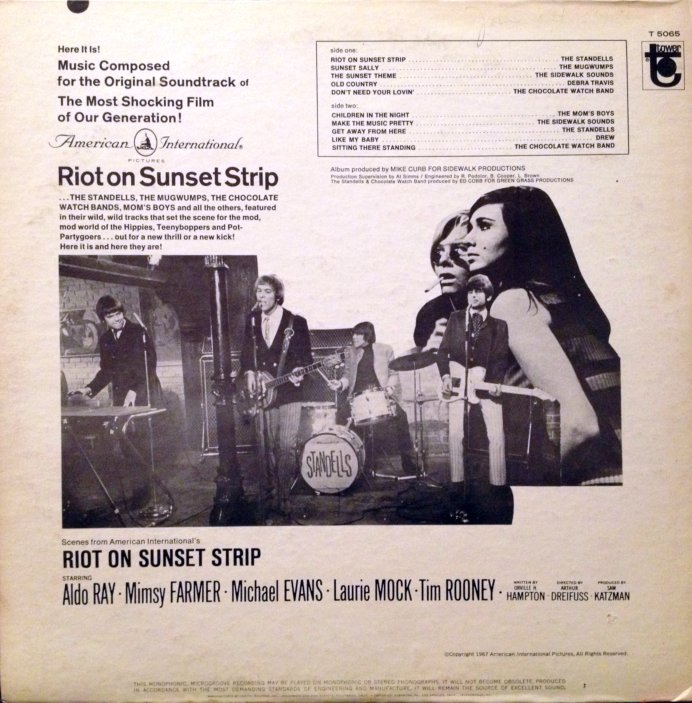
This album is popular with collectors because of the songs by the Standells and the Chocolate Watch Band. There is no doubt that they have the best songs on here but the rest of the record is not without interest. The album opens with the great title song by the Standells which they also perform (or lip synch anyway) in the movie. It is one of their best songs and also appeared on their album "Try It." It is driven by a killer guitar riff and a relentless beat. The lyrics describe the titular riots and are full of teenage angst and alienation. Great stuff. It is followed by "Sunset Sally" by the Mugwumps which is a different group than the one Cass Elliott was in prior to joining the Mamas and the Papas. It is an old timey, variety show type tune akin to the Sopwith Camel or Jim Kweskin and the Jug Band. It's not really my cup of tea. Next up is "The Sunset Theme" which is a surf-rock style instrumental by the Sidewalk Sounds, a studio band Mike Curb assembled that also performed for the film "The Wild Racers." It is generic but at least it rocks. "Old Country" by Debra Travis comes next. She is listed in the movie credits as Deborah Travis, I'm not sure which spelling is correct. As far as I know this is the only song she ever recorded. It is a pretty folk song with just her vocal and an acoustic guitar. The side ends with the best song on the album, the Chocolate Watch Band's "Don't Need Your Lovin'" which the band performs in the film. It is the highlight of the film for me. You hear stories about how great they were live and even if they are only lip-synching the segment, you can still perceive how charismatic front man Dave Aguilar was and how cool the rest of the band members were. The song is a ferocious rocker that reminds me of the Rolling Stones. Aguilar's urgent, passionate vocal and the howling guitars make this a garage classic. Side two opens with "Children in the Night" by Mom's Boys, the Paul Wibier fronted group that is generally believed to be the band that performed as Max Frost and the Troopers for the film "Wild in the Streets" and the album "Shape of Things To Come." It is an atmospheric folk-rock tune with a solid rocking beat. It is the best tune on the album not by the Chocolate Watch Band or the Standells. Wibier's high quavery vocal reminds me of Arthur Lee. The Sidewalk Sounds reappear with "Make the Music Pretty" which is a sugary tune in a sunshine pop style. It is too sappy for my taste. The Standells make their second appearance with the folk-rock style "Get Away From Here." They are also seen in the movie doing some of this song. It is a bit of a departure from their normal sound, it is very melodic and moody, I really like it. Some guy named Drew delivers a song called "Like My Baby" which is shamelessly lifted from the Byrds' version of Dylan's "Spanish Harlem Incident" on "Mr. Tambourine Man." The album concludes with the Chocolate Watch Band doing "Sitting There Standing" which they also perform in the movie. The song is a rip-off of the Yardbirds' "The Nazz are Blue" from their "Yardbirds" album (which itself was a rip-off of Elmore James' "Dust My Broom,) but it is so smoking hot that I'm not complaining. The group plays the song full throttle with lots of sizzling guitar work. It ends the album with a bang. I like this album but I have to admit that this is a pretty skimpy record that doesn't even have all the best music from the film. I particularly miss the Enemys' performance of "Jolene" an excellent garage rocker which they perform in the film. As far as I'm aware, it never appeared on record and it would have been one of the highlights of the album. I think the band was contracted to MGM so presumably Tower was too cheap to license the song from them. I would also have included the psychedelic soundtrack music used for the acid trip scene. It is kind of cheesy but it sure beats the Sidewalk Sounds. Despite its shortcomings, I think the album is worthwhile. You get 4 classics by the Standells and the Chocolate Watch Band, three of which never appeared on their original albums, plus a solid contribution from Mom's Boys. I dig "Old Country" too even though it doesn't fit in very well with the other songs. The rest of the music is forgettable but not unpleasant. 6 good songs out of 10 is a pretty decent ratio for a mid-1960s album, especially a soundtrack. Recommended to garageheads who hate CDs.
Wonderwall Music
George Harrison
Apple ST 3350
1968
This is generally considered to be the first Beatles solo album, released just a few weeks prior to John and Yoko's "Two Virgins" (unless you think Paul McCartney's work on "The Family Way" soundtrack counts.) It is the soundtrack to a film called "Wonderwall" which I've never seen so I can't really say how effective it is as movie music, but as a pop record I find it disappointing. The album consists almost entirely of instrumental music which means Harrison doesn't sing on it (thank God.) Much of the music is Indian in nature, the rest is an assortment of Western style music. My initial interest in the album stemmed from the tracks recorded in Bombay. Unlike many Beatlemaniacs, I'm very fond of the three Indian style tracks Harrison recorded for the Beatles, "Love You To," "Within You Without You" and "The Inner Light," in fact I'd rather listen to them than "My Sweet Lord" and "Give Me Love." I expected the Indian tracks on here to be more of the same, a sort of a pop/Indian hybrid, but they definitely aren't pop. I don't know enough about Indian music to judge this stuff, but it is much less dynamic than the other Indian music that I've heard. I don't blame the musicians, the sarod player Aashish Khan is a world-renown virtuoso. I'm sure the fault lies with the simple little riffs and ditties that Harrison has composed for them. The Western music is not much better. I realize that soundtrack music is generally intended to be unobtrusive (which is why I tend to avoid it on record) but Harrison's tunes are undistinguished even by those standards. The album begins with the Indian musicians doing "Microbes" which is a slow droning number. It is back to London for the keyboard driven "Red Lady Too" which sounds like chamber pop. "Tabla and Pakavaj" is, as you might guess from its title, largely percussive in nature. "In The Park" consists of a sitar and a sarod playing some slow and repetitive runs that never really go anywhere. "Drilling a Home" is a goofy ragtime type number featuring a piano and horns. It reminds me of the soundtrack to a "Benny Hill Show" skit. "Guru Vandana" sounds like the same kind of silly tune played on Indian instruments. "Greasy Legs" starts as a drone and then moves into some aimless keyboard noodling. "Ski-ing and Gat Kirwani" starts out as a rock jam constructed around a heavy riff with some guitar shredding that I assume is courtesy of Eric Clapton (credited as Eddie Clayton) before shifting halfway through the cut into a sprightly Indian segment with some fast paced sarod runs from Khan - easily the best cut on the album. "Dream Scene" features some uncredited vocalists singing in an Indian language over a tranquil droning background which then shifts into a more frenetic instrumental section which then gives way to Western music with some jazzy horn stuff and finally a cacophony of horns and sound effects that is mildly psychedelic. It is a truly weird tune, must be quite a dream sequence. "Party Seacombe" is a rock number reminiscent of the Beatles' "Flying" from "Magical Mystery Tour" only not as good, I find it monotonous. I assume the title is an homage to the comedian Harry Secombe. It is back to Bombay for "Love Scene" which is the track that sounds the most like the Indian style songs Harrison did with the Beatles. There isn't much of a tune, and the runs that Harrison composed for the musicians aren't very interesting, but the music has some propulsion and would probably sound pretty nice in the background at an Indian restaurant. "Crying" sounds like Indian instruments weeping, very irritating. "Cowboy Museum" bares a suspicious resemblance to the "Soon Be Home" section of the Who's "A Quick One While He's Away" with a little "Happy Trails" thrown in. "Fantasy Sequins" is dreary Indian droning. "Glass Box" is a nice mix of Indian droning and Western style riffing and percussion. I wish more of the record sounded like this. "On The Bed" features the Indian musicians going to work on a simple theme with some fast paced playing that is over way too soon for my liking. It figures that one of the best tunes on the album only lasts a minute. "Wonderwall to Be Here" is sappy Western style piano music that could be the soundtrack to a television soap opera. "Singing Om" is exactly that from some uncredited vocalists over a lugubrious organ drone. The problem with a lot of soundtrack albums is that they were assembled to satisfy the needs of a movie with all its corresponding shifts in mood and texture. It doesn't serve the flow of a well-programmed record album. The problem is exacerbated on this record by alternating between Indian music and Western music. It does not make for comfortable listening. Even with more sympathetic programming, this would not be a good record, but it has its moments and the synthesis of Western and Indian style that Harrison occasionally achieves is genuinely stimulating. I suppose he might even deserve some credit as the precursor to Bhangra style music. Recommended to Beatles fans who sort of dig Indian music but have short attention spans.
33 1/3 Revolutions Per Monkee
The Monkees
Zilch MDPM 102
1984
I was at work when a web-surfing colleague announced that Davy Jones had died. It hit me really hard much to my surprise. Part of it was just shock. I saw Jones performing with Micky Dolenz and Peter Tork at the Greek last summer and Jones had looked great. He was vibrant and energetic and seemed at least 10 or 15 years younger than he actually was. But it was more than just surprise, I felt a deep sense of grief, like I had lost a family member. It seemed irrational, but as I thought about it, it started to make sense. I've been a Monkees fan as long as I can remember. I was too young to catch them when they were on the air in prime-time but my sisters and I watched them religiously on Saturday mornings. My sisters adored Jones and we all loved the music. Their cereal box records were the first rock records that I can recall playing. Eventually I discovered the Beatles and they became my favorite group, but I never stopped liking the Monkees and I collected all of their records. The Monkees were a big part of my musical life, they introduced me to rock and roll. They were the musical equivalent of a first love. When Jones died, it felt like part of me died with him. It reminded me of how I felt when John Lennon died. Lennon was of course a greater talent and a bigger part of my life, but his death was an act of madness, cruel fate as it were. Jones' death was a reminder of my own mortality, of old age and decline. Ouch. So to honor my childhood idol, I'm writing about this odd little record. It is a bootleg of the soundtrack to the final Monkees television program, their 1969 special "33 1/3 Revolutions per Monkee." Peter Tork left the band afterward so it was the final work of the original band until they reunited in the 1980s. It is perhaps the weirdest prime-time show ever to air on American network television. The special has been released on DVD as part of the second season release of "The Monkees" program and it is well worth seeing, especially if you like "Head." This record is another story. When it was released in the mid-1980s it was mildly useful, since the show was unavailable. Now you are probably better off just popping in the DVD. The sound quality on this record is awful. It was probably just recorded off someone playing the video, it sounds flat and a little distorted at times. Like so many bootleg LPs it is poorly mastered, you have to crank up the amplifier just to hear it, which amplifies the surface noise as well. The record proceeds chronologically through the special but omits the guest musical performers unfortunately, who include Brian Auger, Julie Driscoll and the Trinity, Little Richard, Jerry Lee Lewis and Fats Domino. It includes all the Monkees' musical performances as well some bits of dialogue mostly featuring Brian Auger doing his bit as the mad scientist type character he plays in the show. The first musical number features Dolenz doing a soul-style version of "I'm A Believer" with Julie Driscoll. I've never cared much for Driscoll, her stiff singing here makes Dolenz's soul man shtick sound more convincing than usual. Next up is Tork doing the Middle Eastern/Indian influenced "(I Prithee) Do Not Ask For Love." If anyone else was singing it, I'd think it was a parody, but Tork sounds like he really means it. It could be perceived as ridiculous, but I like it. Mike Nesmith delivers "Naked Persimmon (The Only Thing I Believe That's True)" which is my favorite song on the record. In the show the song is performed as a duet between country Mike and rocker Mike and the song similarly veers between the two styles. Jones has "Goldilocks Sometime" (listed as "Smile" on this album) for his number which is a music hall type number which suits him well. The group tackles "Wind-Up Man" which reminds me of the Mothers of Invention particularly in the cheesy vocal. The song parodies the image of the Monkees as an artificial, manipulated band. "Darwin" (listed as "In The Beginning") is a slight number they do with Brian Auger. The fifties-style "I Go Ape" is a comic number with silly monkey noises and clownish vocals. Side two opens with the big rock and roll production number in the special which they perform with Little Richard, Lewis, Domino and the Clara Ward Singers. It has been edited to include only the Monkees' numbers which are "At The Hop," "Shake A Tail Feather" and "Little Darlin.'" The arrangements are basically faithful to the originals although the vocals are a bit over the top. It is a shame that the guest performances aren't here because they are really good, especially the Ward Singers' performance of "Dem Bones." "A String For My Kite" features Jones singing the sort of wistful ballad that he was so adept at. It could have been a really good song with a little fleshing out. It is followed by Tork playing C. P. E. Bach on an electric keyboard and then comes the grand finale, an epic version of "Listen To the Band" featuring a bunch of guests including the Buddy Miles Express and Brian Auger and the Trinity. It is self-indulgent, but occasionally spectacular. The performance degenerates into a noisy free-form freakout that is probably the wildest music the Monkees ever made. The album ends with Tork warbling "California Here It Comes" with the "it" being Armageddon apparently as the song is accompanied by images of dancers writhing in front of psychedelic footage of atomic bombs and erupting volcanos. As he croons "this is the end" he is referring to the end of California, but I think about the end of the Monkees since this is the end of original quartet (for a long while anyway). This is hardly essential Monkees music, but I would value this record if it sounded better. Unless you are a hardcore fan, you can easily get by with a DVD of the show itself or if you've got deep pockets, the best songs on here were released on Rhino's fancy CD box set of "Instant Replay." I'm happy to have this record, but I got it absurdly cheap and it is definitely not worth its normal price. I guess I could have picked a better record to honor Davy Jones, but at least I'm honoring him. That is more than the bozos at the Rock and Roll Hall of Fame can say. Rest in peace David Thomas Jones and thank you for all that you've given to me and daydream believers everywhere. Recommended for Monkees fans who don't have DVD players.
Blow-Up
Original Soundtrack
MGM SE-4447
1966
I've been reading about this new music service, Spotify, which gives subscribers access to a giant library of music, allegedly making CDs and records obsolete (unless you are a Beatles fan - they aren't on it yet.) I doubt that I will ever be a subscriber, I have enough music in my own collection to last the rest of my life and besides I'm too into records to ever accept any substitute. But if I were my son's age, I'd probably think it was a great idea, you could hear anything you want and it takes up no space, what's not to like? Maybe music shouldn't be something you collect, it should just be something you experience when you feel like it. I've always enjoyed the hunt, the effort it took to learn about music and to acquire it. To me that is part of the music experience, leafing through the bins, examining album artwork and liner notes, reading record reviews, listening to favorite radio stations. It seems dull to just type in a name and get the music, or worse to let someone curate my listening experience with their own playlists. My record collection is the product of my tastes and interests and it required effort from me to acquire it and represents an abundance of experiences. The nice thing about records as opposed to MP3s is that they have histories. When I look at this record it brings back all kinds of memories. I bought it in 1979. I had a summer job in San Francisco and it was my first chance to spend a lot of time in the City since infancy. Often I would skip lunch and explore downtown. Back then before the invasion of chain stores, there were lots of odd shops downtown - book stores, boutiques and even a few used record stores. Once when I was in the Theater District of the City around Geary Street I happened upon a basement record shop. As I leafed through the bins I realized all the records were soundtracks or original cast albums and all the patrons were middle-aged men. Not my scene at all. Before I beat it on out of there, I stumbled across this album, still sealed and not too expensive. I jumped on it. You might think I just wanted it for the Yardbirds' song, "Stroll On" and you'd be partially right. Actually though, my main interest in it was that I was a giant Michelangelo Antonioni fan. It was admittedly a weird passion for a teenager. I came across a book about him when I was 16 and I was fascinated by the descriptions of his films. I saw "L'Avventura" on TV and "Zabriskie Point" with "Blow-Up" at my local revival theater and I was blown away. As a pretentious teen I ate up his depictions of ennui and alienation. He was my favorite filmmaker until I discovered Jean-Luc Godard in college. Whenever I glance at the record all those memories come back to me. You just can't get that with a download. I'm not particularly interested in soundtrack records, but this is essentially a Herbie Hancock record with a bonus Yardbirds track. Hancock's music doesn't sound much like his jazz records and even less like the music he was doing with Miles Davis, much of it really isn't jazz at all, more like rhythm and blues. You can dance to the funky "Bring Down the Birds," "Main Title" and "The Thief" which are basically organ-driven rock with brief jazz interludes. "Verushka (Part One)" is a blues that reminds me of Booker T and the MGs. "Verushka (Part Two)" is also a blues but it is more conventionally jazzy in its sound. "Jane's Theme" and "The Kiss" sound like cocktail lounge jazz not that there is anything wrong with that. "The Bed" reminds me of Vince Guaraldi, I can almost imagine it in a "Peanuts" cartoon. "The Naked Camera" sounds most like progressive jazz and it is my favorite of the Hancock compositions. There are some compelling solos building off a hypnotic bass riff. I like "Curiosity" and "Thomas Studies Photos" as well although they are quite brief. For me though the best musical track on here is the Yardbirds' "Stroll On." It is essentially "The Train Kept-A-Rollin'" (which the group had recorded before) with new lyrics. I regard "Stroll On" as the greatest hard rock song the Yardbirds ever did, maybe even the best hard rock song of all time. With Jimmy Page and Jeff Beck trading licks there is a ton of guitar firepower unleashed over a relentless driving beat. It is fairly easy to get nowadays, but back when I bought this record, this album was the only way to get it (aside from bootlegs) and it was more than worth the trouble. I've played this record quite a bit over the years but I have to admit from a musical standpoint it is really minor, little more than a footnote in Hancock's distinguished career. Recommended for Jimmy Smith fans and Yardbirds completists.
Head
The Monkees
Colgems COSO-5008
1968
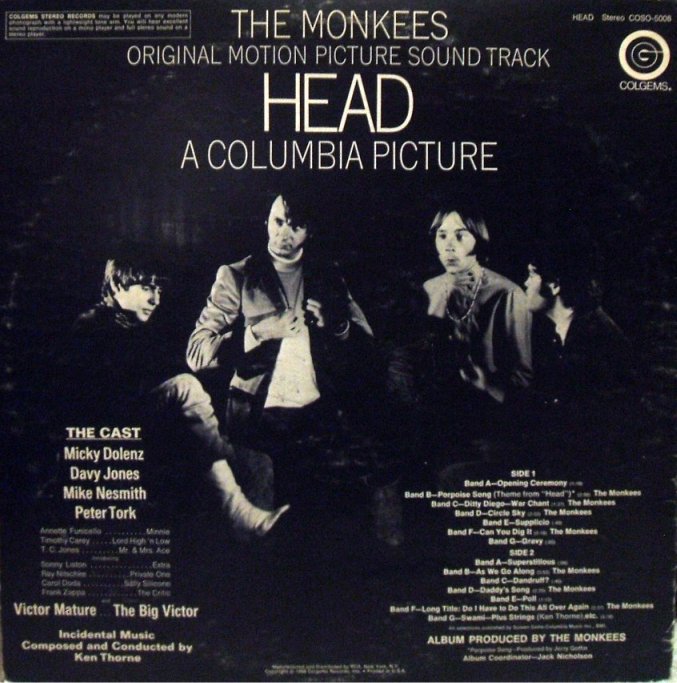
My photo of the cover doesn't do it justice. It is a clear silver cover and when you look into it you see a reflection of your head. Very cool but a bitch to photograph. I saw the Monkees recently in concert. Even though I had been a huge fan of them as a child, I had real misgivings about the show, I only went because my son wanted to go. My doubts about the show stemmed from the absence of Mike Nesmith (my favorite Monkee) and my fear that the show would be some depressing and empty exercise in crude nostalgia with Davy, Micky and Peter just going through the motions for the money. At first my fears seemed justified as Micky and Davy clowned their way through a couple of numbers. But then the excellent 7 member backing band took charge and the music picked up. Finally Peter Tork made a heartfelt speech about how the Monkees were a real band and belonged in the Hall of Fame and I was won over. All these years later and Tork is still looking for acceptance. I was touched. Tork is now the heart and soul of the band. He sang all of Nesmith's parts and is clearly the best singer in the band at this point. I was enjoying the show when Tork again took the mike to announce that they were going to do some songs from "Head." I was ecstatic as they performed the entire album including an astonishing version of "Porpoise Song." It was a terrific concert and I'm really glad I went. "Head" is my favorite Monkees album. I first encountered it via the movie of the same name. Some of you may remember that distant time before cable when the three networks showed theatrical movies. CBS ran movies nearly every night after the late night local news. One night when I was in my early teens, they showed "Head." I stayed up way past my normal bedtime to watch it. I didn't get it, I was expecting something like the TV series. I even dozed off a few times. Years later I was lucky enough to see it in a movie theater and it blew me away. It remains my second favorite rock film after "A Hard Day's Night." It is not only a great film, but a great record as well. It was their final album prior to Tork's departure from the group and Tork goes out with a bang offering up two of his best songs with the band, "Can You Dig It?" and "Long Title: Do I Have To Do This All Over Again." Dolenz replaced Tork as lead vocalist on "Can You Dig It?" although Rhino included the Tork version on its CD re-issue of "Head." Having heard both versions I have to concede that the Dolenz one is better although Tork sang it at the concert and it sounded great. The song has a Middle Eastern flavor to it that befits its use as trippy accompaniment to a belly dancing sequence in the film. "Porpoise Song" is my favorite Monkees song and is arguably the most psychedelic song they ever did with the possible exception of "Daily Nightly." It was written by Gerry Goffin and Carole King and features lyrics of entrapment and escape reflecting one of the key themes of the film. The song is sung by Dolenz with help from Jones and it is driven by majestic organ lines colored by heavy orchestration, very much in the style of English psychedelia. A great, great song. Escape is also the theme in Carole King's other contribution to the record, the idyllic "As We Go Along" which is also sung by Dolenz. It is a very inviting and relaxing song. In total contrast is Mike Nesmith's contribution to the album, the exciting "Circle Sky." I think it is the best rocker the band ever recorded and is one of Nesmith's best songs. That leaves Jones' number, Harry Nilsson's "Daddy's Song," which is a sort of Broadway show tune/old timey song. Normally I hate that sort of thing, but the swelling brass on the chorus wins me over, it reminds me of Dylan's "Rainy Day Women #12 & 35" although not so raucous. The rest of the album is fleshed out with a short bit of Ken Thorne's soundtrack music and sound bites from the movie assembled by Jack Nicholson (yes that Jack Nicholson) including Frank Zappa's immortal line, "that song was pretty white." I love the sound bites, they add a lot of resonance and humor to the album. I think the Monkees are one of the most inspiring stories in rock and I have only the highest respect for them. An artificial band, formed for the crassest commercial purposes, they broke free of their handlers' constraints out of sheer artistic will and dignity and went on to produce some of the best pop music of the 1960s. Yes Peter, the Monkees do belong in the Rock and Roll Hall of Fame (along with Paul Revere and the Raiders, Donovan, Love, Moby Grape, Kiss and the Smiths, but I digress.) By any objective criteria, artistic, cultural or historical significance, the Monkees are more worthy than many of the inductees already there. I defy anyone on the selection committee to explain how the Dave Clark Five, the Flamingos, Frankie Lymon and the Teenagers, James Taylor, the Ventures, the Ronettes, John Mellencamp, Duane Eddy, Abba or Genesis are more deserving. None of them ever made an album as good as "Head." Recommended for people who think the Electric Prunes are a more significant group than Little Anthony and the Imperials (also in the Hall of Fame for reasons I can't begin to fathom.)
Yellow Submarine
The Beatles
Apple SW 153
1969
I bought this while living in Alameda in the mid-1970s. I had not seen the film at the time and I don't remember why I picked it exactly, but I do remember liking the artwork and also not realizing that side two was not by the Beatles. I saw the trippy song titles and figured they were more psychedelic wonders - boy was I wrong. I was so disappointed when I played it. I consider this the worst Beatles record, not really because of the music but because it is such an obvious ripoff. The soundtrack albums for "A Hard Day's Night" on United Artists or the Capitol version of "Help!" are not much better but at least the Beatles had nothing to do with them. This is an Apple product, fully sanctioned by the Beatles. The two best songs, "Yellow Submarine" and "All You Need is Love" had already been released on other albums and the 4 outtakes they dug up to flesh out side one are far from essential additions to the Beatles catalog. My favorite is Lennon's humorous "Hey Bulldog" but despite Paul McCartney's fabulous bass playing on the song, it is definitely minor. I also like Harrison's "Sgt. Pepper" outtake "Only a Northern Song" which would be a much better song if it was not buried in murky production and annoying sound effects. Harrison also contributes the whiny "It's All Too Much" which is a rocking tune with psychedelic touches expanded with excessive instrumentation and lots of repetition. The worst of the four is Paul's insidiously catchy "All Together Now" which is so silly it makes "Ob-La-Di, Ob-La-Da" sound like Leonard Cohen in comparison. George Martin's soundtrack music is conveniently on side two so you can ignore it if you choose, unlike the soundtrack albums for "Help" or "A Hard Day's Night." I'm not a soundtrack music fan but even I can see that this is not particularly distinguished. I kind of like "Sea of Time" which goes from toying with "Within You, Without You" to a corny waltz which is quite a trip. Otherwise side two is just a waste of time for me and I play it about as much as I play "Two Virgins" which is just about never. Just for the record I am not a big fan of the movie either - I dislike the Beatles impersonators' voices and I think the story is dumb although the imagery is wonderful. I imagine it works better if one is high or at least a little buzzed. Recommended for Beatles completists who don't mind getting mugged by the Fab Four.