Eight Miles High
The Golden Earring
Polydor 2485 113
1969
This is a late 1970s/early 1980s Dutch re-issue of Golden Earring's fifth album. Like most Americans I first became aware of the band when "Radar Love" became a hit here in 1974. I had just started to listen to the radio a lot and it was one of my favorite songs of the time. I liked the song so much that I eventually bought "Moontan" which is the album it was featured on. I figured that was all the Golden Earring I would ever need. Many years later I learned that Golden Earring had been around long before I had ever heard them. Their career dates back to the early 1960s. I bought a CD compilation of their 1960s singles in the Netherlands and liked it although it is pretty derivative of British Invasion style pop. It made me interested enough in the band to buy this album when I came across it in a record store. I might have bought it even without knowing anything about the band simply because I was intrigued by their side long cover of the Byrds' "Eight Miles High" which is one of my all-time favorite songs. The record opens with bassist/keyboardist Marinus Gerritsen's "Landing" which is a heavy organ driven rocker that reminds me of a cross between Iron Butterfly and Deep Purple. I'm a sucker for a good riff and I dig the song's heaviness. The lyrics are trippy and enigmatic. The remaining songs on side one were written by guitarist George Kooymans. "Song of a Devil's Servant" opens with a lengthy instrumental passage featuring flute runs by lead singer Barry Hay. Sieb Warner contributes some Indian style percussion as well. The song initially sounds like the Moody Blues, but then the band begins rocking out with a Jethro Tull-like riff. The song is about a guy who sold his soul to the devil. Hay isn't a strong enough singer to hold his own against the band's forceful sound, he sounds strained at times. "One Huge Road" is a straight ahead rocker. It features another booming riff and lots of energetic guitar noise. Kooymans takes the mike on this track but he isn't any more effective than Hay. Despite the song's heaviness it also has an agreeable poppiness to its sound. That is largely absent from the pounding dreariness of "Everyday's Torture." It reminds me of Led Zeppelin's cover of "Dazed and Confused." The torture in the song refers to unrequited love and heartbreak although the lyrics are so awkward that they have little impact. Side two consists of the band's extended workout on "Eight Miles High." The song begins with a subdued, jangly sound that adheres closely to the original song's arrangement. It drifts away from that in the instrumental break with some raga-ish guitar noodling that gradually gains in strength and volume leading into a more highly charged riff-driven instrumental passage that has little resemblance to the original version of the song. Regrettably that gives way to Warner's drum solo which goes on way too long. Gerritsen then joins him for an extended bass solo that isn't much better but restores a little of the song's momentum. Finally the guitar returns and the band lurches into some energetic jamming that eventually after a brief pause evolves into a riff that sounds like it was lifted from Pink Floyd's "Interstellar Overdrive." From there the original Byrds song at last reappears leading to the songs rather abrupt conclusion. I have to admit the first time I played this track I was really disappointed. I like it better now although I still think the drum and bass solos are boring. You should check it out if you are a fan of the original song. The album itself is too derivative and lyrically weak to be essential, but it is worth looking for if you like late 1960s hard rock and appreciate a good riff. Recommended to fans of Humble Pie and Free.
Heavy
Iron Butterfly
Atco SD 33-227
1968
This is the debut album by Iron Butterfly. It features the unique line up of Danny Weis, Darryl Loach, Jerry Penrod, Doug Ingle and Ron Bushy. Prior to its release Weis, Loach and Penrod departed leaving Bush and Ingle to reinvent the band with new members as a quartet. As a young teenager I encountered the single edit of "In-A-Gadda-Da-Vida" on a compilation called "Get It Together." I loved it and bought some of their albums. For awhile I really liked these guys, but I've rarely listened to them in the past 25 years. I was originally drawn to Ingle's organ work and the group's heavy sound, but in retrospect they don't seem all that heavy, particularly in comparison to their contemporaries like Mountain, Cactus, Black Sabbath, Steppenwolf or Led Zeppelin. I still kind of like their debut though. Fans of their later work, may be surprised by this album which sounds poppier and mostly features short songs without extended solos. It is often more "butterfly" than "iron." The album opens with Ingle's "Possession" which begins with a solemn organ intro before the heavy riff that drives the song begins. The song's heaviness is undercut by Ingle's quavery high vocal as he sings inane lyrics about jealousy. Ingle's organ work is the highlight of the song for me. "Unconscious Power" was written by Ingle and Weis with words by Bushy. It was released as a single but failed to chart. It is a straight ahead rocker with trippy lyrics about freeing your mind. The song's frenetic pace and propulsive riff make it one of my favorite tracks on the album. Next up is a lethargic version of Allen Toussaint's oft-covered "Get Out Of My Life, Woman." It starts with another churchy organ intro before launching into the song's familiar funky riff. The song features a joint vocal from Ingle and Loach that tries to be passionate but sounds strained instead. There is a nice rave up at the end that breathes some life into the song but ends too quickly. "Gentle As It May Seem" was written by Weis with words by DeLoach. DeLoach sings the lead vocal but is even less convincing than Ingle and it doesn't help that the lyrics are so vacuous. Musically the song is terrific being a high tempo rocker with scorching guitar work from Weis. Side one concludes with "You Can't Win" which is another collaboration between Weis and DeLoach. It is a protest song about how hopeless it is to fight the authorities. The song is driven by a lumbering riff embellished by screeching guitar runs from Weis. Ingle's vocal is more relaxed than usual. Side two kicks off with Ingle's "So-Lo" with lyrics by DeLoach. It is an incredibly vapid song in which DeLoach describes how his girl left him because he behaved badly. The song has a mildly ominous intro before becoming sunshine pop with a light vocal from DeLoach backed by harmonious background vocals. Ingle contributes a couple of Bach-style organ solos to give the song a slight chamber pop flavor. If I heard the song on the radio (not very likely) I'd never guess it was Iron Butterfly. The band returns to form for "Look for the Sun" which features music by Weis and Ingle and words by DeLoach who sings the lead vocal along with Penrod. The song is driven by a heavy riff that helps cover up the dumbness of the lyrics which celebrate how the sun makes people feel good. Heavy riffing continues with "Fields of Sun" featuring music by Ingle and words by DeLoach. It is another paean to the sun which they like because it makes the plants grow. Ingle sings the lead with his typically intense style which makes the lyrics seem even stupider. "Stamped Ideas" is another Ingle/DeLoach collaboration. DeLoach advises his girlfriend to stay away from plastic people and keep her stamped ideas inside her head, in other words more hippie bullshit. The song is a rocker with a bit of rhythm and blues sound to it. DeLoach sings a sloppy lead vocal but otherwise the song cooks pretty nicely. The side ends with Ingle's instrumental "Iron Butterfly Theme" which foretells the band's future direction. It is a superbly ponderous song with a slow sludgy riff upon which Ingle and Weis noodle about with semi-psychedelic solos. Its dense, weighty sound makes it my favorite track with the added bonus of having no idiotic lyrics to irritate me. There is much that I like about this album. It is less self-indulgent and has more good tunes than any Iron Butterfly album I've ever heard. The band comes up with a bunch of compelling riffs, the rhythm section is solid and I enjoy Weis' guitar work. My problems with the record are the vocals and the lyrics. Ingle is a decent singer but I don't like the sound of his voice and he usually sounds uptight to me. DeLoach on the other hand is too light and relaxed for the weight of the band's sound. As for the lyrics, these guys make the Ramones seem like Shakespeare. I know it's only rock and roll and it isn't supposed to be smart, but the relentless stream of idiocy this band unleashes is hard for me to bear. I'm amazed that a band could have so little to say, but of course they would later top this with an entire album side devoted to the lyrical nonsense of "In-A-Gadda-Da-Vida" so I suppose I should not be surprised. Fortunately the music is strong enough that I can mostly tune out the words and dig the heavy groove the band gets into. Recommended to people who prefer "Fresh Cream" to "Wheels of Fire."
We Are The Star People
Turn Me On Dead Man
Alternative Tentacles Records Virus 453
2013
I knew nothing about this Bay Area band when I bought this album. I had never heard any of their music. I bought it partly because it was cheap, partly for the dazzling cover art, partly for being on Jello Biafra's record label, but mostly because of the band's name. If you are a Beatles fan you are probably aware that you can hear what sounds like the phrase "turn me on dead man" when you play "Revolution No. 9" backwards. It was one of the clues in the "Paul is dead" hoax. Being a Beatles nut myself, I couldn't resist this record and besides it looked like a psychedelic record which is one of my favorite genres. It turned out to be a fine album, I'm delighted that I bought it, but it is more heavy than psych with kind of a whacked out grungy sound, although the lyrics are often very trippy. The band kicks out the jams right from the start with "Heart of the Deaf" which is a paean to an evil goth woman who the singer is attracted to. The song features a pounding rhythm, a heavy riff and plenty of hard rock noise, but it is intelligent and controlled, far from the self-indulgent excesses of heavy metal. "Dreamchild" is another powerful rocker with spacy lyrics buried in the mix like a shoegaze song. I wish it went on longer. That is not a problem for the lengthy "Deep Space Pollen" which features a request to extraterrestrials to come to Earth and take the band for a ride in their spaceship although this might also be interpreted as a drug metaphor. The song is driven by a slow, thunderous riff and lots of metallic guitar noodling. "Missing Time" describes the experience of being taken by the spaceship, although it probably is also a drug trip metaphor. It starts slow and trippy and then some power riffing takes over for awhile before giving away to a calmer conclusion. Side two opens with "Her Majesty the Drug" which is a colorful invitation to take a hallucinogenic trip. The song starts out psychedelic but then a monstrous riff kicks in reminiscent of Blue Oyster Cult's classic "Godzilla." The song returns to psychedelia briefly with some lyrical sitar-like guitar sounds and then the band rocks out again. This is my favorite track on the album. I like the dramatic shifts in dynamics as well as the trippy lyrics. The band quiets down for "Let Them Eat Flowers" which is the lightest sounding song on the album. It is another drug song featuring sky and flower symbolism and it is the most overtly psychedelic song on the album. The band returns to heaviness with the hard driving "Star People" which backs up its ominous lyrics about space invaders with a powerful sonic assault that drives the song to its conclusion. The song has a prog-rock sound to it as well which makes it more interesting than a typical hard rock song. The album concludes with "Uhura" which is a sludgy instrumental that I assume is a reference to "Star Trek" in keeping with the space theme that permeates the album. As an album closer, I find it a downer. I have a limited appetite for hard rock, but this band's use of psychedelia and prog-rock to flesh out their sound makes them very appealing to me. At times I wish the music was as trippy as the lyrics, but for the most part the band's sonic roar excites me. The band's dope-crazed, sci-fi lyrics stimulate me as well. It is an imaginative and creative album that I find consistently engaging. Recommended to fans of the Warlocks and Black Rebel Motorcycle Club.
Fire and Water
Free
A&M Records SP 4268
1970
A belated post for Andy Fraser who died this past March. Fraser was the bass player and principal songwriter along with Paul Rodgers in the British band, Free. I loved this record when I was a teenager. I grew up listening to classic rock on the radio and when I heard "All Right Now" it blew me away and I tracked this record down. I've always been a sucker for a good riff and this band had plenty of them. As I grew older I lost interest in classic rock aside from the 1960s and it has been awhile since I played this. Listening to it now, I'm impressed. It still sounds really good, better than most of the other records that came out in the early 1970s. My favorite track is the opening cut, "Fire and Water" which like almost the entire album was written by Fraser and Rodgers. It is driven by a catchy power riff and an emotional vocal from Rodgers as he assails a former lover for breaking his heart. Paul Kossoff puts the song over the top with a powerful, bluesy guitar solo. I even dig the Simon Kirke drum solo that closes out the song. This is smouldering hard rock at its best, sustained tension and controlled strength throughout the song. The record lets up a bit for "Oh I Wept" which was written by Rodgers and Kossoff. It is a moody ballad about running away from unhappiness that is largely carried by another strong vocal from Rodgers. The band turns to slow riffing for "Remember" which looks back regretfully at a lost relationship. Kossoff delivers another strong bluesy solo that is the highlight of the song. The side ends with "Heavy Load" which is also constructed around a slow heavy riff. The song is driven by Fraser on piano until the end where Kossoff's howling guitar takes over. This dark, ominous song is another one of my favorites on the album. Side two opens with "Mr. Big" which is a group composition. It is a series of threats directed at the title character. The tune is constructed around a simple heavy riff that evolves into an intense jam between Kossoff's soaring guitar runs and Fraser's energetic bass lines. This is the most exciting musical passage on the album. Great stuff. They cool down for the far less charged "Don't Say You Love Me" which is a slow ballad. It is a variation on the so-long-babe-I-got-to-ramble type song beloved of so many rockers. I find it a little boring although it picks up energy towards the end. The album concludes with the group's only hit, "All Right Now." The song is a classic rock radio standard and with good reason. The riff is extremely catchy, Rodgers' gravelly vocal is the essence of hard rock singing, Kossoff lays down some hot licks and Kirke and Fraser propel the song along relentlessly. The song is sexy with a chorus that sticks with you long after the song is over. Thus ends one of the best hard rock records of its era. It is so good it makes me wonder why Free never made it really big. They had all the tools, good songwriting, a terrific lead singer, inspired musicianship, but none of the other Free records I've heard are nearly as good as this one. It was probably a question of band chemistry as well as Paul Kossoff's drug problems. At least they left this one lasting classic album. I love its stripped down sound and sustained power. No mindless boogies or heavy metal wank sessions, it is all purposeful and deliberate. I admire their discipline and intelligence, a rare quality in an era of self-indulgence, excess and vapidity. Rest in peace Andy Fraser, this great album insures that you will not be forgotten. Recommended to fans of the first Jeff Beck Group.
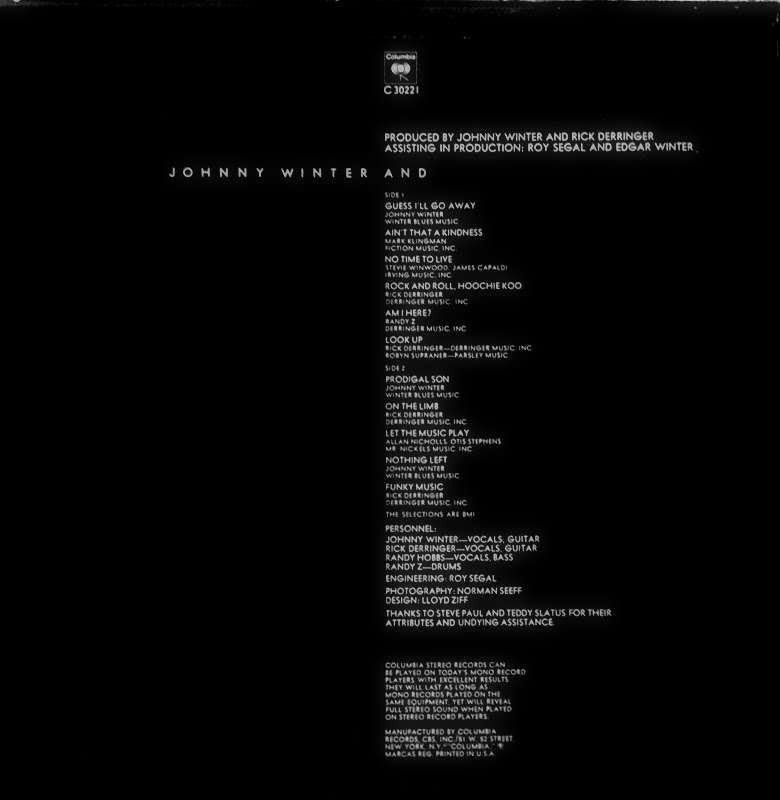
Johnny Winter And
Johnny Winter And
Columbia C 30221
1970
Here's a post for the late Johnny Winter. Winter started out playing the blues and finished his career as a bluesman, but for a little while in between he was a pretty fine rocker. I have some of his blues records and I like them fine. The guitar work is outstanding and the singing is, well, less than outstanding. This however is my favorite Winter record and it is pure 1970s hard rock. It resulted when Winter joined three of the four McCoys to form Johnny Winter And. I'm a big fan of the McCoys' two Mercury albums in the late 1960s and they bring a lot to this record both in terms of instrumental support and songwriting. The record kicks off with Winter's hard riffing "Guess I'll Go Away" driven by the dueling guitars of Winter and Rick Derringer who rock out big time. Fabulous! Mark "Moogy" Klingman's "Ain't That a Kindness" is less exciting being more in a laid-back southern rock vein. It is followed by an unlikely cover of Steve Winwood and Jim Capaldi's "No Time to Live" off of the second album by Traffic. Thanks to the guitar interplay between Derringer and Winter it is better than one might expect, although it sounds more like the McCoys to me than Winter. It is followed by Derringer's classic "Rock and Roll, Hoochie Koo" which would later be a hit single for Derringer when he released his own solo version of it in 1973. I think it is one of the best hard rock songs of its era and I love both versions although I think Derringer's is more forceful. Lots of great guitar riffing on this one and the crude lyrics are pure rock and roll. The band's drummer, Derringer's brother Randy Z (Zehringer), provided "Am I Here?" which is another track that sounds more like the McCoys than Winter with its quasi-existential romantic lyrics and its folk-rock style. I really like the song, it would have fit great on "Infinite McCoys" and it makes a nice change of pace for this record. Things return to normal with Derringer and Robyn Supraner's "Look Up" which is another riff-driven rocker with a southern rock sound to it. It is a bit generic but it rocks and features plenty of guitar action. Side two kicks off with Winter's "Prodigal Son" which is once again another riff-driven rocker with more of a rhythm and blues feel to it and some smoking hot guitar solos. Derringer's "On the Limb" is more southern rock with a nice dual vocal from Winter and Derringer. Allan Nicholls and Otis Stephens' "Let the Music Play" offers another respite from the relentless rock attack of the record. It is slow and soulful with more of a pop flavor than the rest of the record although it still boasts a killer guitar solo. Winter's "Nothing Left" is a generic blues rocker distinguished only by the quality of the playing which I have to admit is pretty high. The album concludes with Derringer's "Funky Music" which is not very funky, but rather another southern rock guitar workout. The song is ordinary but the guitar work is some of the best on the album and this is an album with a lot of great guitar on it. Unfortunately it fades out with the boys still jamming up a storm much to my annoyance. That's a minor complaint for an otherwise first rate record. The songwriting isn't quite strong enough for it to be a truly great record, but as far as hard rock goes in the 1970s, there are not a lot of albums better than this. The playing is fantastic, an aural orgy for connoisseurs of guitar noise. The partnership between Winter and the McCoys benefited both parties. The McCoys brought their pop sensibility and a strong second guitarist for Winter to engage with and Winter gave them a grittier sound and a stronger rock identity. Winter was one of the greatest guitarists in rock history and this album is a magnificent example of the talent we have lost with his passing. Recommended to fans of Lynyrd Skynyrd.
Ready To Die
Iggy and the Stooges
Fat Possum Records FP 1296-1
2013
Depending on your perspective this is either the fifth Stooges studio album or the second Iggy and the Stooges studio album. In past posts I've expressed my reluctance to keep doing obituary posts but I just can't ignore Scott Asheton's recent passing and besides I had this album in my stack of records to blog about, I just moved it up a little. Usually these reunion albums suck. Too often they are just cynical efforts to cash in on a band's fame delivered with little passion, inspiration or relevance. This album is better than that fortunately although it can't match the first three classic records. There is nothing on here that comes close to "Search and Destroy," "Down on the Street," "TV Eye," "I Wanna Be Your Dog," or "1969." On the plus side it actually sounds a bit like "Raw Power" and there are no bad cuts on the album. The entire record is written by Iggy Pop and James Williamson, except for the last cut "The Departed" where Scott Asheton gets a co-credit. "Burn" gets the album off to a rocking start with its roaring guitars and hard driving rhythm. Lyrics like "the Goddess of beauty is beckoning to me" seem a bit pretentious for the Stooges but the theme of destruction and the rise of the young fit in with the classic ethos of the band. "Sex & Money" is one of my favorite cuts on the album. It is a hard-riffing rocker about the pursuit of the title subject bolstered by raucous sax work from Steve Mackay (who was a guest musician on "Fun House.") "Job" and "Gun" continue in a similar vein with Pop venting impressively about his dissatisfaction with his job and the world in general while the band raises a ruckus behind him. He may be in his 60s but Pop can still voice youthful rage convincingly. "Unfriendly World" shifts gears dramatically. It is a slow, countryish tune sung in a gravelly, understated manner by Pop reminiscent of Leonard Cohen or Lou Reed. The lyrics are still disaffected, but more introspective and sentimental than the rest of the album. Side two kicks off with "Ready to Die" in which the band resumes power riffing. This is another one of my favorite tracks on the album. James Williamson lays down a killer guitar solo and Pop delivers the nihilistic lyrics with gusto. "DD's" is a moronic song about sex (the title refers to bra cup size) although the lyrics are surprisingly pretentious with Pop even name dropping Aristotle, Freud and Jung at various points. It is a generic rocker enlivened by Mackay's honking sax fills. "Dirty Deal" is a terrific rocker in which Pop rants about getting ripped off by the music business. It has the best lyrics on the record, probably the most personal song on the album. Williamson has more smoking guitar work, the guy can still bring it big time. "Beat That Guy" is a lethargic song that sounds like filler although I like Williamson's solo. The album ends with "The Departed" which returns to the muted sound of "Unfriendly World" and shares its introspection and sentimentality. It is kind of a downer finish for a highly charged album, but I do appreciate the song's intelligence and sensitivity which seems like a weird thing to say about a Stooges song. I like this album a lot better than I expected to, it compares favorably to much of Pop's solo work and it does not disgrace or tarnish the Stooges' legacy. One of the biggest differences between this album and the classic Stooges records is that Pop has become a better singer which is particularly noticeable in the slower tracks. That may not necessarily be a good thing when it comes to the Stooges. The raw whininess and rage in young Iggy had its own appeal, one that I kind of prefer to the worldly, jaded crooner that Pop has become. Despite that I'm glad this record exists. It is Scott Asheton's final work and is a worthy epitaph for his impressive career. His forceful drumming drives the music relentlessly just like it always has whenever he has been behind the kit for a band. This record is a testament to rock's great loss with Asheton's passing. Recommended to people who prefer "New Values" over "The Idiot."
Queens of Noise
The Runaways
Mercury SRM-1-1126
1977
I recently watched the feature film on the Runaways with my son. To him the movie was ancient history and he was surprised to learn it was based on a true story and that the Joan Jett in the movie is the same artist who performed "I Love Rock 'n' Roll" a song he really likes. For me it was a return to an era I'd rather just forget. I was in high school during the band's heyday and the women were just a few years older than me. Seeing the 1970s lovingly recreated for the film was kind of a nightmare for me, ha-ha. I was not a fan of the band back then, I'm not sure I ever even heard any of their music at the time. I do remember reading an article about them that disapprovingly noted their use of their sex appeal to promote the band (as demonstrated in the cover art of this album with the band clutching strippers' poles) which led me to think they were just a gimmick band. Then Joan Jett became a big star and I liked her records so I went back and checked out the Runaways' music and I liked what I heard. This album was their second record and it sure beats most of what was on the radio back in 1977. I like the band's debut album too but I think this was their definitive statement as a band. The best song is the album opener "Queens of Noise" which was written by Billy Bizeau and sung by Joan Jett. It is the only non-original song on the album but it fits the band perfectly, an ideal theme song for the group. It rocks out wonderfully but I wish the band had increased the tempo and I could certainly do without the hideous synthesizer solo. The song illustrates the difference between the Runaways and the punk bands they are sometimes compared to. A band like the Ramones would have emphasized the song's velocity but the Runaways prefer to emphasize its heaviness. Heaviness also carries the day with Jett's "Take It or Leave It" with its excellent power riff and Jett's forceful vocal as well as lead guitarist Lita Ford laying down some fiery licks in her solo. "Midnight Music" is a lot more poppy although it is still driven by a heavy riff. Cherie Currie sings the lead vocal and co-wrote it with the band's manager Kim Fowley and Steven Tetsch. "Born to Be Bad" was penned by Fowley, drummer Sandy West and future Bangle Michael Steele who had been an early member of the Runaways. It is a self-referential song that plays up their bad girl image. If a guy was singing it I'd find it insufferable, but I like hearing a woman singing about being a rock and roll rebel. The verses are slow-paced, pushed along by a simple heavy riff and then pick up speed for the chorus. Ford delivers a noisy solo that is full of heavy metal cliches but gets the job done. The most appealing part of the song is Jett's charismatic lead vocal. "Neon Angels On the Road to Ruin" was written by Ford, Fowley and bassist Jackie Fox and it is another song inspired by the band's persona. It is a rocking boogie with an outstanding vocal from Currie. Side two opens with Jett's "I Love Playin' With Fire" which is one of the strongest songs on the album. Jett's snarled vocal is backed up with a fast paced hard-riffing tune that foreshadows her solo work. The hard rock noise continues with "California Paradise" which was composed by Fowley, Jett, West and Kari Krome. The song is driven by West's energetic drumming and an alluring, sarcastic vocal from Currie as she croons a twisted paean to California's charms. "Hollywood" is credited to Fowley, Fox and Jett although it is hard to believe it took three people to come up with such an inane song. The song may be dumb but it is very catchy with the chorus boasting one of the strongest hooks the band ever came up with. Jett screeches out the vocal with impressive urgency. "Heartbeat" was written by Currie, Ford, Fowley, Fox and the record's producer Earle Mankey. It is more of a power ballad than a rocker, sweetly sung by Currie as she describes a brief hook-up with a fellow performer. "Johnny Guitar" was written by Fowley and Ford as a showcase for Ford's metallic guitar playing. It is a slow blues that goes on for more than seven minutes. Currie's vocal is buried deep in the mix making it hard to hear the lyrics which describe making love with the title character. The focus of the song is clearly directed at Ford and her guitar. I find her frenzied fretwork self-indulgent but I suppose metal-heads will dig it. The song is easily the worst one on the album for me. Regardless of Ford's regrettable heavy-metal leanings, I consider this to be one of the most exciting hard rock albums of its era right up there with the best work of AC/DC and Blue Oyster Cult. The Runaways were a terrific band, West and Ford could really play, Currie was a talented singer and Joan Jett is one of the greatest rockers of her generation. Despite the sexual exploitation associated with their image, the Runaways' music was a powerful feminist statement of empowerment and liberation. Even with all the countless female punkers and riot grrrls who followed in their wake, I still find this record's statement of female rock power wildly exhilarating. The Runaways kicked out the jams as well or better than any of their male peers. I think they were one of the best American bands of the 1970s. Recommended to fans of the Donnas and L7.
American Woman
The Guess Who
RCA LSP-4266
1970
As a teenager I was a fan of these guys, I even liked "Clap For The Wolfman," a song that now makes me wince. This was my favorite of their studio albums although I rarely listen to it (or any of their other records) anymore. I can't remember why I liked them so much back then but I've always been a sucker for a good riff which was guitarist Randy Bachman's forte. He left after this album eventually forming the riff-happy Bachman-Turner Overdrive another band I really liked back then. The album kicks off with the title track which was a massive hit. I loved the song as a kid, such a compelling riff, but the grown-up me has problems with its misogyny and anti-American lyrics. As I've mentioned in past posts, I'm a huge Canadaphile. I love it up there in the Great White North, but I still resent it when a bunch of jackasses from Winnipeg come down here and start ragging on the people buying their records and making them rich. Furthermore blaming women for the American military industrial complex and institutionalized poverty makes as much sense as blaming Haiti for global warming. This is an obnoxious song that makes the band sound like a bunch of sexist yokels. Unfortunately it is also insanely catchy and powerful which has kept it on classic rock radio for more than 40 years. The entire band gets songwriting credit for "American Woman," but the next song "No Time" is written by Bachman and lead vocalist Burton Cummings who paired up to write all the rest of the songs on the album except "Humpty's Blues" which is another group composition. "No Time" is less offensive than "American Woman" but just as obnoxious. It is a callous kiss off to a lover of the so-long-babe-I-gotta-ramble variety only crueler. Despite its vicious tone the song is melodic and musically pleasant with another catchy riff that helped make it the second hit single off the album. "Talisman" is a respite from riffs and misogyny. It is a slow moody song played on an acoustic guitar with a piano emerging at the end playing some lovely lines. Its trippy lyrics represent the point of view of Native Americans. Bachman's "No Sugar Tonight" is blended with Cummings' "New Mother Nature" to close out the first side. This is my favorite part of the album. I've always liked the little acoustic guitar run that opens the song and reappears in the segue between the two songs. The rest of the tune is driven by hard rock riffing. The sugar in Bachman's song refers to sex and Cummings' tune is more about dope than ecology. Side two kicks off with Bachman's "969 (The Oldest Man)" which is an instrumental. It starts out rocking with plenty of bluesy guitar runs and then slows down for a flute solo from Cummings. It is kind of weird but I like it and at least there are no dumb lyrics to annoy me. "When Friends Fall Out" has the same heavy/light dichotomy. Most of the song is driven by a ponderous riff played on a fuzz guitar but the center and end of the song revert to a very poppy and melodic passage reminiscent of the Association. "8:15" is a fast tempo song with a hard driving guitar line and a percussion-based instrumental break in the center and at the end. The song's alluring mixture of rock power and pop accessibility provide me with a clue of why I liked these guys so much back in the 1970s. "Proper Stranger" features a return to heaviness with a sluggish fuzzy riff and a get-down growling vocal from Cummings as he intones feelings of alienation and confusion living in the big city. Time to get back to Winnipeg, kid. The album ends with the heaviest tune of all "Humpty's Blues" which is a straight blues dominated by Cummings' screechy vocal and harmonica playing supported by a lethargic guitar solo. At the end of the song there is a brief reprise of the acoustic part of "American Woman" from the beginning of the song which has a nice bookend effect for the album. I'm starting to remember why I used to like this record and this group, they definitely knew how to rock a riff and had enough pop smarts to stand out among the bland hard rock of the early 1970s. If the lyrics on this record were smarter (or nicer) I'd probably still be playing it. Recommended to Steppenwolf fans who have issues with their girlfriends.
On Your Feet Or On Your Knees
Blue Oyster Cult
Columbia PG 33371
1975
When I was in the 8th grade in Alameda, my friend and I came across a curious bit of graffiti at school. It was a cross made out of an upside down question mark and underneath it was written "Blue Oyster Cult." This was before BOC's ascension into AOR stardom with the release of "Agents of Fortune," I'd never heard of them. My friend and I looked at each other in bewilderment and even a little bit of alarm. We thought it was a real cult. What kind of lunatics worship oysters? It was not as far-fetched as you might think, the Bay Area was a hot bed of cult activity in the 1970s, I regularly passed Hare Krishnas on my way home from school. So the Oysters became a running joke for us for the rest of the school year. A year or so later I bought the Woffinden/Logan "Illustrated Encyclopedia of Rock" and started reading it cover to cover and in the Bs I came across a picture of this album and learned all about the Blue Oyster Cult. I was never much of a fan, but I bought this in the used bin out of curiousity. As a rule, double live albums suck, they are one of the 1970s worst contributions to rock culture. This is better than most, there isn't too much arena grandstanding and wanking off. Side one kicks off with a pair of songs from "Secret Treaties": "The Subhuman" and "Harvester of Eyes." To me "The Subhuman" sounds like the Allman Brothers playing prog rock. The lyrics are about as weird as any you will ever hear in mainstream pop music and I'm not even going to try to interpret them. I enjoy "Harvester of Eyes" which is surprisingly light and rollicking considering its dark subject matter. The side ends with "Hot Rails To Hell" from "Tyranny and Mutation" which is full throttle, kick-ass rock and roll. The same album yields a smoking version of "The Red & The Black", BOC's ode to the Royal Canadian Mounted Police, and "Seven Screaming Dizbusters" to kick off side two. "The Red & The Black" is one of the best songs on the album with some dazzling guitar work. "Dizbusters" has some nice riffing but its instrumental break bores me with its heavy metal cliches and self-indulgent soloing, although it is pretty funny when Eric Bloom says he knows Lucifer so well that he calls him by his first name, "Hey Lou." Satanic references are practically de rigueur in heavy metal, but at least these guys have fun with it. Side two concludes with Buck Dharma's guitar showcase "Buck's Boogie." It is twice as long as Jeff Beck's boogie and about half as exciting. Air guitarists should get a kick out of it, but I find it only sporadically compelling although it is fun to listen for the various references to other songs scattered throughout Dharma's playing. Side three revisits BOC's debut album with "Last Days of May" and "Cities on Flame." The former, a cautionary tale of a drug deal gone bad is mildly interesting and not at all metallic, it reminds me of Bad Company. "Cities on Flame" on the other hand is pure metal with its monster heavy riffing. The side finishes with "ME 262" from "Secret Treaties" which is told from the point of view of a Nazi pilot flying a jet against the British. For a heavy metal band these guys do find interesting things to write about. The guitar break in the middle of the song is lifted from the Yardbirds" "Lost Women." It goes on a bit too long but the song really rocks. The Yardbirds pop up again on side four with a raucous workout on their version of "I Ain't Got You." Again it goes on too long but it has some powerful moments. Side four also features a hard driving performance of the riff-happy "Before The Kiss, A Redcap" from their debut album. The album finishes with a thunderous cover of Steppenwolf's "Born To Be Wild" that follows the original pretty closely at first and then jumps into some noisy metal cacophony. It is a thrilling performance and ends the album with a bang. Sounds like it was a really exciting show. In the canon of hard rock live double albums I'd rank this a bit below "Kiss Alive" but well above Aerosmith's "Live Bootleg" or Led Zeppelin's "The Song Remains the Same." At least there are no drum solos. As an introduction to Blue Oyster Cult you could do worse. I'd say it is worth buying just for side four alone. Recommended for Led Zeppelin fans who wish their heroes had a better sense of humor.
British Lions
British Lions
RSO RS-1-3032
1978
I was given this record by a friend who was a big Mott The Hoople fan. She was paring down her collection and didn't want it anymore. I can see why, even though 3 of the members, Buffin, Overend Watts and Morgan Fisher, came from the Ian Hunter-era Mott line-up and a fourth, Ray Major, comes from the post-Hunter Mott, this doesn't sound much like Mott. Probably because the fifth guy, John Fiddler, wrote most of the songs and sings them. He came from a band called Medicine Head that I've never heard and judging from this I don't know that I really want to. On the picture on the inner sleeve the boys are all well-coiffed and made-up, looking like five lads on their way to a hairdressers convention, so I expected some glam-rock, but in fact this is mostly generic 70s hard rock. I have a bit of an appetite for that stuff but this is pretty marginal. Fiddler isn't much of a singer. He sounds like he's trying to be Lou Reed on "One More Chance To Run" and he imitates Ian Hunter on "International Heroes." Unfortunately he could be Ian Hunter himself and that wouldn't improve this album much. The two best songs come from outside the band, Garland Jeffrey's "Wild In the Street" and Kim Fowley's "International Heroes." "Fork Talking Man" rocks pretty nicely in a mundane sort of way but the lyrics are dreadful. "My Life's In Your Hands" has a nice power riff and reminds me a bit of Blue Oyster Cult. Fiddler's weak vocals and crummy lyrics drag down "Big Drift Away" which is a power ballad reminiscent of Bad Company. It could have been a decent song but it falls short and goes on way too long. "Booster" is my favorite of the group's originals, it even sounds like a Mott the Hoople song. I like the call and response vocals. Unfortunately the goodwill it generates in me is completely undone by the album's closing song, "Eat The Rich." As much as I approve of that sentiment, it is a really stupid song, even by hard rock standards. This is not an unpleasant record, it sounds sort of nice in the background, but it is instantly forgettable, I can hardly remember a song on it, minutes after it is over. I think the most interesting about it is that Terry Jones and Michael Palin of Monty Python are thanked in the sleeve notes. When the day comes when I have to pare down my record collection, there is a good chance that this record will be on the move again. Recommended for Mott the Hoople fans who dislike Ian Hunter.
Live Yardbirds
The Yardbirds
Epic E30615
1971
I bought this record sealed for $25 in the early 1980s at my favorite record store ever, Rather Ripped Records in Berkeley. It seems like a bargain now, it was actually a bargain then too, but for me, a starving student at the time, it was a princely sum. I had to skip a few meals to pay for it. It was worth it though. The Yardbirds, or more specifically Jimmy Page, had this album withdrawn supposedly because he didn't approve of the dubbed crowd noises or more likely the attempt to cash in on the fame of Led Zeppelin. There was no reason to be embarrassed by this album though, if anything Page ought to be embarrassed by Led Zeppelin's live album "The Song Remains the Same" which is a far worse record. Yes the crowd noise is a little irritating, but the performance is awesome and the recording quality is pretty decent for a 1960s era live recording. The group's performance of "Over, Under, Sideways, Down" is the best I've heard and they also deliver blistering takes of "Mr. You're a Better Man than I," "Heart Full of Soul," "Train Kept A-Rollin'" and "Drinking Muddy Water." If you are a Yardbirds fan you are probably familiar with the extended psychedelic version of "I'm a Man" that the group developed with Page which has been featured on various archival reissues. I admire the effort to breathe new life into the song, but I greatly prefer the version the group recorded with Jeff Beck or even the earlier live version with Eric Clapton. The group also offers up an epic version of Jake Holmes' "Dazed and Confused" (here entitled "I'm Confused") which Led Zeppelin essentially copied for the version they put out on their debut album, which might be another reason why Mr. Page has been so reluctant to allow this record to be released. Much of this record is like a blueprint for the early Led Zeppelin sound. Like any good live record, this performance is a little rough, a little sloppy perhaps, but full of energy and excitement. Tracking down a reasonably priced vinyl original may be difficult at this stage, but it has been widely bootlegged and was also issued on CD a few years back. If you have any interest in the Yardbirds you definitely should check it out. Recommended for people who think Led Zeppelin invented heavy metal.