Jefferson Airplane Takes Off
Jefferson Airplane
RCA LSP-3584
1966
So many of my musical faves have died this year and I don't post enough to keep up unfortunately. Marty Balin's passing last month hit me pretty hard though so I have to acknowledge it. I've been a fan of the Airplane since I was 12 years old. They were my favorite American band when I was a teenager even though they had already broken up. "Surrealistic Pillow" and "After Bathing at Baxter's" were a big part of the soundtrack of my life back then and I still enjoy listening to them. I initially was attracted to the music of Grace Slick and Paul Kantner with its transgressive and defiant attitude as well as its psychedelic character. In contrast I found Balin's songs kind of corny. As a result this album was for many years one of my least favorite Airplane albums, since it is dominated by Balin who wrote or co-wrote 8 of the 11 songs and sang lead on most of them as well. As I grew older though, I became attracted to Balin's romanticism and soulful voice and this album became one of my favorites. When I heard Marty had died, this was the album I reached for. I think it represents the purest expression of his vision for the band. Slick and Kantner asserted themselves on "Surrealistic Pillow" and dominated the band after that. Balin is quoted in the liner notes saying "all the material we do is about love" which is certainly true of this record and has always been Balin's greatest strength as an artist. The album opens with "Blues from an Airplane" by Balin and future Moby Grape member Skip Spence who was the Airplane's drummer on this album. The song is not a blues, it is pure folk-rock propelled by Jack Casady's booming bass lines. The song introduces the elaborate vocal harmonies that would become a signature aspect of the Airplane's sound throughout its existence. The album's velocity increases with Balin and Kantner's "Let Me In" which is driven by Jorma Kaukonen's ringing guitar chords and more frenetic bass work from Casady. Kaukonen has an exciting guitar solo as well. It is a classic example of the zonked out folk-rock that characterized the early Airplane style and foreshadows the sound of "Surrealistic Pillow." Kantner sings lead and does a great job conveying the erotic urgency of the lyrics. Kantner and Balin also wrote "Bringing Me Down" and which is highlighted by Kaukonen's jangly guitar lines and solo. I consider "It's No Secret" to be one of Balin's best ever songs. His yearning vocal is superbly expressive and the dynamic interplay between Casady's rumbling bass runs and Kaukonen's slashing guitar chords is wonderful. John Loudermilk's "Tobacco Road" has always seemed to me an odd song choice for the Airplane but they do it quite well thanks to a heartfelt vocal from Balin and more brilliant bass playing from Casady. The song has been covered many times, but I've never heard a better version than this one. Side two opens with Balin and Kantner's "Come Up the Years." In his liner notes Ralph J. Gleason describes having the song stuck in his head after playing the album and I've always had the same experience. I first heard the song on the 1977 Airplane comp "Flight Log" and I loved it so much that I played it over and over. Even now it still sticks with me every time I play this album. The song features another emotional vocal from Balin with lovely harmony support from Kantner and Signe Anderson. The song is about a guy in love with a girl who is too young for him, but it is so sincere and lovely that it does not comes across as creepy. Casady's bass lines give the song a strong hook and the folk-rock guitar work enhances the song's atmospheric feeling. Casady also stands out on Balin and Kantner's "Run Around" which is sung by Kantner with vibrant harmony support from Balin and Anderson. Dino Valenti's flower power anthem "Let's Get Together" is an ideal vehicle for the early Airplane sound. Kantner, Anderson and Balin trade verses over jangly guitar runs from Kaukonen and Casady's relentlessly driving bass work. The Youngbloods have the best known version of this song, but I think this version is just as good. More jangly guitar introduces Balin and Spence's "Don't Slip Away" which features compelling ensemble vocals over a solid folk-rock beat. Next up Signe Anderson belts out a cover of Memphis Minnie's "Chauffeur Blues." Her powerful vocal reminds me of Judy Henske. It is an uptempo rollicking song that gives Kaukonen an opportunity to rock out over the compelling blues foundation laid down by Casady. The album concludes with Balin and Kaukonen's moody "And I Like It." Balin's vocal is tremendous and the song is loaded with tension and feeling, giving the record an emotional finish. As much as I love this album I have to admit that it feels a bit tentative, it is still deeply rooted in folk-rock unlike the Airplane albums that followed. It is nonetheless magnificent folk-rock, some of the best I've ever heard, easily rivaling the best efforts by the Byrds, the Beau Brummels and Love. There may be a familiarity in the style of the music, but I also hear something new bubbling underneath, the nascent San Francisco sound. I don't think it is purely hindsight, I believe that sympathetic listeners in 1966 heard a calling, a recognition of a shared vision that would emerge in 1967. It is obvious that this music means something to the band and their belief in it is communicated to the listener. It is not commercial music intended solely to entertain and sell records, this record is sharing a communal message. It comes across in the lyrics and in the passionate quality of the music which is driven by the redoubtable instrumental punch offered by Casady and Kaukonen. It is also evident in the band's vocal strength, particularly Balin who was one of the most expressive rock singers of his era. He sang with such commitment and feeling, he completely sends me. I will always be grateful that he introduced himself to Paul Kantner in that folk club many years ago. The result was some of the best rock music I've ever heard. I'm really going to miss him. Recommended to people who value sincerity in music.
Volunteers
Jefferson Airplane
RCA LSP-4238
1969
This one goes out to the new President, congrats on breaking Nixon's long standing record for inaugural dissent protests. I have only hazy memories of the 1972 election and all I remember from the 1968 one is my elementary school classroom's mock election which Humphrey won. If I had been a teenager back then, I would probably have been freaking out just as much as progressives are now, if not more so. Nixon after all was sending kids to die in Vietnam. The protest movement against Nixon naturally extended into rock music resulting in some fine records. I don't think any were better than this one though. This album seethes with anger and rebellion. This is evident in the fiery opening song, "We Can Be Together" by Paul Kantner. With the first verse the sweetly crooned "we can be together, ah you and me" it sounds like a love song, but it is soon evident that this song is urging the counter-culture to unite in violent revolution with lines like "up against the wall, motherf*cker" and "we are forces of chaos and anarchy." When I was younger I thought the song was too extreme and an over-reaction, but I have to admit nowadays I feel a lot more sympathetic to its message. Musically the song is superb, alternating hard rock and more harmonic passages tied together by Jorma Kaukonen's stinging guitar riffs and enhanced by Nicky Hopkins' dynamic piano work. "Good Shepherd" is basically a Hot Tuna song sung by Kaukonen and notable for the interplay between his guitar and Jack Casady's rumbling bass lines. It is a laid back folk-rock interpretation of a 19th Century hymn. It is quite a contrast from "We Can Be Together" and I've always felt it sounded out of place on the album although the religious lyrics are not incompatible with the theme of the album with their emphasis on avoiding the evil and corruption in the world. The bucolic spirit of this tune continues with "The Farm" which is a country rock song by Kantner and Gary Blackman. The song is a tongue in cheek gotta-get-back-to-the-country type song so popular with hippies at the time. The song features Jerry Garcia on pedal steel guitar and offers harmony support from the pioneering all-woman Bay Area rock group, the Ace of Cups. Side one concludes with Grace Slick's "Hey Fredrick" which clocks in at 8 and a half minutes. The song combines a massive ponderous riff with softer passages driven by Nicky Hopkins' lyrical piano playing, over which Slick intones the surreal lyrics with sensuous heaviness. The song drifts into a lengthy jam where Hopkins and Casady are particularly effective. Side two opens with Kaukonen's "Turn My Life Down" which is a poppy rocker that recalls "Surrealistic Pillow" to me. The song expresses disillusionment and confusion. It features a strong lead vocal from Marty Balin bolstered once again by the Ace of Cups. Stephen Stills rocks out on organ and the band's future drummer Joey Covington plays congas enhancing the instrumental palette of the song. "Wooden Ships" was written by Kantner, Stills and David Crosby and was also recorded by Crosby, Stills and Nash. I prefer the Airplane's version which boasts a superior vocal and a much better instrumental arrangement including outstanding contributions from Kaukonen and Hopkins. The track is stirring and powerful and impressed me greatly when I first heard it as a teenager. It is a post-apocalyptic song that describes escaping the carnage of America on a ship and foreshadows the themes Kantner would develop more fully on "Blows Against the Empire." Slick and Kantner's "Eskimo Blue Day" has a similar epic feel to it although with Gracie at the helm it is predictably less idealistic and more sardonic and surreal in its imagery. Slick's authoritative vocal and the swelling and turbulent music churned out by the band behind her makes this one of my all-time favorite Airplane cuts. Country rock returns with Spencer Dryden's "A Song For All Seasons." It is a shambling, lackadaisical track aside from Hopkins' honky-tonk piano but I like the humor in the autobiographical lyrics. "Meadowlands" is Slick's brief organ performance of a classic Soviet propaganda song. The album ends with Balin and Kantner's rousing call to revolution, "Volunteers." The song erupts with blistering guitar lines from Kaukonen and dueling pianos courtesy of Slick and Hopkins. One of the best political songs ever to come out of rock and a nice finale for Balin's last songwriting contribution to the band he founded. "Volunteers" was the last great album the Airplane recorded, things went swiftly downhill from here for the best American band of the late 1960s. The singing of Balin, Slick and Kantner was tremendously powerful and the band was at the peak of its instrumental prowess. This album is passionate and vibrant and full of the spirit of the era. Despite its topical urgency and political message, the album still sounds relevant to me, particularly since history is apparently repeating itself. Recommended to people who think "alternative facts" are lies.
Surrealistic Pillow
Jefferson Airplane
RCA LSP-3766
1967
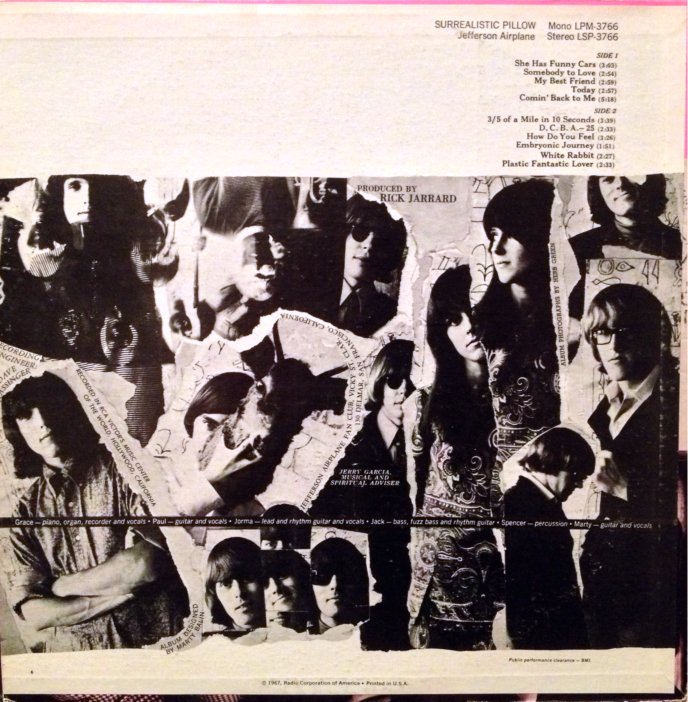
I have a long history with this album, although not with this particular copy. I first encountered it via my stepmother's record collection. I left that copy behind when I moved out and bought my own one soon after. I first heard the Airplane on the first rock record I ever bought, the compilation "Get It Together." It had the two hits off this album, "White Rabbit" and "Somebody to Love" both of which blew my adolescent mind. I was about 14 when I heard this album and it instantly became one of my favorites. I knew very little about the San Francisco Sound but I assumed this zonked out folk-rock must be what it was like. Of course then I heard "Crown of Creation" and "After Bathing at Baxter's" not to mention the Grateful Dead and Quicksilver Messenger Service and realized this album was just the tip of the psychedelic iceberg. It definitely seems a lot less exotic to me now than it did in my teens. I still love it though. It may be tame from a psychedelic standpoint, but for a folk-rock junkie like myself, it is among the very finest expressions of that genre. The band introduces their dynamic fusion of folk-rock and psychedelia with the opening song, Jorma Kaukonen and Marty Balin's "She Has Funny Cars." The song's construction, the vocal interplay between Grace Slick and Balin and the jangly guitar come straight out of folk-rock, but the hypnotic bass line from Jack Casady, Spencer Dryden's tribal style drumming and Kaukonen's guitar solo are pure acid rock. The trippy lyrics seem to be about seizing the day and trying to relate to other people. Slick brought Darby Slick's "Somebody to Love" to the Airplane from the Great Society who cut a version that was in a raga rock vein. The Airplane increased the tempo and added slashing guitar chords giving it some hard rock power. I've always loved the chemistry between Kaukonen and Casady on the song and Kaukonen's closing guitar solo is one of my favorites. "My Best Friend" came from the band's original drummer Skip Spence who left to form Moby Grape. It is a folky song with an idyllic feeling to it that reminds me of the Lovin' Spoonful. The record slows down with the romantic ballad "Today" by Balin and Paul Kantner. Balin sings the song with a lot of feeling and it is one of the most beautiful songs the band ever did. The song is laden in reverb and gradually builds in strength as it goes along and Slick joins the vocal. Jerry Garcia reportedly played the lead guitar riff. The record gets even quieter with Balin's moody "Comin' Back to Me" which he sings solo supported by acoustic guitars and Slick on recorder. It is a poetic and yearning statement about lost love that shows Balin's strength and sensitivity as a vocalist. Side two opens with Balin's raucous "3/5 of a Mile in 10 Seconds". The song is a hippie diatribe in which Marty complains about the price of marijuana and people putting down his hair. This hard driving song is one of the best rockers on the album and has a terrific solo from Kaukonen. Kantner's "D.C.B.A-25" is one of my favorite songs on this album. I used to play it over and over again as a teenager. The dual vocal between Kantner and Slick is very compelling. The song's evocative trippy lyrics foreshadow Kantner's work on "After Bathing at Baxter's" and Casady's melodic bass lines show why he was the best bassist in rock not named McCartney. "How Do You Feel" was written by Tom Mastin and like "My Best Friend" it doesn't sound much like a typical Airplane song. It is a poppy folk-rock love song most notable for the beauty of the joint vocal which resembles the Mamas and the Papas. "Embryonic Journey" is an energetic acoustic guitar instrumental by Kaukonen. "White Rabbit" is Grace Slick's psychedelic ode to "Alice in Wonderland" and it is another import from the Great Society repertoire. In its earlier incarnation it was an uptempo raga-rock adventure. This version is slower and far more dramatic as Dryden's martial drumming inexorably drives the song to its roaring climax. I've heard it a gazillion times and it still sends me. The album concludes with Balin's fabulous "Plastic Fantastic Lover" which I think is one of the best things he ever wrote. The cascade of imaginative lyrics describing the artificial female of the title shows Marty at the height of his creative ability. A relentlessly rocking song with a powerful beat, an irresistible bass riff and lots of howling psychedelic guitar work, it ends the album with a bang. The song clearly signals the Airplane's future musical direction. This classic album demonstrates why the Airplane was the best band to come out of San Francisco - great musicianship, great vocalists and great songwriting, none of their rivals could match their firepower. I would argue that not only were they the best band ever to come out of San Francisco, but during the years that they made "Surrealistic Pillow," "After Bathing at Baxter's," "Crown of Creation" and "Volunteers" they were the best band in America, period. This classic album belongs in every rock fan's collection. Recommended to anyone looking to feed their head.
After Bathing At Baxter's
Jefferson Airplane
RCA LSO-1511
1967
The third Jefferson Airplane album. I bought this while I was in high school. The only other Airplane album I owned was the "Flight Log" comp although I had access to my step-mom's copy of "Surrealistic Pillow." Neither of these really prepared me for the cornucopia of psychedelic delights that awaited me on this album. It quickly became and remains my favorite Airplane album although not too many people share my opinion about it. It is a landmark album for the group in many respects. It marks a break from commercial rock in favor of free form heavy rock and it also marks the point where Paul Kantner took control of the group from Marty Balin. Kantner wrote more than half of the album while Balin merely shares credit on a single song. My favorite song however is by Grace Slick, "rejoyce" which is her reworking of James Joyce's novel "Ulysses." The song has the same relationship to "Ulysses" that "White Rabbit" does to "Alice In Wonderland." Slick takes the characters and events of the book and gives them her own spin. I suppose you could argue that the song is pretentious and even a cynical attempt to replicate the success of "White Rabbit" and you might be right, but I still think it is a great song. The emphasis on rebellion, sexual frustration, bodily functions, anti-war sentiment are all consistent with Slick's songwriting vision and the music is extraordinary - piano driven with Jack Casady's bass rumbling underneath and Slick's recorder for exotic instrumental color, this swirling hallucinogenic masterpiece is Slick's greatest musical moment. There isn't another Airplane song like it, heck there are hardly any rock songs that are like it period. It blends jazz, eastern music and rock brilliantly, a true synthesis. Another unusual and interesting element on this record is that the songs flow into one another with generally seamless segues. I believe this is one of the first rock records to be programmed this way, since it predates "We're Only In it For The Money," "The Who Sell Out," "The Notorious Byrd Brothers" and "Abbey Road." The record is divided into five suites: "Streetmasse," "The War Is Over," "Hymn To An Older Generation," "How Suite It Is" and "Schizoforest Love Suite." I don't think the songs are really connected thematically, but I like the flow of them, I think their juxtaposition gives them extra resonance just like the suite on "Abbey Road" did. The record begins with the distorted roar of electric guitars and a blast of hard rock with Kantner's "Ballad Of You and Me and Pooneil" which appears to have been written while he was tripping since it has some of the most psychedelic lyrics I've ever heard. I love it. The ensemble singing by Slick, Kantner and Balin is just breathtaking. It is followed by a brief shot of self-indulgent nonsense with the cleverly titled "A Small Package of Value Will Come to You, Shortly" which is a jazzy and sporadically amusing instrumental. The Kantner/Balin collaboration "Young Girl Sunday Blues" fuses Balin's romanticism with Kantner's psychedelicism with great success. It boasts another set of evocative lyrics with a tune that feels like a sunny day in the park. "Martha" is a quiet song with more trippy, but lovely lyrics and some very melodic bass playing from Casady. It segues directly into the electric roar of "Wild Tyme (H)." It is a thunderous song with some great guitar playing from Jorma Kaukonen over exuberant lyrics celebrating freedom and change, it is one of the best expressions of the philosophy behind the Summer of Love that I've ever heard. Kaukonen's "The Last Wall of the Castle" sounds like it should be about revolution, but it is actually about a romantic relationship. It is a very propulsive song with a lot of dynamic guitar work, Kaukonen's guitar howls like a cat in heat. This frenzy resolves into the hypnotic allure of "rejoyce" to end the best side of vinyl in the Airplane canon. Side two opens with "Watch Her Ride" which is another trippy love song from Kantner. It is one of the more conventional songs on the record and has a nice sunny feel to it. "Spare Chaynge" comes next and how you feel about this song will probably determine a lot about how you feel about this album. It is a 9 minute instrumental jam between Casady, Kaukonen and Spencer Dryden and if you hate jams, well it may seem like "Revolution No. 9" to you. I'm a huge Jack Casady fan, I think he's a genius and I love everything he plays. For me this jam is wonderful, I just eat it up. Casady's playing is truly inspired, Jorma can barely keep up with him. Slick's "Two Heads" comes next and it is classic Gracie. Hallucinogenic and sardonic at the same time, it is full of wonderful imagery and biting lines, along with a killer riff. The album ends with the magnificent "Won't You Try/Saturday Afternoon." The Airplane was justly celebrated for the incredible power of its vocalists and I would argue that this is the greatest example of their ability. The triple vocal is outstanding, it soars and delivers a message of psychedelic bliss with extraordinary force and beauty. It is a brilliant climax to a truly great album. Lyrically and musically, this is the quintessential psychedelic record, rivaled only by the 13th Floor Elevators' "Easter Everywhere." I consider it one of the great albums in the history of American popular music. Recommended for people who want to experience the Summer of Love, "yellow clouds rising in the noon, acid, incense and balloons." Won't you try?