Sunflower
The Beach Boys
Brother Records/Reprise Records RS-6382
1970
Over the summer I went with my family to the Ventura County Fair. The price of admission to the fair included admission to the show in the evening which is how I found myself watching a concert by Mike Love and his Beach Boys imposters. There is no way I'd ever pay money to watch Mike Love perform and I wasn't even sure I wanted to see him for free, but my wife and son insisted on staying for his performance so I went and to my surprise I enjoyed it. If nothing else Love knows how to please a crowd and unleashed a slew of popular Beach Boys classics plus well-chosen covers like "Surf City" and "California Dreamin.'" Love's nasal whine was in fine form and he showed impressive enthusiasm. He had a solid back-up band which featured some good singers to take the place of Carl and Brian Wilson. He definitely needed them because his two "Beach Boys" were basically window dressing. Bruce Johnston can't sing anymore, his performance on "Please Let Me Wonder" was appalling and David Marks is, well, David Marks. There were a few departures from the stream of hits such as Love's self-serving tribute to George Harrison, "Pisces Brothers." The most notable one came from special guest John Stamos. Stamos sat in for several numbers and had more charisma and a greater passion for the music than any of the hired guns on stage. As a tribute to Dennis Wilson, Stamos delivered a heartfelt and moving performance of "Forever" off this album, easily the highlight of the show for me (Stamos previously recorded the song with the Beach Boys on "Summer in Paradise.") "Sunflower" is my favorite of the Beach Boys' post-Capitol albums. It was a flop when it came out, but I think it has aged well, in large part because of Dennis' strong contribution. He opens the album with "Slip On Through" which is a love song. Dennis sounded more like a rock singer than anyone in the band, his voice was gritty but still capable of delicacy. The song is propulsive and bolstered by excellent back-up singing. Brian delivers another strong song with "This Whole World" which is sweetly sung by Carl. It is extremely poppy in the familiar Beach Boys' style but the vaguely hippie-ish love-is-everywhere lyrics are more characteristic of the Beach Boys in the late 1960s. "Add Some Music to Your Day" is by Brian, Joe Knott and Mike Love. The song is about the value of music in everyday life and its uplifting properties. This extremely catchy and buoyant tune demonstrates this with brilliantly arranged and exhilarating vocal harmonies. It is a classic Beach Boys song and its failure to become a hit single is more a reflection of the crappy state of pop music in 1970 than the quality of the song. Dennis returns with "Got to Know the Woman" which has a harder rock edge than a typical Beach Boys song and a soulful flavor as well. The song describes meeting a woman and immediately falling for her. "Deirdre" is by Bruce Johnston with some help from Brian. Like most of Johnston's songs it is kind of sappy and his wimpy vocal doesn't help much, but the song has some nice vocal harmonies that make it listenable and even enjoyable in the chorus section. Side one concludes with "It's About Time" by Dennis, Al Jardine and Bob Burchman. The song is about someone who has been creatively frustrated but who then discovers his artistic voice and seeks to make the world a better place with his work. I always assumed it was an autobiographical song for Dennis, but then I read that the lyrics were Burchman's. Nonetheless the song seems to have had a lot of resonance for Dennis and he set it to music with a rocked up tune that is bursting with energy befitting the ebullient lyrics. The song features an excellent vocal from Carl that expresses the passionate nature of the song. Side two gets off to a rocky start with Johnston's "Tears in the Morning" in which he whines about his wife leaving him to find fulfillment in Europe. Hard to blame her listening to the stream of self-pity running through this dreary song. It is easily the worst song on the album. Things improve with Love and Brian's "All I Wanna Do" which is a bland love song crooned by Love. The song benefits greatly from a strong vocal and instrumental arrangement reminiscent of "Pet Sounds" that makes it seem more distinguished than it really is. Dennis' "Forever" which he wrote with Greg Jacobson is another album highlight for me. It is a gorgeous love song sung by Dennis and the slight roughness in his vocal keeps it from being sappy or phony. It feels completely sincere and I find it one of the most touching songs that the Beach Boys ever did. It has a memorable melody and more excellent background vocals to help make it a real winner. Brian, Carl and Jardine's "Our Sweet Love" continues in a similar vein. It is another tender love song boasting a typically gorgeous vocal from Carl. It uses strings and lovely background vocals to create a fabulous romantic sound that really sends me. It is followed by Jardine and Brian's "At My Window." The song is about seeing a sparrow outside a window and features a verse spoken in French for reasons that escape me. Although the theme of the song is typical of the interest in nature expressed in many of the band's songs of that period, it still feels like filler to me, albeit beautifully arranged and sung filler. The album concludes with the weirdness of Brian and Love's "Cool, Cool Water." The song sounds like a "Smile" outtake and that is almost what it is. It was derived from "Love to Say Dada" from the "Elements" section of that album. The original version was largely an instrumental aside from the repeated words "water" and "wah-wah." "Cool, Cool Water" retains most of that song's melody and expands the chant to become "have some cool, cool water." There is also a trippy instrumental passage in the center that is followed by some new inane lyrics that sound like the work of Mike Love to me, such as "cool water is such a gas." I still really like the song though. The vocal arrangement is wonderful and the melody is soothing and it gives the album a mellow finish. This record seems almost miraculous to me. With Brian withdrawing into his own little world and only a minimal contribution from Mike Love, Dennis Wilson stepped up and filled the void magnificently. His four songs are all terrific and are the backbone of a record that is only two mediocre Bruce Johnston songs away from being an absolute masterpiece. I love this record and it is one of the Beach Boys albums that I play the most. I like its maturity and the emphasis on love that permeates the record. It sounds fabulous and is full of interesting touches that keep me from ever getting bored with it. It was one of the best albums of 1970 and the last truly great album the Beach Boys ever made. Recommended to people who like "Surf's Up" better than "Surfin' U.S.A."
Smile [The Smile Sessions]
The Beach Boys
Capitol T 2580 [Capitol T-27658]
1967 [2011]
For many years my most treasured CD has been a bootleg reconstruction of the lost 1967 Beach Boys album, "Smile." Like many Beach Boys fans, I've been fascinated by this album ever since I first learned of its existence. I'm not going to go into the background of this album because it is way too complex and mysterious for my humble blog (there is an excellent book about it by Domenic Priore if you are interested.) Nonetheless I think it is the most crucial event in the Beach Boys' long, turbulent history and I've longed for it to come out on a legitimate release on vinyl. Of course much of it was on the Beach Boys" "Good Vibrations" CD box set and various tracks were reworked for some of the Beach Boys albums that followed its non-release (most notably on "Smiley Smile") but that is not the same as a unified album. Then Brian Wilson decided to release his own version of "Smile" re-recorded by his new band and as much as I enjoyed that album, it also made me unhappy because I figured that now he would never sanction a release of the original recording. But then to my amazement and joy, this album was announced and I happily bought it the day it was released. I knock Capitol Records often, but this one they got right. It is in mono just as Brian intended and even has the original catalog number assigned to it back in 1967 as well as a 1960s rainbow inner label. The album itself is gorgeous. Frank Holmes original artwork was retained for the cover and the booklet inside the gatefold cover. It has a facsimile of the original back cover intended for the 1967 release and a back cover that shows the true running order of the album with the additional tracks added to the album for its modern release. There is some question of what the original track sequence for "Smile" was supposed to be, but there is universal agreement that "Our Prayer" is the proper opening track. It is a gorgeous a cappella song with wordless vocalizing from the group that segues into an excerpt of the old doo-wop song "Gee." It is followed by the masterful "Heroes and Villains" which shows Wilson at the height of his creative powers. He takes his catchy riff through numerous permutations in a tour de force of arranging and marries it to brilliant lyrics from Van Dyke Parks evoking the myths of the old west. It is among the greatest of all Beach Boys songs. It leads into the oddly titled "Do You Like Worms (Roll Plymouth Rock)" which features more impressive arranging from Wilson including a reprise of the riff of "Heroes and Villains" along with Hawaiian themes and enigmatic lyrics that refer to Native Americans. "I'm In Great Shape" is barely even a fragment of a song lasting less than 30 seconds as it describes farm life. "Barnyard" expands on the farm theme complete with animal sound effects. "My Only Sunshine (The Old Master Painter/You Are My Sunshine" offers slow string driven fragments of the two old pop songs mentioned in the title.) "Cabin Essence" features amazing lyrics from Parks describing growing wheat on the Great Plains and building the transcontinental railway. This was apparently one of the songs that the other band members objected to as being too obscure to understand but it seems pretty clear to me. Musically it is very strong, alternating between bucolic countryish segments and a harder section driving the line "Who ran the iron horse." This ends side one and the first movement which depicts American history and life on the American heartland. Side two opens with the chamber pop song "Wonderful" which is beautifully sung by Brian. In a delicate and poetic manner it describes a girl losing her virginity and growing up. "Look (Song For Children)" consists solely of the word "child" (with an occasional "the" added) paired with a bouncy tune with carnival elements to it. "Child is Father of the Man" expands on this adding the phrase "father of the man" to the "child" chant. These two songs go on for over 4 minutes combined but are never boring thanks to Brian's arranging skills. The side concludes with the magnificent "Surf's Up." I first heard the song on the Beach Boy's 1971 album of the same name which I picked up as a teenager. It blew me away and was the genesis of my interest in the lost album it was intended for and gave me a life long respect for Brian Wilson's musical genius. This is another one of the songs that the other band members ridiculed for being incomprehensible. I beg to differ. In stunningly poetic language Parks describes upper class emptiness and a night out at the theater which ends with the song's unhappy hero finding redemption in the magic of a child's song which reprises the musical theme from "Child is Father of the Man." The song is blessed with more arranging wizardry from Brian as well as a moving, heartfelt vocal from him (joined by Al Jardine for the concluding polyphonic finale.) I consider the song a pinnacle in pop music art, a triumph in every aspect of songwriting. Brian would never write a better song than this. It ends the second movement which deals with childhood. The third movement on side three explores the theme of the elements of the planet: wind, water, fire and earth. It opens with "I Wanna Be Around/Workshop" which links a jazzy instrumental version of the Johnny Mercer song with the sounds of tools in a workshop. It is followed by the childlike "Vega-Tables." I have to admit that the first time I heard the song (on "Smiley Smile") I disliked it, but now I find it completely charming. The song may seem silly but there is some clever wordplay from Parks and it is lavishly arranged by Brian with complex vocal harmonies supporting Jardine's lead vocal as well as Sir Paul McCartney loudly chomping celery in the background. "Holidays" is a simple bouncy instrumental that also has a childlike flavor to it. It leads into the gorgeous melody of "Wind Chimes" which is beautifully sung by Carl Wilson. The first part of the song is played on a marimba or vibraphone type instrument which replicates the sound of a wind chime and then there is a more elaborate instrumental passage with multi-part vocal harmonies and a full band. "The Elements: Fire (Mrs. O'Leary's Cow)" is often cited as evidence of Brian's mental deterioration since he apparently came to believe that performing the song led to actual fires breaking out in Los Angeles. The song does sound kind of sinister, probably the creepiest thing Wilson has ever written. It is a swirling instrumental driven by a propulsive siren-like musical pattern. The session excerpts from this song (not included on the record) are quite astonishing and well worth seeking out. "Love To Say Dada" is a return to a childlike tune with the repeated refrain of "water" and "wah wah" delivered over an exotica style melody. There is a brief reprise of "Our Prayer" and then the side concludes with the band's immortal "Good Vibrations" arguably the greatest single of all time. The album version is basically the same as the single until towards the end of the song where a tropical vocal passage (sounds like they are singing "hum de dum") is inserted and there is a different, prolonged outro as well. This is the end of the reconstructed "Smile" album. Side 4 features assorted bonus tracks beginning with "You're Welcome" which was recorded during the "Smile" sessions and originally appeared as the b-side of the "Heroes and Villains" single. Many "Smile" fans feel like this was meant to bookend "Our Prayer" on the album, presumably slotting near the end as it does on some "Smile" bootlegs. It resembles "Our Prayer" vocally and is largely percussion driven. It is followed by stereo mixes for "Vega-Tables" and "Wind Chimes" which sound terrific. There is a five minute plus track of session highlights and a stereo backing track for "Cabin Essence." It is interesting to hear the way the song was put together and to get a clearer idea of all that is going on beneath the vocal. The side concludes with a brief session excerpt and a beautiful stereo mix for "Surf's Up." I'm happy to hear it again, I never get tired of it but I would have preferred to have Brian's demo version which I really love and don't have on vinyl. I'm thrilled that this album has finally come out, but I'm not pleased with the sequencing. The potential track
order of "Smile" is something fans like to speculate about, Brian Wilson
has maintained that there wasn't a definitive order when he abandoned
the record. This album follows the sequencing that Wilson and Van Dyke
Parks came up with for Wilson's re-recorded version of the album which
comprises three movements. It is hard to argue with the creators' wishes, but like a lot of "Smile" fans, I think the album was originally designed for just two movements. One side for the Americana songs and one side for the elements songs. The second movement is so slight (barely 10 minutes long) it could easily be folded into the other two. The problem with the second movement is that it moves "Surf's Up" into the middle of the album, whereas it ought to be the concluding song, it sums up all the themes of the record and its majestic melody makes it an ideal concluding number. Even with the questionable sequencing, this is still a magnificent record, it amazes me that Brian chose to shelve it after all that work. Reportedly the release of "Sgt Pepper" caused him to think that "Smile" would be overshadowed by its success. I suppose that is true, "Sgt. Pepper" was more in touch with the zeitgeist of the era and would have inevitably had a bigger cultural impact, but artistically I think this album is equally strong. 1967 saw a lot of great albums released, but I think only "Sgt. Pepper" and Love's "Forever Changes" can approach this in songcraft, originality and artistic vision. It holds up amazingly well, a timeless masterpiece. Its boldness and inventiveness take my breath away and I'm so happy that it has finally come out. Recommended to people whose favorite Beach Boys' album is "Pet Sounds." That used to be mine too, but now it is this.
The Beach Boys Today!
The Beach Boys
Capitol DT 2269
1965
In my post on "Surrealistic Pillow" I loftily declared the Jefferson Airplane to be the best American band of the late 1960s which got me to wondering who was the best American band before them. As much as I love the Byrds, I'm pretty certain it was this band. This may have been the best American rock album ever at the time of its March 1965 release although Bob Dylan would challenge that a few weeks later with the release of his first rock album, "Bringing It All Back Home." It was the first great Beach Boys album and began a string of remarkable albums and singles that established Brian Wilson as a pop genius culminating with "Smile" and Wilson's subsequent mental breakdown. The album's A-side is devoted to uptempo commercial pop and the B-side features quieter, more introspective pop songs that foreshadow "Pet Sounds." It opens with a cover of Bobby Freeman's "Do You Wanna Dance?" which was a hit single for the group. Dennis Wilson delivers a strong lead vocal and the elaborate arrangement is clearly inspired by Phil Spector although the guitar break is pure surf rock. I consider this the definitive version of this much covered song. For "Good To My Baby," "Don't Hurt My Little Sister" and "When I Grow Up," Brian and Mike Love trade vocals throughout the songs. I like the dynamic contrast between Love's nasal whine and Brian's angelic choir boy voice which I think opens up the songs. All three songs are catchy and creative, clearly indicating Brian's growth as a writer. I particularly like "When I Grow Up" with its sparkling harpsichord riff and its sense of innocence and wonder. The song was a top ten single for the group. Al Jardine sings lead on "Help Me Ronda" which the band would re-record for a punchier and faster single version that is superior to this one. The song fades in and out at the end in an irritating manner. Love sings lead on "Dance, Dance, Dance" which was written by Brian and Carl Wilson. It is driven by a terrific guitar riff and although the lyrics are inane the song is so propulsive I hardly notice. The song provided yet another hit single for the band. Side two opens with "Please Let Me Wonder" which was co-written by Mike Love and Brian and again they trade vocals on the song. It was arguably the most beautiful song they'd done at this point, one of my all time favorite Beach Boys songs. The touching lyrics are expressed with a lovely melody and a yearning vocal that really sends me. "I'm So Young" is a cover of a 1950s doo-wop song but it covers some familiar Brian Wilson territory with its too young protagonists wishing they were old enough to get married. Brian arranges up a storm on the reverb laden song with gorgeous vocal harmonies behind a stunning lead vocal from Brian. Brian's "Kiss Me, Baby" features Brian and Love trading vocals again. It is another song with elaborate vocal arrangements that are like sonic cotton candy - light and sweet. Brian sings "She Knows Me Too Well" brilliantly and the contemplative lyrics are worlds beyond the surf and car songs from earlier in his career. It is one of the best songs on the album. "In the Back of My Mind" is one of the weaker songs on the album hampered by a lackluster vocal from Dennis and a forgettable melody. The album ends with a thud with the stupid "Bull Session with the 'Big Daddy'." It is not a song but rather a mercifully brief interview between the group and journalist Earl Leaf. The group argue over food and discuss their European tour with Brian giving a shout-out to some flunky from Capitol Records. Not only is it boring, but its vapidity undermines the sensitivity and beauty of the songs that preceded it, an unfortunate blemish on an otherwise near perfect album. The astonishing growth displayed by Brian Wilson on this album put him in elite territory with Dylan and Lennon and McCartney as the most important trailblazers in pop music in 1965. For most pop artists this would have been a career topping achievement but for Brian it was only the beginning. Recommended for those who value youthful romanticism over jaded cynicism.
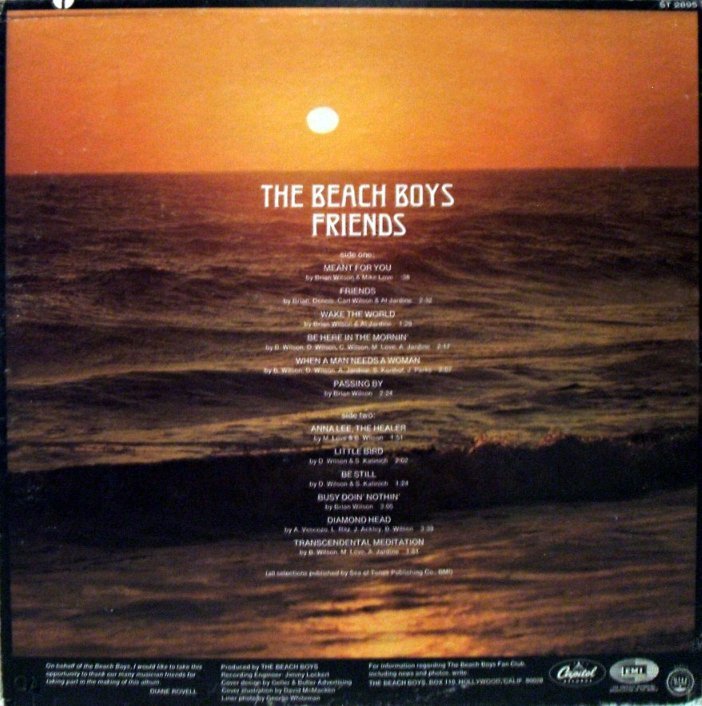
Friends
The Beach Boys
Capitol ST 2895
1968
When the Beach Boys announced that they were reuniting for a 50th anniversary tour, my initial reaction was shock followed by dismay. I love their music, but I don't love Mike Love. I've read lots of books and articles about the band and none of them have ever had anything flattering to say about Love, indeed he often comes across as a villain, Brian Wilson's merciless nemesis. I can see Al Jardine and Love burying the hatchet despite their recent animosity, they both want the money. But I can't fathom why Brian would want to share a stage with these guys, I've seen his solo shows, he definitely doesn't need them and I doubt that he cares about the money. I hope his decision stems from some sense of loyalty to his ex-bandmates and perhaps a desire to celebrate his accomplishments and that he hasn't been coerced into doing it by Love. I skipped the local shows but I heard they were pretty good. I don't care though, nothing could induce me to pay money to watch Mike Love on stage. Aside from Brian the only Beach Boy I have much affection for is Dennis Wilson and of course he definitely isn't going to be there. Dennis is very much present on this album however and happily for me Mike Love is hardly on it at all. Love was in India with the Beatles seeking enlightenment from the Maharishi. Love has some co-composer credits on several songs but only sings on two songs for a total of less than three minutes of music. This was the Beach Boys' third studio album after the "Smile" debacle (which Love deserves a lot of the blame for according to Domenic Priore's book on "Smile.") It is a modest album, extremely skimpy, but I'm fond of it. Brian was still a big contributor at this point, in fact he has a credit on every song aside from Dennis' two songs. The album begins with the 38 second long "Meant For You" which introduces the theme of love and serenity that permeates the album. It is sung by Love who then disappears for the rest of the side. It is followed by the only major song on this album, the title song "Friends." It was written by the three Wilson brothers and Al Jardine. How appropriate that Mike Love is missing from a song about the value of friendship and supporting each other through good times and bad. Carl Wilson sings a strong lead with gorgeous back-up support from the others. The basic tune is a waltz with lots of musical flourishes on top. The song has a rich instrumental sound and a complex arrangement. It could easily be mistaken for an outtake from "Smile." "Wake The World" is a simpler song but it has a charming horn line and elaborate vocal arrangements. Too bad it is such a short song although given how simple-minded the lyrics are, perhaps it is just as well. The soulful "Be Here In The Mornin'" features processed vocals which is unusual with The Beach Boys. The lyrics are again very simplistic. The jaunty "When A Man Needs A Woman" is about starting a family and has a very appealing vocal from Brian. "Anna Lee, The Healer" is a collaboration between Brian and Love and name-checks Rishikesh, the location where the Maharishi had his ashram. It is more stripped down then most of the songs on the record as it is largely driven by a solid piano riff and it is more spirited than most of the album. Dennis has the next two songs. "Little Bird" is the second best song on the album. It celebrates nature's harmony and is sensitively sung by Dennis. It is a beautiful song and quite moving. The philosophical "Be Still" is more of a drone with another fine vocal from Dennis. I'm impressed by the depth and feeling Dennis brought to his music. After this album Dennis' songs would repeatedly reveal the quiet intelligence that burned within him and I would say that after Brian he was the best songwriter in the group. The aptly titled "Busy Doin' Nothin'" is a solo contribution from Brian that describes a day in his life. It gives insight into his mindset at the time. Musically it reminds me of Antonio Carlos Jobim and it has a musical simplicity that suits it well. The album concludes with "Transcendental Meditation" essentially a commercial for the Maharishi although fortunately he is never mentioned by name. It is a silly song but I dig the horns and the lively melody. There are two instrumentals on the album as well. "Passing By" features some wordless vocalizing from Brian and sounds like a work in progress. "Diamond Head" is Hawaiian flavored and reminds me of the exotica lounge music of Martin Denny. It is an elaborate production but I don't feel like it fits in well with the rest of the album. "Friends" is basically a transitional album. My favorite Beach Boys albums are "Pet Sounds" and "Smile." I like Brian's fanciful pop confections and the big elaborate production numbers of their classic period. This album moves away from that. It points in the direction the band would follow for the next several years as they entered their hippie phase singing about being true to nature instead of your school and exploring spirituality and self-awareness with a more direct and mellow style of music. "Friends" is about personal fulfillment and being at one with the world. I
appreciate the spiritual character and tranquil feeling of the music,
but it is too relaxed for my taste. The banality of so much of
this album seems like a reaction against the brilliant wordplay
that Van Dyke Parks brought to "Smile." I don't approve of that, yet I can't resist the charm and good vibes of this record. It makes me feel good. Recommended to people who like yoga better than aerobics.