Sunday, August 7, 2022

The Goldebriars - The Goldebriars


The Goldebriars
The Goldebriars
Epic Records BN 26087
1964

I first encountered Curt Boettcher as a young teen in the liner notes on the back of my copy of "The Association's Greatest Hits!" where he was listed as one of the producers.  I was obsessed with that album for a little while so the names associated with it stuck with me.  Thus I remembered Boettcher when I encountered him in Sagittarius and the Millennium and became a fan.  This was his first foray into commercial music.  He formed the Goldebriars while in college with Sheri and Dottie Holmberg and Ron Neilson.  Given that his career was largely devoted to extravagantly arranged sunshine pop, I was a little surprised to find Boettcher leading a folk group, but once I spun the record I recognized his style instantly.  The group sings mostly folk songs with folk style accompaniment but the vocals are pure sunshine pop.  They feature elaborate harmonies with multi-tracking to give the music an astonishingly rich and vibrant sound.  This is evident on the opening track "Railroad Boy" which is a traditional song that is often known as "The Butcher's Boy."  Joan Baez recorded it on her second album which I assume is where the group picked it up.  It is one of those wronged maiden type ballads.  The Holmberg sisters' voices blend beautifully and complement Boettcher's delicate voice and the result is a lovely and haunting performance.  "He Was a Friend of Mine" is a well-known traditional song that the Byrds made famous the following year on "Turn! Turn! Turn!" when Roger McGuinn changed the lyrics to be about John F. Kennedy.  Dave Van Ronk recorded it on his "Folksinger" album in 1962 and it was in Bob Dylan's early repertoire.  It is a gloomy song but it sounds practically euphoric with the Goldebriars' enthusiastic vocal arrangement.  "Come Walk Me Out" is listed as a traditional song but it is actually Bonnie Dobson's song "Morning Dew."  That poor woman was always getting screwed out of her royalties - Tim Rose claimed a songwriting credit on it when he recorded it for "Tim Rose."  My favorite version is the Grateful Dead's intense and emotional cover of it on "The Grateful Dead."  In contrast the prettiness of the Goldebriars' version diminishes the song's gravity although I have to admit it sounds fabulous.  I could say the same about "Alabama Bound" which is credited to Leadbelly although the song predates him.  The grittiness of the song does not benefit from Boettcher's pretty vocal and the Holmbergs' captivating harmonies.  They sound condescending and out of touch with the song.  "Pretty Girls and Rolling Stones" is attributed to the Goldebriars themselves but it sounds convincingly like a folk song.  It's a girl chasing I gotta ramble type of song.  They sing it with winning enthusiasm.  "A Mumblin' Word" is an old spiritual about the crucifixion of Jesus that is also known as "He Never Said a Mumblin' Word" and "They Hung Him On a Cross."  This song was also sung by Leadbelly.  Boettcher's vocal is a little more grounded and coarse than usual but I still feel like the song's arrangement trivializes the subject even though I'm not the least bit religious myself.  This is equally true of  "Old Time Religion" which has got to be the slickest version of that old song around.  I don't actually like traditional versions of the song and I find the Goldebriars' performance invigorating and pleasantly brief (a mere 1:37 in length.)  The gospel theme continues with "Long Time Travellin'" which is equally slick but I find it more successful than the other religious songs because of its folk propulsion and more traditional harmonies.  It reminds me of the Seekers' work in this vein.  It is followed by a gorgeous version of the venerable old folk song "Shenandoah" which I consider one of the highlights of the album.  The vocals absolutely send me.  It resoundingly points towards Boettcher's future as a sunshine pop master.  "No More Auction Block" is an old anti-slavery spiritual that had previously been recorded by Odetta.  This is arguably the most ridiculous song on the record.  The contrast between the mesmerizing vocals and the harshness of the lyrics is almost comical.  "Sing Out Terry O'Day" was written by Boettcher in a folk style.  The group sings the song with great vigor and verve and again remind me of the Seekers.  From a folk standpoint it is perhaps the most credible song on the album particularly in Boettcher's urgent vocal.  The album concludes with "Voyager's Lament" which is an English language version of "Un Canadien errant" which was written by Antoine Gérin-Lajoie.  I first heard it on the debut album by Ian and Sylvia where it blew me away however the song dates back to 1842.  The song describes the unhappy exile of a French-Canadian following the Lower Canada Rebellion in 1837-1838.  The Goldebriars strip the Canada references from the song in the English section of their performance and then they sing a verse in the original French which is then crossed with "Plaisir d'amour" (uncredited) which is sung in English.  I find Boettcher's creativity in the song breathtaking and immensely pleasurable.  When I first got this album I played this track over and over savoring the vocal richness and the brilliant splicing of the two songs.  This is my favorite track and its dazzling arrangement again foreshadows Boettcher's future career.  I think that if I were a folk purist I'd probably hate this album or at least have serious problems with it.  The music is almost totally divorced from the foundations of the songs.  However I am far from being a folk purist.  I prefer folk-rock to folk and I like Curt Boettcher a lot more than I like Pete Seeger.  Boettcher basically used these folk songs as a vehicle for his own creative interests and that is fine with me.  There were lots of performers who did these songs the "right way" if I feel like hearing that (and I have to confess I seldom do.)  Hardly anyone arranged music like Boettcher did so this album is more valuable to me.  Recommended to people who think it would have been cool if Brian Wilson had produced a Seekers album.

Tuesday, May 31, 2022

Barbra Joan Streisand - Barbra Streisand


Barbra Joan Streisand
Barbra Streisand
Columbia PC 30792
1971

I am now much older than my father was when I was living with him and I'm becoming more appreciative of the influence he had on the development of my musical tastes.  As a teenager I felt disdain for his music even though he had the first the Mamas and the Papas, Janis Joplin, Santana, Linda Ronstadt and Creedence Clearwater Revival albums that I ever heard.  Mostly I associated him with easy listening type stuff like Frank Sinatra, Andy Williams, Al Martino, Vikki Carr, Johnny Mathis and above all Barbra Streisand who was his great favorite.  I loathed this stuff at the time although as I reached middle age I started to dabble with it particularly Sinatra.  Nonetheless I have a very limited appetite for it and to this day if I hear Martino crooning "Spanish Eyes" (which my father played over and over) I cringe.  I was surprised a while back when I found myself wanting to hear this album again.  My father had it on an 8-track tape (yecch) and played it often.  I did not like it much at the time but I preferred it to his other Streisand albums and I was intrigued by the two John Lennon covers, "Mother" and "Love" which I had never heard since I had yet to buy "Plastic Ono Band" where they first appeared.  Somehow this album stuck to me which led me to buy it a few years ago.  Listening to it again after all those years was definitely a little weird, but once I got past the memories and nostalgia it generated in me, I found I enjoyed it as music.  It was Streisand's third album of contemporary music following "What About Today?" and "Stoney End."  The knock on Streisand's forays into contemporary music is that she can't rock.  I won't dispute that but I still find merit in her work in this vein.  Unlike some crooners she is not condescending about the material and sings her heart out.  She is too uptight to rock convincingly but she definitely emotes a lot which I find engaging most of the time.  The album benefits from the presence of the producer Richard Perry who was one of the most successful producers of the era.  He was always excellent at providing a setting for the artist to succeed and compensating for their limitations as his exemplary work on "Ringo" demonstrates.  This album mostly features songs that suit Streisand's style and sensibility and I imagine she had no trouble relating to songwriters like Carole King and Laura Nyro.  The arrangements and supporting musicians are also well chosen for her.  My favorite tracks have always been the two Lennon songs which is probably a minority opinion even from a Beatles fan.  I admit that Lennon's own versions in particular his gut-wrenching performance of "Mother" are superior and more heartfelt but I am still taken with the depth of feeling Streisand brings to the songs.  "Love" in particular is given a spartan but appealing chamber pop arrangement that places all the focus on Streisand's gorgeous vocal.  "Mother" has a more robust arrangement driven by dual organs from Billy Preston and Perry.  I appreciate the majestic and dynamic quality of the performance and at the risk of sounding like a philistine, I'm kind of relieved not to have to experience the pain Lennon brought to the song.  My other favorite track is "I Mean To Shine" written by Donald Fagen and Walter Becker prior to the rise of Steely Dan.  They apparently had a low opinion of the song and never bothered to record it themselves, but I think it is a delightfully uplifting and inspired song which gives Streisand an opportunity to shine herself.  She's backed by Fagen on organ along with members of the female rock band Fanny and a whole bunch of studio pros who give Streisand a solid foundation for her exuberant vocal.  I also like her performance of Mathew Moore's "Space Captain" which had been part of Joe Cocker's stage show as documented on the "Mad Dogs and Englishmen" album.  Compared to Cocker's throat-shredding histrionics, Streisand sounds tame but it is still one of her most energetic performances and the closest she comes to rocking out on the album.  The song has a punchy arrangement by Fanny and they support her along with Preston and kudos to Perry for pairing his clients Fanny and Streisand.  They work together extremely well.  There are three Carole King songs (all from "Tapestry") on the album which makes sense considering King and Streisand's similar backgrounds.  Streisand sounds comfortable on all of them but I like "Where You Lead" the best.  It has plenty of propulsion courtesy of Streisand's vibrant vocal supported by another spirited arrangement and performance by Fanny.  Preston's organ riffs and the background singers give the song a winning soulful flavor that makes Streisand seem less uptight and it is the one other song on the album besides "Space Captain" that suggests Streisand is capable of rocking out.  Her upbeat performance of "Beautiful" is enjoyable but kind of forced as if she was trying too hard.  I think it would have benefited from the looseness that King brought to her own version of the song and that is also true of "You've Got a Friend" although I greatly prefer Streisand's version to James Taylor's hit version.  The remaining songs are closer in tone to the standards and show tunes that Streisand started her career with rather than actual rock songs.  Laura Nyro's "I Never Meant To Hurt You" is a sensitive song that benefits from Streisand's over-emotional style and gives her plenty of opportunities to show off her pipes.  I think it is the song that fits her best, but it is far from my favorite.  There is a medley of Burt Bacharach and Hal David's "One Less Bell To Answer" and "A House Is Not a Home" which is also right in her wheelhouse although I prefer the far more subdued versions by The 5th Dimension for the former and Dionne Warwick for the latter.  Streisand invests so much emotion in them she makes their lyrics seem trivial since they can't match her intensity.  They do sound nice though.  Buddy Johnson's "Since I Fell For You" is an old-fashioned romantic ballad that was a hit for Lenny Welch in 1963.  It is basically the sort of the song Streisand could do in her sleep and she easily crushes Welch in emoting and vocal acrobatics but the song hardly fits the contemporary feel of the rest of the album.  This is equally true of "The Summer Knows" from the film "Summer of '42" by Michel Legrand and Marilyn and Alan Bergman.  It may have been a contemporary song but it is a lot closer to "People" or "My Man" than it is to any kind of rock music particularly with Dick Hazard's easy listening arrangement.  Of course it sounds gorgeous but I am not a fan of it.  I am a fan of this album though.  Part of me feels like it is a mistake, that Streisand should stick to the standards and show tunes she excelled at.  On the other hand I relate much more strongly to John Lennon and Carole King than Rodgers and Hammerstein or Kander and Ebb.  I would rather hear her sing contemporary music even if it is not her strength.  It gives me more of an opportunity to appreciate her tremendous gift.  Sure she is too stiff and over-emotes too much, but this album fascinates me.  The dialectical tension between the styles of traditional pop standards and contemporary rock music that drives this record is intriguing and stimulating to me.  This record has been in my life for decades even though for much of that time I did not have a copy of it.  I never forgot it and it was nearly as firmly imprinted in my psyche as my early Beatles albums.  I'm delighted that I finally do have a copy again and although I don't play it as much as my father did, it does spend plenty of time on my turntable.  Recommended to Timi Yuro fans.

Sunday, April 17, 2022

A Giant Crab Comes Forth - Giant Crab


A Giant Crab Comes Forth
Giant Crab
UNI 73037
1968

When I was in college I thought I knew everything I needed to know about 1960s rock after I read a bunch of rock encyclopedias and histories of the era.  How many good records could have come out in the decade?  I figured I could get them all.  I was wrong.  40 years later and I am still working on it.  By the time I was in my thirties I assumed I had all the essential classics but then the internet came along and I found out there were a lot more worthwhile records out there that I had never heard of.  The Santa Barbara based band Giant Crab was not in any of the books I read as a youth.  I first heard them on a specialty program on my favorite college radio station KXLU.  I loved the song I heard and checked out the band on the internet.  Eventually I was able to find their two albums.  This is their excellent debut album.  It begins with a spoken intro by Johnny Fairchild who was a Santa Barbara disc jockey who helped the band get on the radio.  It simulates a dramatic news flash although its impact is diminished by an attempt to work all the song titles from the album into the intro which makes it sound contrived.  Most of the album was written by the band's talented leader Ernie Orosco with occasional help from his band mate and brother Ruben (or maybe his other brother Raymond - it is not clear on the song credits) as well as the album's producer Bill Holmes.  Most of the songs are catchy sunshine pop like "It Started with a Little Kiss," "Groovy Towne," "Thru the Fields," "Believe It or Not" and "The Answer is No."  These songs feature charming vocal harmonies and elaborate arrangements often bolstered by punchy horn support from band members Dennis and Kenny Fricia.  "Directions," "Intensify Your Soul" and "The Chance You Take" are harder in sound with a soulful flavor and heavier instrumentation.  They remind me of the Rascals.  "Watch Your Step" is pop-psych with hypnotic keyboard riffs driving it.  "Hot Line Conversation" is also pop-psych and the heaviest song on the album.  Its lumbering riff and organ washes make me think of early Iron Butterfly.  The album closer is a slow and majestic ballad called "Why Am I So Proud?" that gives the record an emotional finish.  There are also four covers on the album.  "Enjoy It" was written by Scott English and Claus Ogerman and it plays to the bands' sunshine pop strengths.  English also wrote "Hi Ho Silver Lining" with Larry Weiss and it was a British hit for Jeff Beck and I think it should have been one here as well.  The cover version doesn't stray too far from the Beck version.  The Beck version is more energetic and I miss his guitar solo but since singing was hardly Beck's strength, I welcome Ernie Orosco taking a crack at the song.  Both versions are worthwhile.  "I Enjoy Being the Boy" was written by Marc Bellack and bubblegum stalwart Joey Levine.  It is less inane than a lot of Levine's stuff and features a lovely arrangement that makes it seem less lightweight than the lyrics would suggest.  My favorite of the covers and my favorite track overall is "Lydia Purple" by Don Dunn and Tony McCashen.  It appeared on the debut album by the Collectors earlier in the year.  Giant Crab's version is heavier and more propulsive which I appreciate but I think the song's moodiness and portrayal of alienation was better served by the Collectors' chamber pop arrangement.  I still love the Giant Crab version though.  This is such a good album that I'm surprised it is not better known.  It deserved a better fate.  I was already middle-aged when I finally got a copy which I regret.  I would have eaten this up back when I was a teenager worshipping the Turtles and the Hollies.  Even in my dotage it still is immensely appealing to me.  It is records like this that humble me and keep me from getting too cocky about my knowledge of rock history.  If you dig pop-psych or sunshine pop this album is essential.  I've played it a bunch of times in recent years and it still makes me happy whenever I give it a spin.  Recommended to fans of the Strawberry Alarm Clock.

Sunday, February 13, 2022

Peter and Sophia - Peter Sellers and Sophia Loren


Peter and Sophia
Peter Sellers and Sophia Loren
Parlophone  PMC 1131
1960

I first heard the song "Goodness Gracious Me!" when some joker on KXLU played it.  Even though the song is racist and inane, it stuck in my head and led me to purchase this record although I was certain it would be awful.  I was largely correct about that but I have no regrets.  Sophia Loren was my first movie star crush as a child and I'm still fond of her.  I also was a big fan of Peter Sellers as a child, but that has not lasted.  I find him tedious and annoying now.  The record was produced by the great George Martin probably one of the least distinguished albums in his discography.  He had a long association with Sellers producing his comedy records in the 1950s.  The album is a mix of music and comedy bits.  I like Loren's two solo numbers which are the beguiling and silly "Zoo Be Zoo Be Zoo" and Rodgers and Hart's "To Keep My Love Alive" which chronicles the various ways that a woman murders her many husbands.  Loren is not a strong singer but her voice is pleasant and warm.  I find her engaging.  I think her best performance comes in Leslie Bricusse's "I Fell in Love with an Englishman" in which she breathily croons and then speaks of her love for the title character who is voiced by Sellers as an upper class twit in one of his typically exaggerated caricatures.  There are three more duets with Sellers and Loren which I find simultaneously appealing and annoying.  The best is easily "Goodness Gracious Me!" which describes an Indian doctor fending off an amorous patient's advances.  George Martin commissioned the song for inclusion in the film "The Millionairess" which has a similar plot.  It was rejected but a photograph from the film was still used for the cover of this album.  Sellers' caricature of an Indian is blatantly racist and unfunny but Loren's ardent wooing of him is genuinely sexy.  The song is mercilessly catchy and whenever I hear it, it sticks in my head for awhile.  It was a hit in England and inspired a follow-up "Bangers and Mash" in which Sellers portrays a Cockney who marries an Italian woman during World War II and finds himself missing English food because his wife only serves him Italian food.  It is as stupid as it sounds.  Sellers can't resist showing off, adopting an American accent for the middle section and then an Italian accent for the final verse.  I can barely stand his clowning but Loren is charming.  The final duet is the swinging "Fare Thee Well" which Sellers starts singing in his normal voice which is too weak for the demands of the song.  Of course Sellers being Sellers that does not last long as he quickly breaks into his bag of accents to muck up the song.  Loren struggles with the song as well which is beyond her skills but unlike Sellers she gamely sticks with it to the end.  Sellers has three musical numbers of his own.  In Gershwin's "Oh! Lady Be Good" he thankfully does not sing.  It is an up-tempo jazz number performed by Ron Goodwin and his orchestra in which Sellers uses his voice to sound like a piccolo although I think he sounds more like a clarinet or a saxophone.  If I am to believe his dumb patter at the end of the song he apparently recorded his voice at a slower speed and then they speeded up the tape for the record.  It sounds like a George Martin type thing to do.  If nothing else the song does cook and it is neither offensive nor tedious unlike most of Sellers' other tracks.  He poorly impersonates an old timey crooner for "Ukelele Lady" which dates back to 1925.  He is accompanied by the faux 1920's jazz band "The Temperance Seven" who later had a hit with "You're Driving Me Crazy."  The song is tiresome and pointless to me.  The worst of the three is "Grandpa's Grave" in which Sellers portrays a cockney singer named Eugene Squills regaling the audience with a ditty about moving grandpa's grave to the sewer.  It is moronic but still better than Sellers' comedy bits which comprise the rest of the album.  I find them all painful and unfunny.  In "'Smith'" he portrays a pompous thespian describing his latest play in mind-numbing detail.  "Setting Fire to the Policeman" finds him nostalgically recalling his favorite childhood prank of setting policemen on fire.  "Why Worry?" employs a man in the street interview approach to allow Sellers to show off a variety of English accents as he trivializes the arms race and the nuclear bomb.  The worst track is easily "Africa Today" in which Sellers portrays the savagely racist Brigadier Sir John Hanley-Adamant droning on and on about abusing his African servants.  I know he is mocking him but it is still hard to listen to.  I find it mind-boggling that anyone ever thought this was funny.  If Sophia Loren were not on this record, I would have discarded it long ago.  Her charisma and allure are enough to get me to endure Sellers' contributions.  I could just record her bits and listen to them without Sellers, but I have to admit that terrible though they may, I do find Sellers' tracks fascinating in their awfulness.  I can't recommend this record, but if you like Sophia Loren as much as I do you might want to seek it out.

Saturday, January 29, 2022

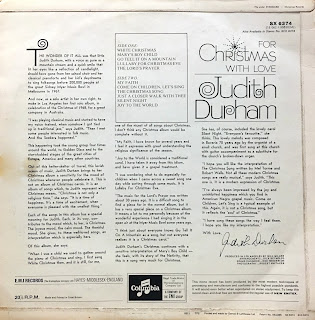
For Christmas With Love - Judith Durham


For Christmas With Love
Judith Durham
Columbia SX 6374
1968

This is a mono pressing of the British version of Judith Durham's Christmas record.  It differs from the Australian version by having one additional track "Just a Closer Walk With Thee."  Curiously the song features a 1965 copyright on the inner label which is also the date that the song appeared on The Seekers' album "A World of Our Own" but it is not that version.  I believe it is the version she released on a 1967 single in Australia.  I prefer The Seekers' version which features harmonies from the boys and a folk style arrangement to this version with its gospel organ and piano accompaniment although she sings both great.  Although this album was recorded at Capitol Records studio in Los Angeles I don't believe it was ever released here.  This was her first solo album after leaving The Seekers and being a big fan of that group I have long coveted it.  I finally found a copy last year but I was disappointed when I played it.  Arguably it is more of a gospel record than a Christmas record.  Every song is religious aside from "White Christmas," "Lullaby for Christmas Eve" and "The Christmas Song."  "The Lord's Prayer," "My Faith" and "Come On Children, Let's Sing" are not Christmas songs at all.  Her piety is obviously sincere and her singing is heartfelt, but this is not my cup of tea and it sounds nothing like The Seekers so I shelved it after a couple of spins.  I brought it back out at Christmas and played it while trimming the tree and I liked it better probably because my expectations were different.  "White Christmas" opens the album in an orchestrated easy listening style version.  Durham delivers a pleasant vocal but the track is otherwise unremarkable.  "Mary's Boy Child" was written by Jester Hairston and was released as a single by Harry Belafonte in 1956.  His version had a slight calypso flavor to it which is not present in this stiff orchestrated version.  The song lacks the warmth of the Belafonte recording even though Durham sings it impeccably.  The album finally comes to life with a jumping gospel style performance of "Go Tell It On a Mountain" driven by piano and organ.  Durham showed an interest in gospel with The Seekers but really shows her affinity for it here and I love the way she hits the high notes at the end.  This is one of my favorite tracks.  The record loses this energy with the heavily orchestrated "Lullaby for Christmas Eve" which had been a single for Jack Jones in 1964.  Nonetheless it is a sweet song and at least it isn't religious.  Durham's soaring vocal on "The Lord's Prayer" impresses me but I dislike the song and the heavy inspirational arrangement.  "My Faith" is even worse.  Durham sings it like she means it, but the song is just too sappy for me to tolerate.  The record picks up with the lively gospel song "Come On Children, Let's Sing" which was recorded by Mahalia Jackson in 1960.  I love Durham's voice and she sings it well but she can't compete with Jackson.  She sounds stilted by comparison.  I wish there were more songs like "The Christmas Song" on the record.  She seems more inspired by the religious stuff, but she still sings this well and it is a much more appealing song to me.  "Just a Closer Walk with Thee" fits well with the rest of the album both in terms of sound and content even though it was recorded earlier.  As I said before I prefer The Seekers' version but this is still pretty compelling.  Most of the arrangements on this album are stodgy and conservative, so it is surprising that "Silent Night" is given an up-tempo treatment including drums, probably the most dynamic version of the song that I have ever heard.  I'm not sure that the song is well-served by such treatment but I like it anyway especially with Durham's exquisite vocal.   The album concludes strongly with a kinetic gospel arrangement of "Joy to the World" that inspires Durham to loosen up and have some fun.  It is my other favorite track on the album.  Although there are parts of this album that I enjoy, I have to admit there is no way I would keep it if Durham was not singing on it.  I like her voice so much I would listen to her sing just about anything even a bunch of hymns, but I'm not going to listen to it very much.  I'm alienated by religion and I prefer folk arrangements to easy listening ones so I'll just stick with my Seekers albums.  Recommended to religious Judy Collins fans who dislike folk music.

Friday, November 26, 2021

Bad Rice - Ron Nagle


Bad Rice
Ron Nagle
Warner Bros. WS 1902
1970

My obsession with the San Francisco Sound led me to Ron Nagle's mid-1960s group the Mystery Trend.  For many years they were a mystery to me, a trippy name I encountered on old concert posters or histories of the San Francisco rock scene.  Eventually I heard their excellent 1967 single "Johnny Was a Good Boy" which whetted my appetite to hear more.  Finally I got the Big Beat CD compilation of their unreleased recordings and was enormously impressed.  Their music was of astonishingly high quality and deserved an actual album back when they were still active.  Unfortunately they were totally out of touch with the hippie zeitgeist of that era with their commitment to well-crafted songs and chamber pop along with their total disdain for the psychedelic scene.  I figured I had satisfied my curiosity about the Mystery Trend but then several years ago I came across this album while flipping through a record bin.  I had no idea what it was, I was just struck by how weird and ugly it was.  As I examined it I remembered who Nagle was and eagerly bought it.  It sounds nothing like the Mystery Trend but I was not disappointed I bought it.  The album gets off to an exciting start with "61 Clay" which is a Chuck Berry style rocker that reminds me that Nagle was an rhythm and blues/rock and roll fanatic when he first got into music.  There is a smoking guitar solo from Ry Cooder that kicks out the jams and puts the song over the top.  The lyrics are pure teen rebellion with a little matricide thrown in.  It is easily my favorite track on the album.  The record's momentum continues with the rollicking boogie "Marijuana Hell" which Nagle co-wrote with John Blakeley.  The song outlines the evils of marijuana with all the fervor of "Reefer Madness."  I assume it is a joke although Nagle's drug of choice was alcohol and he never hid his contempt for hippie culture so who knows.  The album abruptly shifts direction with the melancholy "Frank's Store" which is driven by Nagle on piano and a poignant string arrangement by the album's producer Jack Nitzsche.  Nagle's vocal is full of emotion and puts across the sadness in the lyrics very effectively.  The album returns to boogie with "Party in L.A." although this is not an ode to partying down with some Angelenos.  The party of the title is the Communist Party (or some like-minded variant) and the song describes a child custody dispute between a leftist activist mom and a centrist father.  Just your typical pop song.  Side one concludes with "That's What Friends Are For" which returns to singer-songwriter melancholy.  Nagle croons the lyrics about the nature of a relationship while accompanying himself on piano.  Side two starts with "Dolores" which is lushly orchestrated by Nitzsche.  It sounds like something by Nagle's idol Burt Bacharach until I listen to the lyrics which I interpret as an older woman teaching a boy the ways of love.  "Capricorn Queen" is a  raucous rocker about Nagle's addiction to alcohol.   It features a frenetic rockabilly style vocal from Nagle and is another one of my favorite tracks.  "Sister Cora" is a wonderful riff-driven banger about the title character's ability to cure folks' ills and solve their problems.  The album settles down with "Somethin's Gotta Give Now" which has a country feel to it and displays some of the pop craftsmanship Nagle exhibited with the Mystery Trend.  The country sound continues with the lumbering "Family Style" which features mildly vulgar and humorous lyrics about a disorderly family.  The record concludes with "House of Mandia" which manages to combine the two musical directions on the album.  The verses are powered by a heavy riff over which Nagle bellows about a working class man's misery while the choruses are silky smooth pop with Nagle crooning a description of a tropical paradise supported by Nitzsche's sugary string arrangement.  Normally I would have a problem with such a schizophrenic record.  The abrupt shifts between rock and singer/songwriter pop are definitely jarring to me, but the consistency of tone and overall intelligence of the record smooth it over somewhat.  I definitely prefer the rock side though.  Nagle's career was primarily teaching art and creating ceramic art with a lot more success than he had as a musician.  However he was no dilettante, he had genuine chops and great integrity as a musical artist and certainly deserved a better fate.  He is often compared to Randy Newman because they both value musical craftsmanship and display a dark sense of humor.  Nagle is far less cynical than Newman though and he likes rock a lot more than him as well.  He is also a better singer.  This album is well worth seeking out.  You rarely find such a stimulating combination of intelligence and sincere love of rock and roll.  Recommended to people who think it would be cool if Randy Newman jammed with Creedence Clearwater Revival.

Sunday, November 14, 2021

How Do You Do? - Mouth and MacNeal


How Do You Do?
Mouth and MacNeal
Philips PHS 700-000
1971

As I get older my memories of my youth are getting fuzzier which I am not happy about although there is plenty of stuff from back then I wish I could forget.  For some reason I still remember 1972 quite well.  That was the year that I consider my first year as a fan of pop music.  I have liked music as long as I can remember but that was the year it became important to me.  It began that summer when my family rented a vacation cabin at Lake Tahoe that had no television.  It did have a radio that was tuned to a top 40 station all day long.  In retrospect the summer of 1972 was not a particularly good year for music, but back then I loved what I heard.  I remember singing along to Sammy Davis Jr.'s "Candy Man,"  Gallery's "Nice to Be with You," Elton John's "Rocket Man," Gilbert O'Sullivan's "Alone Again (Naturally)," Bill Withers' "Lean On Me," and my two favorites "Brandy" by Looking Glass and "How Do You Do?" by this band.  When we came back home I convinced my mom to give me an old clock radio she was not using much and with access to my own radio I was hooked.  My tastes rapidly evolved once I discovered the oldies stations (and later AOR when I got a radio with FM) and soon I did not listen much to top 40 radio at all.  The Beatles obliterated any interest I had in collecting popular music from the 1970s on vinyl although I did eventually come to like and buy Elton John and Bill Withers albums.  I also bought the Looking Glass album many years ago.  This record I bought last year online mostly out of nostalgia.  As usual with childhood memories, "How Do You Do?" is not as good as I remembered but I am not sorry about the album which is better than I expected.  This is the 1972 American release of this Dutch duo's 1971 debut album which features an identical track selection and running order but different cover art.  The duo consisted of a male singer named Willem Duyn who performed under the apt pseudonym Big Mouth shortened to Mouth here.  He has the kind of loud gravelly voice that people seemed to dig back then.  He sounds like a cross between John Fogerty and David Clayton-Thomas.  His partner was Sjoukje van't Spijker who performed under the name Maggie MacNeal.  She has a smoother, sweeter voice that acts as a refined counterpoint to Mouth's growling.  The album opens with "A.B.C" which was written by Andreas Holten and the album's producer Hans van Hemert.  The song has a spoken (or shouted in Mouth's case) intro before it gets down to its pounding riff.  The dynamic between Mouth's bellowing and MacNeal's silky crooning is displayed to impressive effect.  It gives the record a strong start that is largely dissipated by a lumbering and lethargic cover of Ivory Joe Hunter's "I Almost Lost My Mind." "I Heard It Through the Grapevine" was lifted from MacNeal's 1971 solo debut single.  It follows the familiar arrangement of the Marvin Gaye classic and MacNeal delivers a robust vocal which with her heavily accented English reminds me of Mariska Veres of Shocking Blue.  This cover is pointless but I enjoy it.  "Hey, You Love" was written by van Hemert and the album's arranger Harry van Hoof.  Much of the tune is stolen from "Rule Britannia" and is largely pedestrian although I like the interplay between MacNeal and Mouth.  "Remember (Walking in the Sand)" was taken from the debut Big Mouth single from 1971.  Somehow the song is even more melodramatic than the Shangri-Las' classic original with Mouth's histrionic yowling suggesting he's auditioning for a Joe Cocker cover band.  Side one closes with "Rosianna" which was written by the Manhattan Transfer's Gene Pistilli along with Terry Cashman and Tommy West and was featured on the Transfer's debut album.  It is a rollicking country style song that does not play to the duo's strengths but it is still engaging.  Side two opens with van Hemert's "Why Did You, Why?" which is a slow soulful song beautifully sung by MacNeal supplemented by some subdued roars from Mouth.  "How Do You Do?" was written by van Hemert and van Hoof.  When I bought this album I don't think I had heard the song for at least 40 years.  I remembered it as a boisterous rocker which it definitely is not, although I was so naïve back then maybe it really did sound rocking to me.  Once I got over my initial disappointment that it was not like I remembered, I started to like the song again.  It is charming with a touch of bubblegum and to my great surprise an appealing string arrangement.  I like the shifts in tone and the contrast between the rowdy sections featuring Mouth and the softer sections with MacNeal although she cuts loose in a few places to show off her own ability to bring the noise.  The song is extremely catchy and sticks in my head all day whenever I play it just like it did when I was kid.  "Land of Milk and Honey" is another Holten/van Hemert collaboration.  It sounds very Europop with a bit of a Mediterranean flavor.  Mouth reins in his vocal and listening to him I can easily imagine someone like Tom Jones performing it.  Jones could also cover van Hemert and van Hoof's "Tell Me World" which is more bouncy Europop that reminds me of ABBA.  "It Happened Long Ago" was written by Leo Bennink and Rudy Bennett and was the b-side of the first Big Mouth single.  It has a dramatic arrangement that almost achieves the impossible task of overwhelming Mouth's emoting.  The album ends with John Lennon's "Isolation" which was the b-side of MacNeal's debut single.  It lacks the intensity of Lennon's version but MacNeal sings it with feeling and I am grateful that Mouth is not around to muck it up.  This is definitely a minor record, but I find it mostly entertaining.  Mouth and MacNeal work well together.  On his own I would find Mouth hard to listen to since he is so intense and overbearing and the material is not strong enough to contain him.  MacNeal is more my style and I think she is a good singer, but she isn't good enough to stand out with such ordinary material.  Mouth brings the energy and intensity that she lacks.  This is exemplified by "How Do You Do?" which probably would have been a hit for anyone, but is made more memorable by their chemistry.  I expect some of my fondness for this record is nostalgia and objectively I can't deny that most of the songs are mediocre, so I am hesitant to fully endorse it.  I enjoy it but I know I am not going to play it much.  Nonetheless if you like the music of this era (I have mixed feelings about it) you will likely find stuff on here that will appeal to you.  You could definitely do worse.  Recommended to Sonny and Cher fans who dig ABBA.