P.J. Proby
P.J. Proby
Liberty LRP-3421
1965
When I bought this at Amoeba Records, the woman at the counter snickered at Proby's pageboy haircut. I could hardly argue with that, although as a teen I wanted the same haircut and never could make it work. How times have changed, Proby was once a teen heartthrob famous for splitting his pants on stage and now he's the object of ridicule for young record clerks. My interest in Proby stems entirely from his covering some obscure Beatles songs, one of which is on this album. Because of his supposedly wild stage appearances and his association with the Beatles and Elvis Presley, I assumed Proby was a rocker, but in fact he's more like a lounge singer. He has a rich deep voice, he sounds a bit like an Elvis impersonator. Unless you have a thing for big romantic pop ballads, there is only one reason to own this album, Proby's version of Lennon and McCartney's "That Means A Lot." You can hear the Beatles' version on "Anthology 2" as well as numerous bootlegs and listening to their version it is easy to see why they gave it away. To his credit, Proby's version is better than the Beatles' version which sounds blasphemous but it is true. His bigger than life voice gives drama and substance to a flimsy song aided by an elaborate arrangement from George Martin, producer of the Beatles. Martin also arranged the only other good song on the record, the soulful "Let The Water Run Down" which is also the only song that might be considered a rocker on the album. Proby's passionate vocal at least gives some evidence of why he was considered an exciting performer in his day. Most of the record consists of covers and standards. He slows down Jackie Wilson's "Lonely Teardrops" for some reason yet delivers a very emotional and raw vocal that almost makes it worthwhile. He offers a decent cover of Charlie Rich's "Lonely Weekends" although I find the big band arrangement annoying. There is also a lame cover of Jay and the Americans' "She Cried" in which his vocal is even more overwrought than the original. He speeds up "Mission Bell" and makes it work but the other standards are mostly boring. "The Nearness of You," "I Will," "If I Loved You," "With These Hands" and "Secret Love" feature corny arrangements and hammy vocals that make them a waste of time unless you are a fan of the likes of Eddie Fisher or Frankie Laine. There is no denying that Proby has a great voice, but he has such bad taste that he might as well sound like Tiny Tim. Recommended for people who prefer fat Vegas Elvis to young rocker Elvis.
A World Of Our Own
The Seekers
Columbia 1722/Capitol T2369
1965
I'm not embarrassed that I'm a fan of the Seekers, but I am a little embarrassed that I'm a big enough Seekers fan that I have both the English and American versions of this album. It was their second album for Capitol Records and I believe their 4th album overall. I bought the Capitol issue first and then I came across the English version many years later. I didn't remember the track listing for the Capitol album and I knew that there were often significant differences between the Capitol and EMI issues of albums so I bought the import but in fact the only difference is that the American album has one less track and the English album has much better liner notes. There might be a little difference in the mix, the American pressing sounds a little clearer to me, but I haven't the patience to compare the two that closely. I probably ought to get rid of the Capitol album, but I like the cover picture so I keep it for now. I became a Seekers fan as a child when I fell for "Georgy Girl." It was one of my favorite songs for many years, I even would watch some of the movie just to hear it although I didn't succeed in sitting all the way through it until I was an adult. This is genteel folk-pop similar to Peter, Paul and Mary. The record was produced by Tom Springfield who had been in the similar sounding Springfields with his sister Dusty Springfield. He also wrote the title song which was a hit single and is the best song on the album. It is extremely catchy and the group's vocal harmonies are sublime. The rest of the album consists mostly of a bunch of well-known folk standards including two Dylan songs, "Don't Think Twice, It's All Right" and "The Times They Are A'Changin'." They also do Woody Guthrie's "This Land Is Your Land" and Ian Tyson's "Four Strong Winds." Those are all great songs but the Seekers bring nothing new to them. They do a pair of traditional songs as well, "The Leaving of Liverpool" and "Just A Closer Walk With Thee." The former is my second favorite song on the record and boasts one of Judith Durham's best vocals. The latter has been done a million times and I'm partial to the Patsy Cline version myself. I love Durham's voice but this version seems lackluster to me. "Allentown Jail" benefits from a more passionate vocal from Durham and she single-handedly rescues Bob Gibson's "You Can Tell The World" from folkie tedium. She takes the mike after the first verse and brings the song to life. Group guitarist and banjo player, Bruce Woodley, wrote a pair of songs for the record. I like "Two Summers" which is a lovely and moving song. It is one of the best on the record. I enjoy his "Don't Tell Me My Mind" as well but its familiar babe-I-got-to-ramble lyrics bore me. The biggest dud on this record is the old-timey instrumental "Whistling Rufus" which Capitol left off the American version of this album. The only good thing about it is that it is short. Ultimately how you feel about this album will probably depend on how you feel about Judith Durham. I like her big voice and enthusiasm. Even though I think some of the music is pedestrian, her singing makes it special. Recommended for We Five fans who don't like electric guitars.
Let's Live For Today
The Grassroots
Dunhill DS 50020
1967
I saw Rob Grill's obituary a couple of weeks ago (he's the guy in the striped shirt in the upper left hand corner in the picture above.) He sang the lead vocals on most of the Grassroots' hit singles. He died from a head injury he sustained in a fall. I wasn't a fan, but I still mourn his passing, I have a sentimental attachment to a couple of his group's songs. This was the group's second album although the group that recorded their debut album was a different group entirely. The original band had a conflict with producer/songwriters Steve Barri and P. F. Sloan and quit. Barri and Sloan recruited Grill, Warren Entner, Creed Bratton and Rick Coonce to be the new Grassroots and record this album. It is an engaging album, mostly in a commercial folk-rock vein. If you have "Golden Grass" you probably don't need it unless you are a big fan, four of the best songs on here are on that comp as well, namely "Things I Should Have Said." "Wake Up, Wake Up," "Let's Live For Today" and "Where Were You When I Needed You." Aside from "Wake Up, Wake Up" they were all big hits and are my three favorite Grassroots songs. I also like "Out of Touch" which has a nice surging chorus and a solid riff as well as "Tip Of My Tongue" which has a bit of a chamber pop feel in places. The Barri/Sloan tunes are formulaic, but at least it is a nice formula. They are all catchy with nice arrangements although the lyrics are pretty trite. Most of the album is composed by Barri and Sloan, but the group contribute four numbers none of which depart much from the Barri/Sloan formula. They are largely pleasant but undistingished, although I do like Entner and Bratton's "Beatin' Round The Bush" and Bratton's "House of Stone" both of which are sung by Entner. The former is atmospheric folk-rock while the latter is more of a rocker with some nice stinging fuzz guitar, it is the only time I've ever heard these guys sound like a garage band. I don't play this album often, but I enjoy it when I do. It sounds nice on a sunny afternoon. Recommended to fans of the Mamas and the Papas and the first two Turtles albums.
Blow-Up
Original Soundtrack
MGM SE-4447
1966
I've been reading about this new music service, Spotify, which gives subscribers access to a giant library of music, allegedly making CDs and records obsolete (unless you are a Beatles fan - they aren't on it yet.) I doubt that I will ever be a subscriber, I have enough music in my own collection to last the rest of my life and besides I'm too into records to ever accept any substitute. But if I were my son's age, I'd probably think it was a great idea, you could hear anything you want and it takes up no space, what's not to like? Maybe music shouldn't be something you collect, it should just be something you experience when you feel like it. I've always enjoyed the hunt, the effort it took to learn about music and to acquire it. To me that is part of the music experience, leafing through the bins, examining album artwork and liner notes, reading record reviews, listening to favorite radio stations. It seems dull to just type in a name and get the music, or worse to let someone curate my listening experience with their own playlists. My record collection is the product of my tastes and interests and it required effort from me to acquire it and represents an abundance of experiences. The nice thing about records as opposed to MP3s is that they have histories. When I look at this record it brings back all kinds of memories. I bought it in 1979. I had a summer job in San Francisco and it was my first chance to spend a lot of time in the City since infancy. Often I would skip lunch and explore downtown. Back then before the invasion of chain stores, there were lots of odd shops downtown - book stores, boutiques and even a few used record stores. Once when I was in the Theater District of the City around Geary Street I happened upon a basement record shop. As I leafed through the bins I realized all the records were soundtracks or original cast albums and all the patrons were middle-aged men. Not my scene at all. Before I beat it on out of there, I stumbled across this album, still sealed and not too expensive. I jumped on it. You might think I just wanted it for the Yardbirds' song, "Stroll On" and you'd be partially right. Actually though, my main interest in it was that I was a giant Michelangelo Antonioni fan. It was admittedly a weird passion for a teenager. I came across a book about him when I was 16 and I was fascinated by the descriptions of his films. I saw "L'Avventura" on TV and "Zabriskie Point" with "Blow-Up" at my local revival theater and I was blown away. As a pretentious teen I ate up his depictions of ennui and alienation. He was my favorite filmmaker until I discovered Jean-Luc Godard in college. Whenever I glance at the record all those memories come back to me. You just can't get that with a download. I'm not particularly interested in soundtrack records, but this is essentially a Herbie Hancock record with a bonus Yardbirds track. Hancock's music doesn't sound much like his jazz records and even less like the music he was doing with Miles Davis, much of it really isn't jazz at all, more like rhythm and blues. You can dance to the funky "Bring Down the Birds," "Main Title" and "The Thief" which are basically organ-driven rock with brief jazz interludes. "Verushka (Part One)" is a blues that reminds me of Booker T and the MGs. "Verushka (Part Two)" is also a blues but it is more conventionally jazzy in its sound. "Jane's Theme" and "The Kiss" sound like cocktail lounge jazz not that there is anything wrong with that. "The Bed" reminds me of Vince Guaraldi, I can almost imagine it in a "Peanuts" cartoon. "The Naked Camera" sounds most like progressive jazz and it is my favorite of the Hancock compositions. There are some compelling solos building off a hypnotic bass riff. I like "Curiosity" and "Thomas Studies Photos" as well although they are quite brief. For me though the best musical track on here is the Yardbirds' "Stroll On." It is essentially "The Train Kept-A-Rollin'" (which the group had recorded before) with new lyrics. I regard "Stroll On" as the greatest hard rock song the Yardbirds ever did, maybe even the best hard rock song of all time. With Jimmy Page and Jeff Beck trading licks there is a ton of guitar firepower unleashed over a relentless driving beat. It is fairly easy to get nowadays, but back when I bought this record, this album was the only way to get it (aside from bootlegs) and it was more than worth the trouble. I've played this record quite a bit over the years but I have to admit from a musical standpoint it is really minor, little more than a footnote in Hancock's distinguished career. Recommended for Jimmy Smith fans and Yardbirds completists.
On Your Feet Or On Your Knees
Blue Oyster Cult
Columbia PG 33371
1975
When I was in the 8th grade in Alameda, my friend and I came across a curious bit of graffiti at school. It was a cross made out of an upside down question mark and underneath it was written "Blue Oyster Cult." This was before BOC's ascension into AOR stardom with the release of "Agents of Fortune," I'd never heard of them. My friend and I looked at each other in bewilderment and even a little bit of alarm. We thought it was a real cult. What kind of lunatics worship oysters? It was not as far-fetched as you might think, the Bay Area was a hot bed of cult activity in the 1970s, I regularly passed Hare Krishnas on my way home from school. So the Oysters became a running joke for us for the rest of the school year. A year or so later I bought the Woffinden/Logan "Illustrated Encyclopedia of Rock" and started reading it cover to cover and in the Bs I came across a picture of this album and learned all about the Blue Oyster Cult. I was never much of a fan, but I bought this in the used bin out of curiousity. As a rule, double live albums suck, they are one of the 1970s worst contributions to rock culture. This is better than most, there isn't too much arena grandstanding and wanking off. Side one kicks off with a pair of songs from "Secret Treaties": "The Subhuman" and "Harvester of Eyes." To me "The Subhuman" sounds like the Allman Brothers playing prog rock. The lyrics are about as weird as any you will ever hear in mainstream pop music and I'm not even going to try to interpret them. I enjoy "Harvester of Eyes" which is surprisingly light and rollicking considering its dark subject matter. The side ends with "Hot Rails To Hell" from "Tyranny and Mutation" which is full throttle, kick-ass rock and roll. The same album yields a smoking version of "The Red & The Black", BOC's ode to the Royal Canadian Mounted Police, and "Seven Screaming Dizbusters" to kick off side two. "The Red & The Black" is one of the best songs on the album with some dazzling guitar work. "Dizbusters" has some nice riffing but its instrumental break bores me with its heavy metal cliches and self-indulgent soloing, although it is pretty funny when Eric Bloom says he knows Lucifer so well that he calls him by his first name, "Hey Lou." Satanic references are practically de rigueur in heavy metal, but at least these guys have fun with it. Side two concludes with Buck Dharma's guitar showcase "Buck's Boogie." It is twice as long as Jeff Beck's boogie and about half as exciting. Air guitarists should get a kick out of it, but I find it only sporadically compelling although it is fun to listen for the various references to other songs scattered throughout Dharma's playing. Side three revisits BOC's debut album with "Last Days of May" and "Cities on Flame." The former, a cautionary tale of a drug deal gone bad is mildly interesting and not at all metallic, it reminds me of Bad Company. "Cities on Flame" on the other hand is pure metal with its monster heavy riffing. The side finishes with "ME 262" from "Secret Treaties" which is told from the point of view of a Nazi pilot flying a jet against the British. For a heavy metal band these guys do find interesting things to write about. The guitar break in the middle of the song is lifted from the Yardbirds" "Lost Women." It goes on a bit too long but the song really rocks. The Yardbirds pop up again on side four with a raucous workout on their version of "I Ain't Got You." Again it goes on too long but it has some powerful moments. Side four also features a hard driving performance of the riff-happy "Before The Kiss, A Redcap" from their debut album. The album finishes with a thunderous cover of Steppenwolf's "Born To Be Wild" that follows the original pretty closely at first and then jumps into some noisy metal cacophony. It is a thrilling performance and ends the album with a bang. Sounds like it was a really exciting show. In the canon of hard rock live double albums I'd rank this a bit below "Kiss Alive" but well above Aerosmith's "Live Bootleg" or Led Zeppelin's "The Song Remains the Same." At least there are no drum solos. As an introduction to Blue Oyster Cult you could do worse. I'd say it is worth buying just for side four alone. Recommended for Led Zeppelin fans who wish their heroes had a better sense of humor.
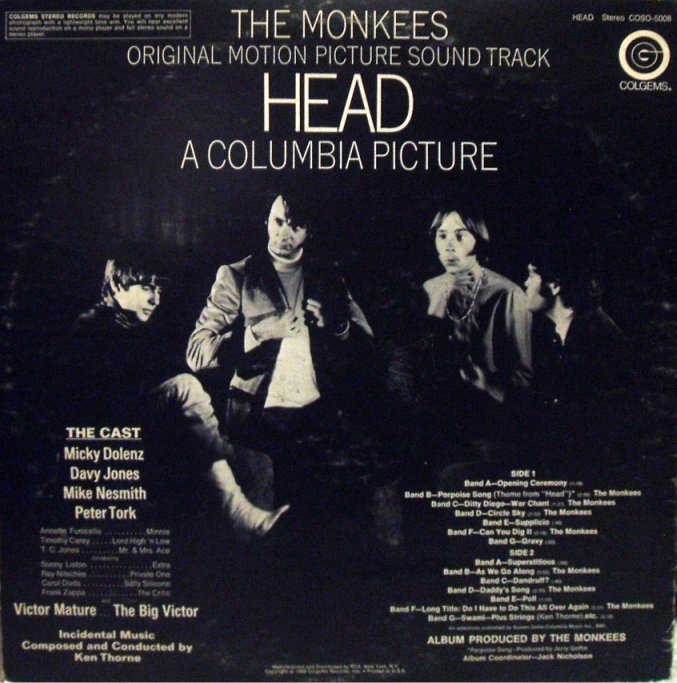
Head
The Monkees
Colgems COSO-5008
1968
My photo of the cover doesn't do it justice. It is a clear silver cover and when you look into it you see a reflection of your head. Very cool but a bitch to photograph. I saw the Monkees recently in concert. Even though I had been a huge fan of them as a child, I had real misgivings about the show, I only went because my son wanted to go. My doubts about the show stemmed from the absence of Mike Nesmith (my favorite Monkee) and my fear that the show would be some depressing and empty exercise in crude nostalgia with Davy, Micky and Peter just going through the motions for the money. At first my fears seemed justified as Micky and Davy clowned their way through a couple of numbers. But then the excellent 7 member backing band took charge and the music picked up. Finally Peter Tork made a heartfelt speech about how the Monkees were a real band and belonged in the Hall of Fame and I was won over. All these years later and Tork is still looking for acceptance. I was touched. Tork is now the heart and soul of the band. He sang all of Nesmith's parts and is clearly the best singer in the band at this point. I was enjoying the show when Tork again took the mike to announce that they were going to do some songs from "Head." I was ecstatic as they performed the entire album including an astonishing version of "Porpoise Song." It was a terrific concert and I'm really glad I went. "Head" is my favorite Monkees album. I first encountered it via the movie of the same name. Some of you may remember that distant time before cable when the three networks showed theatrical movies. CBS ran movies nearly every night after the late night local news. One night when I was in my early teens, they showed "Head." I stayed up way past my normal bedtime to watch it. I didn't get it, I was expecting something like the TV series. I even dozed off a few times. Years later I was lucky enough to see it in a movie theater and it blew me away. It remains my second favorite rock film after "A Hard Day's Night." It is not only a great film, but a great record as well. It was their final album prior to Tork's departure from the group and Tork goes out with a bang offering up two of his best songs with the band, "Can You Dig It?" and "Long Title: Do I Have To Do This All Over Again." Dolenz replaced Tork as lead vocalist on "Can You Dig It?" although Rhino included the Tork version on its CD re-issue of "Head." Having heard both versions I have to concede that the Dolenz one is better although Tork sang it at the concert and it sounded great. The song has a Middle Eastern flavor to it that befits its use as trippy accompaniment to a belly dancing sequence in the film. "Porpoise Song" is my favorite Monkees song and is arguably the most psychedelic song they ever did with the possible exception of "Daily Nightly." It was written by Gerry Goffin and Carole King and features lyrics of entrapment and escape reflecting one of the key themes of the film. The song is sung by Dolenz with help from Jones and it is driven by majestic organ lines colored by heavy orchestration, very much in the style of English psychedelia. A great, great song. Escape is also the theme in Carole King's other contribution to the record, the idyllic "As We Go Along" which is also sung by Dolenz. It is a very inviting and relaxing song. In total contrast is Mike Nesmith's contribution to the album, the exciting "Circle Sky." I think it is the best rocker the band ever recorded and is one of Nesmith's best songs. That leaves Jones' number, Harry Nilsson's "Daddy's Song," which is a sort of Broadway show tune/old timey song. Normally I hate that sort of thing, but the swelling brass on the chorus wins me over, it reminds me of Dylan's "Rainy Day Women #12 & 35" although not so raucous. The rest of the album is fleshed out with a short bit of Ken Thorne's soundtrack music and sound bites from the movie assembled by Jack Nicholson (yes that Jack Nicholson) including Frank Zappa's immortal line, "that song was pretty white." I love the sound bites, they add a lot of resonance and humor to the album. I think the Monkees are one of the most inspiring stories in rock and I have only the highest respect for them. An artificial band, formed for the crassest commercial purposes, they broke free of their handlers' constraints out of sheer artistic will and dignity and went on to produce some of the best pop music of the 1960s. Yes Peter, the Monkees do belong in the Rock and Roll Hall of Fame (along with Paul Revere and the Raiders, Donovan, Love, Moby Grape, Kiss and the Smiths, but I digress.) By any objective criteria, artistic, cultural or historical significance, the Monkees are more worthy than many of the inductees already there. I defy anyone on the selection committee to explain how the Dave Clark Five, the Flamingos, Frankie Lymon and the Teenagers, James Taylor, the Ventures, the Ronettes, John Mellencamp, Duane Eddy, Abba or Genesis are more deserving. None of them ever made an album as good as "Head." Recommended for people who think the Electric Prunes are a more significant group than Little Anthony and the Imperials (also in the Hall of Fame for reasons I can't begin to fathom.)
Gloria
The Shadows of Knight
Dunwich 666
1966
The Shadows of Knight were a Chicago group that specialized in covers of Chicago-style blues and rhythm and blues. That makes sense right? Unlike their fellow Chicagoans, the Paul Butterfield Blues Band, who derived their style from the likes of Muddy Waters, Howling Wolf and Little Walter, the Shadows of Knight derived their style by imitating the Yardbirds, the Animals and the Rolling Stones, that is British groups imitating Muddy Waters, Howling Wolf and Little Walter. I understand that, I listen to my Yardbirds records more than my Muddy Waters records, but it still seems a little ridiculous to me. The Shadows of Knight are much revered in garage band circles but I think they are too derivative to be ranked in the top tier of garage bands with groups like the Standells and the Chocolate Watch Band. They also don't compare well with the British Invasion bands they were imitating. They lacked a high quality guitarist and lead vocalist Jim Sohns was competent but could hardly compare with the likes of Eric Burdon, Van Morrison or Mick Jagger. All they really had going for them was good taste in material and their raw energy and enthusiasm. Consider their version of "Gloria" which was their biggest hit. It is hopelessly inferior to Them's ferocious original. Sohns sounds like a kid next to Van Morrison and the band lacks the drive and frenetic energy of the manic performance on Them's version. I could go through most of the covers on this record and pick superior versions by other bands from that era but I'll spare you that tedium. As for the three originals on the album, "Light Bulb Blues" is basically Muddy Waters' "Rollin' and Tumblin'" with crummy new lyrics. "Dark Side" is considerably better with a pleasing folk-rock element to it and "It Always Happens That Way" has a nice fuzz guitar riff and sounds a bit like Paul Revere and the Raiders. They are both very promising songs although the lyrics are pretty dreadful even by garage band standards. My favorite song on the record is the cover of Bo Diddley's "Oh Yea" (listed as "Oh Yeah" on this performance) which also appeared on the "Nuggets" compilation album. It is lots of fun and has a powerful Yardbirds-style arrangement. The Yardbirds also come to mind on my other favorite song on this album, the cover of Willie Dixon's "I Just Want To Make Love To You." The song begins in the conventional manner but then breaks into a great surging rave-up. It builds and builds and then just when it needs a great stinging guitar solo to cap it off, it delivers an utterly anti-climatic and pedestrian one, so disappointing. It still rocks though, as does their driving version of Chuck Berry's "Let It Rock" which is one of the most exciting performances on the album. Despite all its flaws this is a really worthwhile record, I just wish it were better. Recommended for fans of the Downliners Sect and the Wailers.