The Goldebriars
The Goldebriars
Epic Records BN 26087
1964
I first encountered Curt Boettcher as a young teen in the liner notes on the back of my copy of "The Association's Greatest Hits!" where he was listed as one of the producers. I was obsessed with that album for a little while so the names associated with it stuck with me. Thus I remembered Boettcher when I encountered him in Sagittarius and the Millennium and became a fan. This was his first foray into commercial music. He formed the Goldebriars while in college with Sheri and Dottie Holmberg and Ron Neilson. Given that his career was largely devoted to extravagantly arranged sunshine pop, I was a little surprised to find Boettcher leading a folk group, but once I spun the record I recognized his style instantly. The group sings mostly folk songs with folk style accompaniment but the vocals are pure sunshine pop. They feature elaborate harmonies with multi-tracking to give the music an astonishingly rich and vibrant sound. This is evident on the opening track "Railroad Boy" which is a traditional song that is often known as "The Butcher's Boy." Joan Baez recorded it on her second album which I assume is where the group picked it up. It is one of those wronged maiden type ballads. The Holmberg sisters' voices blend beautifully and complement Boettcher's delicate voice and the result is a lovely and haunting performance. "He Was a Friend of Mine" is a well-known traditional song that the Byrds made famous the following year on "Turn! Turn! Turn!" when Roger McGuinn changed the lyrics to be about John F. Kennedy. Dave Van Ronk recorded it on his "Folksinger" album in 1962 and it was in Bob Dylan's early repertoire. It is a gloomy song but it sounds practically euphoric with the Goldebriars' enthusiastic vocal arrangement. "Come Walk Me Out" is listed as a traditional song but it is actually Bonnie Dobson's song "Morning Dew." That poor woman was always getting screwed out of her royalties - Tim Rose claimed a songwriting credit on it when he recorded it for "Tim Rose." My favorite version is the Grateful Dead's intense and emotional cover of it on "The Grateful Dead." In contrast the prettiness of the Goldebriars' version diminishes the song's gravity although I have to admit it sounds fabulous. I could say the same about "Alabama Bound" which is credited to Leadbelly although the song predates him. The grittiness of the song does not benefit from Boettcher's pretty vocal and the Holmbergs' captivating harmonies. They sound condescending and out of touch with the song. "Pretty Girls and Rolling Stones" is attributed to the Goldebriars themselves but it sounds convincingly like a folk song. It's a girl chasing I gotta ramble type of song. They sing it with winning enthusiasm. "A Mumblin' Word" is an old spiritual about the crucifixion of Jesus that is also known as "He Never Said a Mumblin' Word" and "They Hung Him On a Cross." This song was also sung by Leadbelly. Boettcher's vocal is a little more grounded and coarse than usual but I still feel like the song's arrangement trivializes the subject even though I'm not the least bit religious myself. This is equally true of "Old Time Religion" which has got to be the slickest version of that old song around. I don't actually like traditional versions of the song and I find the Goldebriars' performance invigorating and pleasantly brief (a mere 1:37 in length.) The gospel theme continues with "Long Time Travellin'" which is equally slick but I find it more successful than the other religious songs because of its folk propulsion and more traditional harmonies. It reminds me of the Seekers' work in this vein. It is followed by a gorgeous version of the venerable old folk song "Shenandoah" which I consider one of the highlights of the album. The vocals absolutely send me. It resoundingly points towards Boettcher's future as a sunshine pop master. "No More Auction Block" is an old anti-slavery spiritual that had previously been recorded by Odetta. This is arguably the most ridiculous song on the record. The contrast between the mesmerizing vocals and the harshness of the lyrics is almost comical. "Sing Out Terry O'Day" was written by Boettcher in a folk style. The group sings the song with great vigor and verve and again remind me of the Seekers. From a folk standpoint it is perhaps the most credible song on the album particularly in Boettcher's urgent vocal. The album concludes with "Voyager's Lament" which is an English language version of "Un Canadien errant" which was written by Antoine Gérin-Lajoie. I first heard it on the debut album by Ian and Sylvia where it blew me away however the song dates back to 1842. The song describes the unhappy exile of a French-Canadian following the Lower Canada Rebellion in 1837-1838. The Goldebriars strip the Canada references from the song in the English section of their performance and then they sing a verse in the original French which is then crossed with "Plaisir d'amour" (uncredited) which is sung in English. I find Boettcher's creativity in the song breathtaking and immensely pleasurable. When I first got this album I played this track over and over savoring the vocal richness and the brilliant splicing of the two songs. This is my favorite track and its dazzling arrangement again foreshadows Boettcher's future career. I think that if I were a folk purist I'd probably hate this album or at least have serious problems with it. The music is almost totally divorced from the foundations of the songs. However I am far from being a folk purist. I prefer folk-rock to folk and I like Curt Boettcher a lot more than I like Pete Seeger. Boettcher basically used these folk songs as a vehicle for his own creative interests and that is fine with me. There were lots of performers who did these songs the "right way" if I feel like hearing that (and I have to confess I seldom do.) Hardly anyone arranged music like Boettcher did so this album is more valuable to me. Recommended to people who think it would have been cool if Brian Wilson had produced a Seekers album.
It Hurts To Be In Love
Gene Pitney
Musicor MS3019
1964
Gene Pitney was basically a singles artist. If he ever recorded an essential album, I have not heard it. His albums generally contain a hit single or two and a bunch of filler so most people who are not big fans should probably just pick up a compilation. I'm a moderate fan but I like Pitney's voice enough to pick up his albums when I run across a bargain. Since his records are relatively easy to find and generally not expensive, I've ended up with a bunch of them. I rarely play them but I enjoy them when I do. This is my favorite of the ones in my collection. The album begins with a bang with Pitney's soaring melodramatic performance of Barry Mann and Cynthia Weil's "I'm Gonna Be Strong" which was a top ten single for Pitney. The song showcases Pitney's range and strength as a singer, but it is a little over the top for my taste. My favorite version of the song is Jackie DeShannon's cover of it on "This is Jackie DeShannon" and I also prefer Tim Rose's performance of the song on "Tim Rose." It is followed by "Walk" by Howard Greenfield and Helen Miller which is a charming, jaunty song that lightens the mood of the record. Van McCoy's "I Love You More Today" is a pedestrian and sappy country-flavored ballad that Pitney makes listenable with his emotional vocal. The record picks up again with the upbeat and poppy "Who Needs It" which was written by the successful British songwriting team of Len Beadle and Robin Conrad (a pseudonym for Peter Callender.) It has a British Invasion sound and is one of my favorite tracks on the album. "Follow the Sun" was composed by Peter Udell and Gary Geld who wrote Brian Hyland's big hit "Sealed With a Kiss." The song has a rhythm and blues sound to it which Pitney bolsters with his robust vocal. "Lips Are Redder On You" was written by legendary British producer Joe Meek. It is a cheerful poppy song that Pitney puts over with ease. Side two opens with another Greenfield/Miller composition "It Hurts To Be In Love" which was a top ten single for Pitney. The song was originally intended for Neil Sedaka and Pitney recorded his version over the original Sedaka backing track, I think I still hear Sedaka on the background vocal. It is an extremely catchy and appealing song, one of my all time Pitney favorites. Al Kooper wrote "The Last Two People on Earth" with Bob Brass and Irwin Levine. Blues Project fans should not get too excited, the song is utterly mediocre although the science fiction theme is kind of interesting. The main reason I bought this album was to hear "That Girl Belongs to Yesterday" which was written by Mick Jagger and Keith Richards. The song was deservedly a hit single in England where it was the first Jagger/Richards song to crack the top ten. The song sounds nothing like the Rolling Stones, but its dramatic character is perfect for Pitney's emotional style. It is my favorite track after the title cut and the album is worth buying for it alone. "E se domani" is an Italian song written by Giorgio Calabrese and Carlo Alberto Rossi. I presume this is the same version that appeared on Pitney's Italian language album "Gene Italiano" released earlier in the year although I have no idea why it was stuck on this album as well. This old-fashioned song is fine if you like that sort of thing but it does not fit in with the rest of the record at all. "Hawaii" is another Kooper/Brass/Levine composition. I would not say it is better than "The Last Two People on Earth" but it is a lot more fun. The album concludes with "I'm Gonna Find Myself a Girl" by Ray Adams, Elaine Adams and Valerie Avon who were in the English pop group, The Avons. It is a subdued but enticing love song that features a double tracked vocal from Pitney that reminds me of the Everly Brothers. It gives the album a pleasant finale. Six of the twelve tracks on this record are memorable and worthwhile which is a good ratio on a pop album in the mid-1960s. As a result I play this album as much as I play my Pitney compilation album. If you are a Pitney fan, it is well-worth seeking out and probably would appeal to most fans of pre-Beatles pop music. Recommended to fans of the early Warner Bros. Records era Everly Brothers.
Help! In Concert
The Beatles
Coda Publishing CPLVNY193
2016
My 400th post is naturally a Beatles post. This is a Czech bootleg of some classic Beatles concerts that were filmed for television broadcast. There are two concerts from Blackpool, one from July 19th, 1964 and the other from August 1, 1965. There is also a show from Palais des Sports, Paris from June 20, 1965. The title is rather misleading, of the 20 tracks only four of them come from the album "Help!" (all from the second Blackpool show.) Most of the tracks are drawn from "Beatles For Sale" and "A Hard Day's Night." It is nicely packaged for a bootleg with a sturdy sleeve illustrated with images of the 1965 Blackpool show. The record is pressed on light blue marbled vinyl that looks lovely and sounds mediocre. The Blackpool recordings are excellent with only minimal screaming to distract from the performance. The 1964 show begins with one of the best live performances of "A Hard Day's Night" I've ever heard. "Things We Said Today" also sounds really good, especially the quality of Paul McCartney's robust vocal. John Lennon matches McCartney with a rocking performance of "You Can't Do That." Despite the listing on the cover, the next track is "I Feel Fine" which is taken from the 1965 show. It usually sounds crappy live, but the boys nail it this time around. The record jumps back to 1964 for a scorching performance of "Long Tall Sally" that I think is just as good as the studio version and George Harrison's guitar work is first rate throughout. "If I Fell" is also from the 1964 concert. The vocal work from John and Paul is extremely good. The record returns to the 1965 Blackpool show for the remainder of side one. "I'm Down" sounds a little murky, but the performance is very dynamic with more fine guitar work from Harrison and Lennon going nuts on the organ. "Ticket to Ride" sounds cleaner and it features another outstanding performance from the band. Harrison introduces McCartney's solo performance of "Yesterday" which was the first time the song had been performed live. McCartney accompanies himself on acoustic guitar supported by the strings in the theater orchestra. It sounds great, I think I prefer it to the studio version. The Beatles return and John facetiously calls McCartney "Ringo" as he thanks him for his performance. This is followed by the first live performance of "Help!" which they knock out of the park even though Lennon flubs the vocal at one point. It sounds fantastic, when it is over I want to join the girls in screaming. Side two begins with one final song from the 1965 Blackpool show, "Act Naturally" which is out of order having originally been performed after "I'm Down." Ringo gives himself a humorous introduction before launching into his vocal. Again the recording lacks sharpness. Four of the 1965 Blackpool tracks were on the "Anthology 2" album where they sound great. The two that were omitted were "I'm Down" and "Act Naturally." I suspect that the bootleggers lifted the four tracks from "Anthology 2" and then used another source for the other two. The Palais des Sports show occupies the rest of side two. It is not nearly as clean as the Blackpool concert recordings but still sounds okay for a vintage live recording. It begins with a typically raucous work out on "Twist and Shout." It is followed by a punchy performance of "She's a Woman." McCartney's vocal is very exciting. A lively version of "I'm a Loser" is next. It sounds a little sloppy but I like it. The Beatles run through "Can't Buy Me Love" which sounds pretty murky. I think I hear the crowd singing along during the chorus which I find charming. "Baby's In Black" is also rather muddy but the vocal is very strong, especially McCartney's harmony vocal. McCartney tries out some French in his introduction of Ringo for "I Wanna Be Your Man." Ringo is poorly recorded but he gives a very enthusiastic performance. Harrison gets his turn at the mike for "Everybody's Trying to Be My Baby" where he sounds more comfortable and passionate than he does on the studio version. The Beatles kick out the jams with "Rock and Roll Music" which is very exciting despite the muddy sound. Lennon's throat shredding vocal is thrilling. In the original concert this was followed by performances of "I Feel Fine" and "Ticket to Ride" but the record jumps ahead to the encore, which is "Long Tall Sally." The recording is a bit cacophonous but the performance is explosive. It ends the show and the record with a bang. I'm always a bit hesitant to endorse a bootleg but the Blackpool shows are essential. "The Beatles at the Hollywood Bowl" has my favorite Beatles' live recordings but only because the thunderous roar of the crowd is so exciting. The Blackpool shows feature superior performances and make for more comfortable listening. The song selection is terrific as well. The Palais des Sports show is basically just gravy. The band plays well but the songs aren't as good and the sound quality is not as sharp as either the Blackpool or Hollywood Bowl recordings. I'm still happy to have it though. The Blackpool shows have been bootlegged multiple times, there are probably better versions than this one. The mastering is decent but the vinyl has some sporadic surface noise. I'm also not happy that the running order of the Blackpool shows is messed up. Nonetheless Beatlemaniacs ought to have this in some form. Recommended to people who think the Hollywood Bowl shows are too noisy.
The American Tour with Ed Rudy
The Beatles
Radio Pulsebeat News News Documentary #2
1964
I enjoyed Ron Howard's recent documentary on the Beatles' touring days although I didn't learn anything new and it wasn't particularly insightful. I think Albert Maysles' documentary on the first tour is the best portrait of this time. For me the highlight of the screening was watching the Shea Stadium concert film on the big screen with good sound. That was fantastic. All the hoopla about the movie inspired me to pull out this record which attempts to document the Beatles' first visit to the United States. It is presented and narrated by Ed Rudy who was a journalist who accompanied the Beatles on their trip. Rudy seems to like the group and is consistently enthusiastic, but he has nothing interesting to say about Beatlemania and generally ignores the music, he is mostly attracted to the mass hysteria they generated. Side one is a 22 minute assembly of sound bites from the tour mixed with a bunch of promos for Rudy by the Beatles as well as roadie Mal Evans, Lennon and Harrison even label Rudy "the fifth Beatle." There are numerous snippets from the Beatles' first press conference in New York and Rudy interviews some fans as well. Despite traveling with the band, Rudy doesn't get much face time with the group. Initially the longest conversations he gets are with Mal Evans and road manager Neil Aspinall. He also wastes some time talking to a twit from the British Embassy. In Washington D.C. Rudy gets some muffled comments from a Beatle who he claims is John Lennon, but it sounds like Paul McCartney to me. He also has an amusing conversation with Ringo Starr at the British Embassy party in Washington regarding his sex appeal. Near the end of side one, on the plane flying back to New York after the Miami visit, Rudy finally gets some quality time with the band and their handlers. On side two there is a fifteen minute telephone interview with George Harrison. Predictably the sound quality is not good, but it is a nice conversation. The "quiet Beatle" is surprisingly loquacious. He and Rudy discuss the fan reaction on the tour, the Beatles' sound, the origin of the group's name, Beatle haircuts and fashions, mods vs. rockers, Harrison's personal ambitions, dating, friendships with the other Beatles and musical influences (Rudy astutely compares them to Buddy Holly and the Crickets.) At one point Rudy refers to "Johnny" Lennon and asks if Harrison ever calls him "Jack" Lennon, which cracks me up. This record is worth buying for side two alone. I enjoy the entire record aside from Rudy's relentless self-promotion. Even though it contains virtually no music at all, I still prefer it to Capitol Records' vinyl documentary of the Beatles on "The Beatles' Story." This album is easy to find and generally not expensive (I bought my copy in a thrift shop for $2.) Recommended to Beatlemaniacs whose favorite Beatle is George.
Live at the Regal
B. B. King
ABC-Paramount Records ABCS-509
1965
Most of the world is paying tribute to Prince, but I'm just getting around to my tribute to B. B. King who died last May. I actually started this post several weeks ago, but then I got sick and didn't feel like listening to music much less blogging. My introduction to the blues mostly came second hand from English rock bands like Led Zeppelin, Cream and the Yardbirds who imitated American bluesmen. King was the first genuine blues performer I remember seeing, I saw him when I was a kid in the early 1970s on Flip Wilson's television show. The first real blues album I ever bought was King's "Live in Cook County Jail" which I picked up as a teenager. I have to admit that at first I wasn't all that impressed, I preferred the flashiness and showboating of the English guitar heroes. As I grew older and more musically sophisticated I came to appreciate King's economical and controlled playing style a lot more. I realized it was better to emphasize feeling like King than to show off technical prowess by playing a gazillion notes as fast you can like Alvin Lee. This is my favorite B. B. King album, an opinion that is hardly unique. The album is widely acknowledged as a classic record. It was recorded at the Regal Theatre in Chicago in 1964 in front of a loudly appreciative audience. King and his band were in top form as they ran through his back catalog delivering definitive versions of some of his best known songs. The record opens with "Every Day I Have the Blues" which was a hit single for King in 1955. It is a swinging, fast-paced performance that is my favorite version of this oft-covered song. I love it when King's voice soars in the final chorus. "Sweet Little Angel" was a 1956 single derived from the old blues song "Black Angel Blues." King introduces it as a "real oldie." His vocal is full of gusto. He was justly celebrated for his guitar work, but his ability as a blues singer was also outstanding. He shows off his range and power with a very emotional performance that elicits screams from the ladies in the crowd. "It's My Own Fault" is a cover of a John Lee Hooker song released as a b-side in 1960. It is a slow, smoldering blues with another spectacular vocal from King backed up by a wailing guitar solo. "How Blue Can You Get" was a 1964 single for King. King shows just how blue he could get with a volcanic vocal and some inspired guitar work in the intro. "Please Love Me" was a 1953 hit single written by King. It is a smoking hot song that gets me bopping and features a high-tempo yet impressively fluid solo from King. Side two opens with King's 1954 hit "You Upset Me Baby." It is a jumping track that opens with an exciting guitar run before King tears into the vocal. He lets his sax player take the solo which really cooks. "Worry Worry" was originally the b-side of a 1950 single that was re-released as an a-side in 1959. It is another slow blues that begins with a long fiery guitar intro from King that rouses the crowd. When King finally breaks into his passionate vocal the crowd starts screaming and I would have too if I had been there. It is a stunning performance on every level, the highlight of the album. I don't think the blues gets any better than this. "Woke Up This Mornin'" was written by King and was a hit single in 1953. It sounds like filler practically after the previous titanic track, but it is full of energy and fine singing from King. "You Done Lost Your Good Thing Now" was originally a b-side in 1960. It opens with a typically graceful and dynamic guitar solo from King before he gets down with another steamy vocal that he punctuates with short bursts from his guitar. His horn section gives the song extra oomph as it moves towards its conclusion. "Help the Poor" was a 1964 single for King. It is more rhythm and blues than straight blues and gets into a nice groove to close the album. This is truly a classic album, ten heartfelt tracks of superb singing and playing that showcase King's brilliance. As a vocalist/guitarist, King was as a virtuoso without parallel. I'm sure going to miss him. Recommended to people who believe that the blues need to be sung as well as they are played.
That's My Song
Carolyn Hester
Dot Records DLP 3604
1964
On our way home from our summer vacation this year I insisted on a detour to Clovis, New Mexico because I wanted to see the town where the great Buddy Holly began his recording career. As we pulled into town my wife thought I had lost my mind. Clovis has obviously seen better days. We went to the buildings that housed Norman Petty's recording studio and office which are now closed although still intact and largely untouched except for the decay of time and neglect. We then headed over to the Chamber of Commerce where I checked out the Norman Petty museum in their basement. It was full of wonderful artifacts including a re-creation of the Petty recording studio. I really enjoyed it and I recommend a visit if you ever find yourself in the area. While I was perusing the exhibits I was surprised to see a copy of this record. I've had it for years but never realized it was produced by Petty presumably in Clovis. When I got home I examined the record which contains no production credits but I noticed that Petty was mentioned in the liner notes. This album was Hester's first for Dot after Columbia dropped her after a pair of albums. The liner notes emphasize the Southwestern influence on the album noting that everyone who performed and produced the record was born or raised in Oklahoma, Texas or New Mexico (Hester is from Texas.) Also the notes claim that all but two of the songs were written by people from the Southwest or are concerned with the area. The album begins with "That's My Song" by George and Barbara Tomsco. George Tomsco was in the Petty-produced group the Fireballs and plays guitar on eight of the tracks of this record. The song has a jaunty, countryish melody and a cheerful vocal from Hester. It is one of my favorite tracks on the record. "Amapola" is identified as a Mexican song in the liner notes for the album but it was actually written by the Spanish songwriter Joseph Lacalle. Hester sings the first two verses in Spanish and then sings one of the English verses by Albert Gamse. Her vocal is fabulous and shows off her ability to hit the high notes with ease. It is a superbly romantic song and another one of my favorites. "Ain't That Rain" is another song by the Tomscos. The song is a farm worker's lament about life's difficulties that uses weather metaphors to convey its message. The song is slow and moody with a low key but expressive vocal from Hester. "Momma's Tough Little Soldier" is the first of three songs by Tom Paxton on the album. It is a lively song about a rambunctious child. It is silly but fun. "Lonesome Tears" is a Buddy Holly song. Holly of course worked with Petty and Hester met him when she was recording her debut album "Scarlet Ribbons" in Clovis in 1957. She and Holly became friends and made some unreleased recordings together. Hester imbues the song with a bluesy feeling that I prefer to Holly's more rock and roll style original. Side one concludes with "Stay Not Late" which was written by Hester. It is a lovely, enigmatic song that reflects on the transience of life in poetic language. Side two opens with "Everytime" by Paxton. It is a somewhat sappy love song, but Hester's vocal is so pure and emotional that she makes it convincing. "Can't Help But Wonder Where I'm Bound" is also a Paxton song. It is a familiar rambling-around-this-world type folk song that Hester once again makes sound deeper than it is by virtue of the sincerity and strength of her singing. Hester wrote "Ten Thousand Candles" which refers to a UNESCO statistic that 10,000 people died of malnutrition every day. It is a powerful protest song given an anthemic quality by Hester's forceful singing. "The Times I've Had" is an anti-war song by Mark Spoelstra. Hester gives it an old-timey, bluesy interpretation that is very effective. "Jute Mill Song" is a labor protest song of Scottish origin. Hester's vocal is typically gorgeous, but perhaps the gritty lyrics deserved a little more bite. "The Rivers of Texas" is credited to Irene Carlyle but I've read that she denied writing it and said she learned it from a Texan in the 1920s. It is a wonderful song describing an ill-fated love affair and the singer's determination not to love again using an assortment of rivers to narrate the song's story. It gives the record a charming finish. Hester is one of my favorite singers and I'd listen to her sing just about anything. This record is made stronger I believe by the continuity of theme and sound that it derives from its Southwestern focus. It feels like a statement rather than just a collection of songs. Hester's impeccable vocal technique and the tasteful musical accompaniment make it consistently stimulating and pleasing to listen to as well. Norman Petty was obviously an excellent collaborator for her. I have a limited appetite for folk music, but I never get tired of listening to Carolyn Hester. Recommended to Buddy Holly fans who dig folk music.
The Astounding 12-String Guitar of Glen Campbell
Glen Campbell
Capitol ST 2023
1964
I recently saw the excellent documentary "Glen Campbell: I'll Be Me" which is a behind the scenes look at his farewell tour emphasizing the devastating effect of Alzheimer's Disease on him. I saw one of the shows on that tour and I was astonished to see in the film how far gone he already was. Sitting in the audience at his show I thought he seemed in control and confident. In reality not only could he not remember the words to songs he has sung thousands of times (he used a teleprompter for the lyrics), he could barely remember his kids' names. Amazingly he could still play like the virtuoso guitarist he has always been. I guess that part of his brain is different from the part ravaged by his disease. This album showcases his instrumental skill. It was his third album. It seems likely that the weasels at Capitol Records did not know what to do with him. Here's this good-looking kid with a wonderful voice and they tried to turn him into Chet Atkins. It is a testament to his immense talent that he made this record work with his engaging and energetic fret work. My favorite cut is a performance of Bob Dylan's "Walkin' Down the Line" which starts out as a sprightly instrumental and then almost as if he can't help himself, Campbell bursts into song to sing a couple of verses. The record really jumps to life at that moment and you can see why the guy who wrote the liner notes felt that Campbell was going to "gain equal fame" as a vocalist. My favorite cuts among the instrumentals are a pair of duets with Roy Clark on the banjo, "Lonesome Twelve" and "The Ballad of Jed Clampett." The dynamic interplay between Clark and Campbell is very stimulating and frenetic. The album is worth picking up just for those two cuts alone. Campbell's own compositions "12-String Special" and the rocking "Bull Durham" are almost as good with lots of fine country-style picking. Campbell also tackles a bunch of folk hits. He is joined by Clark again for "Wimoweh" which isn't as exciting as the other two Clark cuts but still enjoyable. On "Puff (The Magic Dragon)" and "This Land Is Your Land" he plays the first verse straight then starts to embellish the songs with some terrific jazzy flights before coming back to earth to finish. Great stuff. He uses the same formula for "Blowin' In the Wind," "500 Miles (Away From Home)" and "Green, Green" but the improvised sections are more sedate. He's joined by Earl Palmer on bongo for "La Bamba" which gives the cut plenty of propulsion upon which Campbell lays down some of his finest guitar work on the record. I'm fond of this record, Campbell was a natural entertainer and that goes for his guitar solos as well. There is not a boring moment on this record. The man was certainly among the best guitar players of his generation. It makes me sad to think that not only has the great man's voice been silenced, but that I'll never get to hear another one of his lightning fast guitar runs again either. At least I have this record to remind me of his tremendous ability. Recommended to fans of the "pickin' and grinnin'" segments on "Hee-Haw."
The Beatles at the Hollywood Bowl
The Beatles
Capitol SMAS 11638
1977
This is my belated acknowledgement of the 50th anniversary of the beginning of Beatlemania in the United States with the arrival of the Fabs in New York to play on "The Ed Sullivan Show." As I mentioned in an earlier post, I may have witnessed that fabled event. My father claims we watched it but given that I was little more than a baby at the time, it may have been past my bedtime. In any case I have no memory of it, but I cherish it as much as anybody. I have really enjoyed all the hype in the press about the anniversary as well as the television program that reunited Paul and Ringo. I became a Beatles fan in the 1970s well after they had broken up and it seemed to me that they were under-appreciated at the time. None of my friends liked them much and I was forever hearing that the Rolling Stones, the Who or Led Zeppelin were the world's greatest rock band. Even worse was the rise of the Bay City Rollers (my sisters were fans) and all the ridiculous comparisons between Rollermania and Beatlemania. I listened to lesser artists have big hits with crummy covers of Beatles' classics and seethed with resentment. So it was doubly sweet to me to see the arrival of the Beatles being hailed as a cultural landmark event. I suppose the ideal album to play to celebrate the anniversary would be "Meet the Beatles" which was the album they were promoting with their visit or "Something New" which features a cover photo of the Beatles on "The Ed Sullivan Show" but I've already done posts on those records. So I've opted for this one, the only legitimate issue of a Beatles live album which was drawn from two shows at the Hollywood Bowl, one from August 23, 1964 and one from almost a year later on August 30, 1965. This album was the first time I got to experience the exquisite pleasure of buying a brand new Beatles album as soon as it came out. I was thrilled with it at the time and I still love it but some of my enthusiasm is tempered by my disappointment that the record does not contain the full contents of both concerts. The album consists of 13 songs but runs just a little over 30 minutes which may accurately reflect the length of a Beatles' show but is pretty skimpy for an album. I have a bootleg of the 1964 show on a record called "30 Nostalgia Hits" and it is all worthwhile. There are six tracks from the twelve songs they performed at that concert on the album: "Things We Said Today," "Roll Over Beethoven," "Boys," "All My Loving," "She Loves You" and "Long Tall Sally." The 1965 show provides seven songs: "Twist and Shout," "She's a Woman," "Dizzy Miss Lizzie," "Ticket To Ride," "Can't Buy Me Love," "A Hard Day's Night" and "Help!" with five other songs from the show not making the album. The sound quality is phenomenal, George Martin did a brilliant job polishing the recordings and seamlessly editing the two shows together. It sounds a lot better than my bootleg. The crowd is loud and the persistent roar is exhilarating but the music is nonetheless clear with decent separation. The Beatles' performances are excellent, I love the raw energy of the vocals of John and Paul and the instrumental backing is remarkably good considering that they could not hear themselves play. I suspect they were probably trying harder knowing that they were being recorded for a possible record. These are by far the best Beatles concert recordings I've ever heard. I particularly like the raucous performances of "Twist and Shout," "She's A Woman" "Dizzy Miss Lizzie," "Boys," "Help!" and best of all, an incendiary version of "Long Tall Sally." Martin has preserved the lads' between songs patter on the album which I appreciate but it does make for some temporal inconsistencies when they refer to their latest albums or songs since the album jumps back and forth between 1964 and 1965. This is a minor complaint though that hardly diminishes the appeal of this wonderful record. I may be a little prejudiced, but I say this is one of the best rock live albums ever. If I had access to a time machine and could pick one single show to go back and see, it would be one of these two - the hard part is picking which one! I go to the Hollywood Bowl quite often, it is one of my favorite venues for a show, and there is not a time that I go there that I don't think about the Beatles having played there. I wish I had been there, but having this record is the next best thing. Recommended to Beatles fans too young to have experienced Beatlemania first hand.
Kinks
The Kinks
Zafiro ZL-340
1980
You Really Got Me
The Kinks
Reprise R-6143
1964
The UK and American versions of the debut album by the Kinks. The Kinks have been one of my favorite groups since I first heard them in 1973 on the compilation album "Get It Together." I've wanted to do an entry on them for awhile but I haven't been able to decide on an album, so I opted to just start at the beginning. I have the UK version of the record (which was originally released in 1964 on Pye Records in England as NPL 18096) in a Spanish stereo reissue that I bought in Berkeley and an original mono pressing of the American version. Actually even though the inner label on the Spanish record says stereo, the record still sounds like mono to me. The mixes on both albums appear to be identical, although the Reprise pressing sounds a little better. The two versions are similar aside from the Reprise edition missing three tracks on the Pye version, "I Took My Baby Home," "I'm A Lover Not a Fighter" and "Revenge." The Reprise version has slightly better liner notes and a nice picture of the group on the back cover, other than that I don't think there is any good reason to have it except as a dumb collector thing which is why I have it. The record is unique among Kinks albums in that more than half of it was written by someone other than Ray Davies. Davies has six compositions on the album, two of which are first rate. "You Really Got Me" is of course an eternal rock classic. I've loved it since I was a teen. I still remember my outrage when a classmate in physics class in high school played me a tape of Van Halen's cover version which I regarded as sacrilege. The song's explosive heavy guitar riff and Dave Davies' raucous guitar solo are hard rock landmarks and Ray's urgent, desperate vocal adds to the recording's intensity. It still sounds powerful nearly 50 years after it was recorded. "Stop Your Sobbing" is a more sedate but catchy tune that is the only song on the album that hints at Davies' future as a pop craftsman although it isn't as good as the Pretenders' cover version. As for Davies' other songs, "So Mystifying" is primitive but fun, I like the jangly guitar riff. "I Took My Baby Home" is a very poppy, almost bubblegum type tune that sounds more like Jan and Dean than a Kinks song. The only thing I find interesting about it is Ray's harmonica playing. "Just Can't Go To Sleep" sounds like a girl group type song and the chorus seems to be aping the Beatles with "no no no" replacing "yeah yeah yeah." "Revenge" is a simple and very short instrumental that Davies co-wrote with the band's manager, Larry Page. It is probably the most undistinguished song Davies ever wrote. There are two numbers by the album's producer, Shel Talmy, which are easily the worst songs on the record. The inane "Bald Headed Woman" sounds like Talmy just made it up at the session. It is boring until the rave-up at the end. Talmy got The Who to record this silly ditty as the b-side to "I Can't Explain" which I think is a superior version. The Australian band The Missing Links also recorded it on their debut album so I guess some people hear something in it that I don't. "I've Been Driving on Bald Mountain" (Talmy seems to have had a thing about hair loss) is just as bad, it sounds like the same song played a little faster. It is a dumb and repetitious song that is sheer tedium to listen to. Too bad Reprise didn't choose to leave these two off their version of the album, that would have made it better than the Pye version. The rest of the album consists of covers. My favorite of the covers is the band's frantic version of Chuck Berry's "Beautiful Delilah" which is full of energy, has an effectively sloppy vocal and features a manic guitar solo. The band also tackles Berry's "Too Much Monkey Business" but their performance here is less exciting. It pales in comparison to the Yardbirds' version of the song on "Five Live Yardbirds." That same Yardbirds album also offers a superior version of Slim Harpo's "Got Love If You Want It." The Kinks version is uninspired, although I do like the two rave-ups. There is a rocking version of Bo Diddley's "Cadillac" that gets me bopping. "Long Tall Shorty" is a cover of a song by Tommy Tucker. It a rhythm and blues tune with crude, boasting lyrics that sound unconvincing coming from Ray Davies although he makes a game effort practically croaking out the lyrics trying to sound tough. Ray does a little better with "I'm A Lover Not a Fighter" which is a cover of Lazy Lester's 1958 single. This tune is highly propulsive and Ray's scratchy vocal is delivered with gusto. The Kinks would never have made it as a rhythm and blues band, but at least they had good taste in covers. This is the worst Kinks album of the 1960s, but that is as it should be. They just got better and better as the decade went on. The one thing that stands out for me on this album is its vitality and energy. When I saw Ray Davies last year at the Wiltern, those were the two qualities that impressed me as well. There on stage was a 68 year old man rocking with passion and vigor, his indomitable spirit was still present after all these years. I consider Davies a brilliant pop craftsman, one of the great songwriters of his era who writes with intelligence and artistry, but inside him beats the heart of a true rock and roller as is evident on this album. Recommended to people who prefer the Animals over the Zombies.
The Beatles' Story
The Beatles
Capitol STBO 2222
1964
I sometimes wonder how I became such a big Beatles fan and why I continue to love them. My father told me that my family watched them on "The Ed Sullivan Show" but I have no memory of it since I was just a toddler at the time. I was barely aware of them during the 1960s and mostly because of the Saturday morning cartoon show about them. When I became a real fan, the group had been defunct for several years. I didn't know anyone among my peers who liked them. I wasn't particularly interested in music, my cultural heroes were professional athletes and astronauts. Then when I was 12 I saw "Help!" on television and I was mesmerized. After that I would never be the same, I was a Beatlemaniac. I grew my hair and combed it over my forehead trying to achieve a moptop. That was when I started collecting records and spending my time at home around a turntable rather than a television set. If I had had any money and if Beatles fan paraphernalia were still easily available, I would have filled my room with it. Instead I had to settle for records and I bought this one quite early much to my subsequent embarrassment - well before I bought "Revolver," "Abbey Road" or the "White Album," yikes. Once I saw it advertised on the back of "Beatles '65", I was obsessed with having it. Finally it turned up in the bin at my local record store and I pounced on it. I loved it and played it until I had memorized it. Given the paucity of books in print about the Beatles at the time, I learned a lot about the early Beatles from this record. As I got older, my adolescent fandom changed and became more music-based than personality oriented and I lost interest in this record. I don't think I've played it at all in the last 15 years. The album is a bit of a rip-off. It is a double album but the sides are extremely short, all under 15 minutes long and side three is less than 10 minutes long. The Beatles are hardly on the album at all, mostly heard in brief snippets taken from press conferences. There are also some excerpts from their songs. Most of the album's content is provided by three narrators, Roger Christian, John Babcock and Al Wiman, who take turns telling the Beatles' story and reciting various quotes from the Fabs. Christian will be familiar to Jan and Dean and Beach Boys fans as the lyricist for many of their early hits and he was also a well-known Top-40 DJ in Los Angeles in the 1960s. Christian also co-produced this album along with Gary Usher who will be familiar to 1960s rock fans from his work with the Byrds and Sagittarius. The rock backgrounds of the producers insure sympathetic treatment of the group and their fans although it is still condescending in spots and the narrators sound more like they are selling soap than describing one of the most exciting events in the history of rock and roll. For all its faults, the album is informative and comprehensive. Side one opens with a recording of the screams at a Beatles concert (although no music is heard) which is followed by a discussion of Beatlemania and its origins with some amusing recordings of hysterical girls gushing about the boys. The narrators then pay tribute to Brian Epstein and discuss his background. John Lennon gets profiled next. Much to my amusement there is a lengthy bit about Lennon's refusal to discuss politics or make public expressions about his beliefs. We all know that didn't last long. The side ends with the Beatles' early history prior to stardom and then a discussion of their finances which is a subject that crops up quite a bit on the record. I think the narrators were more interested in the band's money than their music. Side two returns to the early history of the Beatles with a discussion of the Quarrymen and the origin of the Beatles' name. One of the more glaring mistakes on the record comes when the narrator notes that Ringo came from a group called Rory Storm and The Texans whereas all Beatlemaniacs know that Storm's group was called the Hurricanes when the Beatles poached Ringo from the band. The narration next praises George Martin and Capitol Records for their role in the Beatles' success while somehow neglecting to mention Capitol's rejection of the Beatles' debut album. This is followed by a profile of George Harrison, "blasé with a beat" is their description of him. They falsely give him credit for inventing the Beatle haircut which the group actually learned about in Hamburg from Astrid Kirchherr and her friends and it is well-known that Stu Sutcliffe was the first Beatle to adopt it. The narration notes how much Harrison enjoys the attention of screaming fans which is pretty funny considering how vocal he was later about his hatred of touring and the trappings of fame. Side three discusses their movie, "A Hard Day's Night" and then profiles Paul McCartney. Side four opens with a live excerpt of a performance of "Twist and Shout" which was the earliest legitimate release of a Beatles live track although unfortunately it is only a few bars long. There is further discussion of Beatlemania with some more soundbites from fans and detractors including some idiot who calls them a bunch of "monkeys." Up next is a medley of Beatles songs segueing together in 30 second segments. Finally it is Ringo's turn to be profiled where he is described as the "quiet Beatle" a sobriquet normally given to Harrison. The album ends with a brief discussion of Liverpool. Much of this album is devoted to the narrators explaining the mysteries of Beatlemania, but their answers are simplistic and unconvincing to me. I'm not sure there is a satisfying answer as to why so many people love them. Anyway there is nothing on this album that Beatlemaniacs don't already know and there isn't enough actual Beatle talk to make the album worthwhile. I'm not sorry I have it though, it is an interesting artifact. Recommended for casual Beatles fans who hate to read.
Something New
The Beatles
Capitol ST 2108
1964
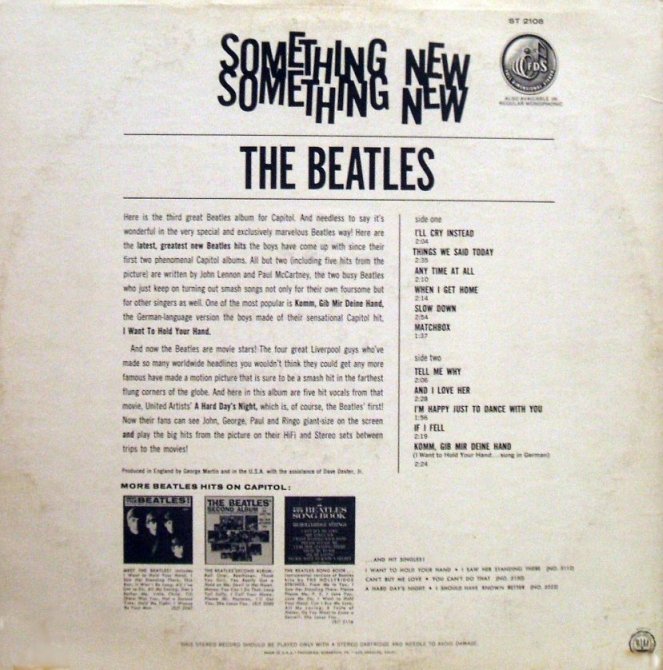
Another example of the typically shoddy treatment of the early Beatles albums by Capitol Records. This is largely drawn from the British version of "A Hard Day's Night" which in my opinion is the best Beatles album prior to "Rubber Soul." American Beatles fans had to buy two albums to get the contents of the British album, this one and the soundtrack album to "A Hard Day's Night" on United Artists. This record has 8 of the 13 songs on the British album and shares 5 titles with the soundtrack album. The remainder of this skimpy album is fleshed out with "Matchbox," "Slow Down" and "Komm, Gib Mir Deine Hand" which is of course the German language version of "I Want To Hold Your Hand." I bought this album late in my Beatles collecting history. I resisted it a long time because I had the infinitely superior British album and because it irritated me to give Capitol money for it. When I finally bought one, I picked up a used one just to make sure Capitol didn't get a dime from me for it. I criticize this album, but only because of the packaging. It is still a Beatles album and all the songs on it aside from the German one are worthwhile. "Matchbox" is my favorite of all their many Carl Perkins covers (I count 7 officially released ones including the ones on "Live at the BBC" and the "Anthology" albums.) The song is a perfect fit for the lead vocalist, Ringo. The cover of Larry Williams' "Slow Down" shows what an excellent rock and roll band the Beatles were. "And I Love Her" may be corny but it displays McCartney's growing musical sophistication as does "If I Fell" for Lennon. The country flavored "I'll Cry Instead" demonstrates their amazing versatility and shows the personal quality Lennon was bringing to his lyrics as he grew as a songwriter. Its desperation foreshadows his brilliant lyrics in "Help" the following year. "Things We Said Today" has long been one of my favorite early Beatles songs. This is a consistently stimulating record, but you probably don't need it. Stick with the British version. Recommended for Beatles fanatics only.
Northern Journey
Ian and Sylvia
Vanguard VSD-79154
1964
Ian and Sylvia's third album. I first discovered Ian and Sylvia via the We Five's cover of Sylvia Fricker's "You Were On My Mind." My stepmother had the first We Five album, "You Were On My Mind," and I listened to that one song many times as a teenager. I became curious about the original and sought it out. I started with an Ian and Sylvia comp but the song first appeared on this album which I picked up a few years later. After Dylan, Ian and Sylvia are my favorite folkies, at least as far as North America is concerned. There are many reasons for this, starting with my obsession with Canada. Their albums feature many songs about Canada and listening to them made me yearn to visit the great white north. Secondly, Ian and Sylvia had excellent taste in songs and were both good songwriters also. I believe that all of their Vanguard albums are worthwhile. They were talented singers as well, Ian Tyson has one of the best voices in North American folk music, I think only Tom Rush is better and Sylvia Fricker is a brilliant harmony singer, that vibrato in her voice always sends me. Finally, I have to admit, I had a crush on Sylvia Fricker. When I saw her picture on the comp I bought, I was instantly smitten. As a youth I totally idealized her and what I thought she and Tyson represented - integrity, bohemia and the true north strong and free. According to the album's liner notes the album title reflects the folk scene in Canada or more particularly the way Anglo-American songs traveled there from England and the United States. Many of the songs are either about Canada, from Canada or collected in Canada. The album begins with "You Were On My Mind." When I heard the We Five version (which altered the lyrics) I thought it was about a depressed person who was cheered up thinking of her love, but my error became clear when I heard the Ian and Sylvia version and realized that the narrator is depressed because she is heartbroken, she is trying to forget the person on her mind. Despite the sad subject matter, I'm always elated when I hear this song, it makes me feel good to be alive. The lyrics sound like a blues song but the music is almost joyous. There is a rich string sound in the performance which features two guitars, a bass and Fricker on autoharp. This is characteristic of most of the album aside from the autoharp. All but one of the songs features a bass and most of the songs feature a second guitarist. The resulting richness of sound is very appealing. My two other favorite songs were both written by Tyson. "Some Day Soon" is a classic song about a girl in love with a rodeo performer. It is set in the United States, but given Tyson's background in rodeo I would assume that the song is a little autobiographical as well. With no less than three guitars and a bass it has a very dynamic sound and boasts a terrific duet vocal. It would later be a minor hit for Judy Collins although I greatly prefer this version. Tyson's other song is "Four Rode By" which describes the exploits of the criminal McLean gang in British Columbia in 1879. The song is mostly neutral in its perspective, ignoring the various social and political aspects of the events. It is a very propulsive tune with some stirring guitar work from John Herald. The remaining songs are all traditional. I particularly like the compelling "Nova Scotia Farewell" which is about the hardships of the life of a sailor. The mournful dirge, "Brave Wolfe" recounts the battle of Quebec between the French and the British in 1759 and celebrates the valor of James Wolfe, the British general killed in the battle. "The Moonshine Can," another Canadian folk song on the album, could not be more different than "Brave Wolfe." It is a frenetic tune recounting moonshining activities in Newfoundland and features some fast-paced picking from Monte Dunn on mandolin and John Herald on guitar. The haunting ballads "The Jealous Lover" and "The Ghost Lover" feature subject matter typical of Anglo-American folk music. Anyone who is familiar with the Child ballads will recognize their tales of the man who kills his true love mistaking her for someone else and the dead lover who pays one final ghostly visit to his love. "Green Valley" also covers familiar territory, that of the young woman wronged by a false lover, but it is apparently unique to Canada and Ian and Sylvia credit the New Brunswick traditional singer, Marie Hare, as their source for the song. The song is given a charming country treatment with Dunn's mandolin providing much of the instrumental color. Although collected in Nova Scotia, "Captain Woodstock's Courtship" is an old Scottish ballad that Child included in his anthology. It is an amusing series of riddles sung by Fricker and responses sung by Tyson. For an old folk song, it is kind of sexy. The remaining songs are less connected to Canada. The acappella performance of "Texas Rangers" and the lively gospel tune "Swing Down, Chariot" are obviously American and "Little Beggarman" is a rollicking Irish tune that the duo picked up from Tommy Makem. They are all good songs but I don't see how they fit into the concept of the album except perhaps as a display of the diversity of music popular in Canada. I love this record, this music has been the soundtrack for many of my Canadian road trips. Recommended to people who'd rather make a journey to Halifax than Hollywood.
The Standells in Person at P. J.s
The Standells
Liberty LRP-3384
1964
"Live" and Out of Sight
The Standells
Sunset SUM-1136
1966
Many years ago I bought "'Live' and Out of Sight" not realizing it was a reissue of the 1964 Liberty album "The Standells In Person at P.J.s." I was miffed when I found out but not so much that I made a big effort to get the original. It kept bugging me though because I'm a silly collector so when I finally found a nice copy at a bargain price, I bought it. The records are not identical. The original has better cover art and superior liner notes. The reissue drops two tracks from side one of the original album, "You Can't Do That" and "What Have I Got Of My Own," and substitutes the early Standells singles "Peppermint Beatle" and "Shake." It also radically alters the running order of the songs which I don't approve of at all. However I like having the singles so I keep both versions. The Standells were arguably the greatest of all 1960s garage bands although I'm not really sure the term is accurately applied to them. Sure they sound like a garage band, but they were hardly a bunch of teenage punks making a ruckus on stage at the school dance. These guys were professional musicians with considerable ability and talent, they were no more a garage band than the Byrds were. I'm referring primarily to their classic recordings on the Tower Records label. On this record, they sound pretty much like an ordinary garage band. The live tracks consist entirely of covers, all competently performed with lots of energy. If I was watching them at P.J.'s I'd be completely satisfied, they have a good beat and you can dance to them. It sounds like a really fun concert. On a record though, I expect something more original than this. If nothing else they do have excellent taste in covers. My favorite cut is the high energy cover of Ray Sharpe's "Linda Lu" which shreds the original. Not far behind is their speeded up version of Jimmy Reed's "Help Yourself" which really cooks. I particularly dig the ferocious electric organ playing that drives this cut. I also like their versions of Jessie Hill's "Ooh Poo Pah Doo," the Fiestas' "So Fine," Larry Williams' "Bony Maronie" and James Brown's "I'll Go Crazy." Their versions aren't particularly distinctive but they are propulsive and fun. "Louie Louie" and "Money" exist in so many other better versions that they are essentially useless. I enjoy their covers of the Beatles' "You Can't Do That" and Trini Lopez's "What Have I Got Of My Own" but they don't really add anything to the original versions. Dropping them for the two singles makes the reissue a slightly better record than the original. Both singles are credited to Larry Tamblyn. "Stand" features original drummer Gary Leeds who would later join the Walker Brothers and change his name to Gary Walker. The song is simple and somewhat derivative of the Isley Brothers' "Shout" but it is fast paced and very enjoyable. "Peppermint Beatle" is a little more sophisticated musically but features equally silly lyrics. In case you were wondering the Peppermint Beatle is a dance, not a food. I don't play either version of this album very much but when I do, it does make me hop and wiggle around. If you plan on throwing a toga party any time soon, this might make a nice soundtrack for it. Recommended for fans of the Kingsmen.