Showing posts with label 1975. Show all posts
Saturday, July 13, 2019
Rocking the World - Earth Quake
Rocking the World
Earth Quake
Beserkley JBZ-0045
1975
"Rocking the world?" Rocking California is more accurate. This is a live album drawn from shows this Bay Area band played in California. They played my high school back in the mid-1970s. I did not go largely because I had never heard of them, but judging from this album I missed a good show. The record consists mostly of covers which is probably part of why they never became popular outside of their home turf. Their three original songs are weak in comparison. "Power Glide Slide" is the best of the trio. It features a lumbering heavy riff laid over a straight ahead boogie that helps disguise that the song is otherwise so undistinguished. It glides into a frenetic rave up that is straight out of the Yardbirds' playbook and must have been exhilarating to see live. The similarly riff-driven "Mr. Security" is a generic rocker that is entertaining but forgettable. I find "(Sitting In the Middle of) Madness" to be tedious but the crowd seems to dig it, maybe you had to be there. They may not have very good songwriters, but the group did have excellent taste in cover songs. The record kicks off with a high voltage interpretation of Bobby Troup's "Route 66" which is one of the best versions of this much covered song that I have ever heard. They load up the song with guitar noise and a relentless driving beat that gets me bopping. Their version of the Easybeats' "Friday On My Mind" suffers from weak vocals. John Doukas' lead vocal is labored and screechy and the band's background vocal is feeble. Musically they transform the song from power pop to an energetic boogie which was probably fun to see live but I don't really approve of the changes. The band sticks pretty close to the original arrangement of the Small Faces" "Tin Soldier." Vocalist Gary Phillips can't match Steve Marriott's performance, but he gives it a solid effort. The song is too similar to the original to be interesting, but I adore the original so I'm not complaining. The band kicks out the jams on the Velvet Underground's "Head Held High." It is really exciting and must have been thrilling to see live. I consider it the highlight of the album. The final cover is the Electric Light Orchestra's "Ma Ma Ma Belle." Bassist Stan Miller takes the lead vocal but he isn't up to the challenge and often sounds strained. I like the band's raucous work out on the tune though, it is much more lively than the original. It gives the album a dynamic finish. I enjoy this album but I don't play it very often. It is basically the 1970s equivalent to a garage band album. Nonetheless I admire the band's commitment to full-throttle rocking out which was an all too rare commodity back then unless heavy metal counts. Recommended to fans of the J. Geils Band and Faces.
Sunday, April 21, 2019
Second Chapter - Danny Kirwan
Second Chapter
Danny Kirwan
DJM Records DJLPA-1
1975
I was sad to read that Danny Kirwan died last June after many years of mental illness. He was my third favorite member of Fleetwood Mac after Peter Green and Christine McVie and his tenure in the band from 1968 to 1972 is my favorite period of the band's discography. I have his three solo albums from the latter half of the 1970s and although none of them are essential, I like all three. This is my favorite, it was his solo debut. It opens with "Ram Jam City" which is a country-flavored seduction song. It is a catchy tune with a charming vocal from Kirwan. "Odds and Ends" is a slight love song that has a music hall flavor to it. Kirwan's exuberant vocal puts the song over for me. The record slows down for the romantic "Hot Summers Day" which reminds me of Paul McCartney. I could do without the sappy strings but otherwise I find the song appealing. The record changes direction again for the reggae style "Mary Jane." Kirwan delivers a fine guitar solo and the song has a strong pop feeling that verges on bubble gum. The music hall returns for "Skip A Dee Doo." Kirwan always had an affinity for this style of music and he does it convincingly while still maintaining a rock sound courtesy of his guitar work. It is yet another love song with rather inane lyrics. I don't think that lyric writing was one of Kirwan's strengths. Side one concludes with "Love Can Always Bring You Happiness" which is a McCartneyesque love song. The string arrangement gives the song a rich pop sound. Side two opens with the laid-back "Second Chapter." I always assumed that the title of the album referred to the second stage of Kirwan's career following his work with Fleetwood Mac, but the song with the same title is an obscure love song. I dig the sax embellishments but the string arrangement is heavy-handed. "Lovely Days" is a very pretty song with sensitive impressionistic lyrics. It is one of my favorite tracks. "Falling in Love With You" is an idyllic country-style song. The lyrics are trite but Kirwan's warm vocal makes them sound sincere. "Silver Streams" is an entrancing song that invites the listener into Kirwan's vision of blissful romance. Gerry Shury's arrangement is very successful and uses strings and brass to add vigor to the gentle melody. "Cascades" is very similar. It is another winsome evocation of romance with a sweet melody and pleasing arrangement. It gives the album a tender and endearing conclusion. This record shows the strength of the album format. None of the songs are particularly strong on their own, but programmed together they contribute to an overall feeling of harmony and enchantment. This album always makes me feel good when I play it and fills me with affection towards the artist. The lyrics are generally mundane, but they are effective and Kirwan sings them extremely well. My only complaint about the album is that Kirwan's guitar work is so subdued. He generally takes a back seat to the keyboards and orchestrations. Nevertheless the album is very satisfying and fans of low-key romantic 1970s pop ought to give it a spin. I think Kirwan was one of the more under-appreciated figures in rock music and I equate his mental decline with that of Syd Barrett as one of the more tragic stories in rock history. Recommended to fans of Paul McCartney's silly love songs.
Saturday, January 20, 2018
Le tour de l'ile - Félix Leclerc
Le tour de l'ile
Félix Leclerc
Polydor 2424 146
1975
Back in 2013 my family was up in Montreal on vacation. After dinner my wife and I took a stroll and came upon a giant street party in the big plaza downtown. There was lots of dancing and music along with large cartoonish figures acting out some sort of story. I found it baffling but fun. I did figure out that it was a tribute to Félix Leclerc who I had never heard of. I looked him up when I got back to the hotel and learned he was a French-Canadian pop singer who was a cultural hero and ardent supporter of Quebec nationalism. A few months later I came across this album in a bin of French vinyl at a record store and bought it. Leclerc croons in the French chanson style and has a warm, smooth voice. The music is most interesting to me for its political edge as is evident with the opening track, "L'encan" which is a biting satire of Canada's natural resources and cultural treasures being auctioned off to the rich, including a dig at American interlopers. The song has a carnival feel to it and Leclerc speaks the lyrics more than he sings them. "Chant d'un patriote" takes the point of view of an armed rebel attacking his monarch presumably a reference to the Lower Canada Rebellion of 1837 in Quebec. The stirring guitar strumming and martial drumming convey a feeling of patriotic urgency which enhances Leclerc's passionate vocal. It is one of my favorite tracks on the record. My French isn't good enough to figure out the poetic "Comme une bête" which features a series of metaphors which I believe are meant to convey feelings of loneliness and loss. The music is romantic with evocative use of strings. "La complainte du phoque en Alaska" is a cover of a song by Michel Rivard. It is about a lovelorn seal that has lost his blonde lover or something like that, which apparently is meant to convey the author's own feelings about losing his lover. The song has a music hall flavor that suits Leclerc well. I don't really get "L'ancêtre" which seems to be an homage to his ancestor although there are probably some metaphoric or poetic overtones that escape me. Leclerc's vocal is very spirited on this track. Side two opens with "Les poteaux" which is a humorous song about utility poles. It is another music hall style song. "Le dernier point" was written by Jean-Luc Juvin. It is a dramatic song full of poetic imagery. "Sors-moi donc Albert" expresses the frustrations of a woman imploring her spouse or lover to take her out on a date. It has a cabaret feel to it with jazzy overtones. "Fatalité" is a lively folk-style song. "Un an déja" addresses a recently deceased friend. He inquires about conditions in the afterlife contrasting it with dissatisfaction with current conditions some of which seem specific to life in Quebec. The music is very subdued as Leclerc recites the lyrics rather than singing them. The album concludes with the brilliant "Le tour de l'ile" which describes L'Île d'Orléans where Leclerc lived in Quebec. He describes the beauty and charm of the island, as well as its exploitation by the government and outsiders (including another dig at the United States.) He compares the island to France and asserts his support for French-Canadian sovereignty in Quebec. It is a beautiful song bolstered by a sensitive string arrangement and a robust, yet tender vocal from Leclerc. It is my other favorite track on the record and gives the album a powerful finish. I don't have the language skills or cultural awareness to fully appreciate Leclerc's work. I like the music, but I'm mostly drawn to this record by Leclerc's vocals. I find his phrasing and the timber of his voice very pleasing and he is able to reach me emotionally even when I'm not sure what he is singing about. I also appreciate the personal and poetic quality of his songwriting despite my limited understanding. Recommended to Francophile Leonard Cohen fans.
Sunday, May 18, 2014
Pre-Creedence - The Golliwogs
Pre-Creedence
The Golliwogs
Fantasy Records F-9474
1975
When Saul Zaentz died earlier this year, my first thoughts were of John Fogerty. I admire Zaentz's film productions and I love Fantasy Records' vast jazz library, which they put out in reasonably priced and nice quality re-issues many of which I have purchased. However when it comes to Fogerty's bitter feud with Zaentz, I am completely on Fogerty's side. I think Fantasy under Zaentz took advantage of Fogerty and treated him shabbily even by record company standards. This album is a classic example of that. All four members of Creedence Clearwater Revival were opposed to this release of their early recordings when they were known as the Golliwogs, but Fantasy ignored their wishes and released it anyway. I have mixed feelings about this. I sympathize with the band's embarrassment and feel that they should have control over what material gets released to the public, yet as a huge CCR fan I always wanted to hear this stuff and I have to admit that I'm pleased to have this record. I do understand why the band would be embarrassed by these songs. None of them are bad really, but most of them are derivative and sound nothing like CCR's mature recordings. The album is comprised of the 7 Golliwogs singles running in order, which I like since you get to easily track the band's development. The earliest single is "Don't Tell Me No Lies" backed with "Little Girl" which was released in late 1964. Like all the singles except the final one, it was composed by John Fogerty and his brother Tom. They share vocals on the A-side which is a punchy tune that sounds like a cross between the British Invasion and early sixties American pop like Jan and Dean. Tom sings lead on the inane "Little Girl" which resembles the Beach Boys, in particular "Surfer Girl." "Where You Been" and "You Came Walking" are from 1965. Tom sings lead on both. The former is a shameless retread of "Little Girl" with similarly trite lyrics. The B-side is a lot better. It is another British Invasion inspired song with a surf-style guitar break. "You Can't Be True" and "You Got Nothin' On Me" were also released in 1965. The A-side features John on lead vocal and I think he is a big improvement over his brother whose vocals I find kind of sappy. John is a grittier singer and this rhythm and blues style song is right in his wheelhouse. The song is not particularly distinguished but the group is starting to sound a little like CCR. The B-side is a rocking tune that is a duet with John and Tom and is obviously derived from Chuck Berry. The band is still searching for their sound but this single is a big improvement. "Brown Eyed Girl" and "You Better Be Careful" came out in 1966. This is another step forward. The A-side bares a suspicious resemblance to Link Wray's "Rumble" but it is still a fine song that would hold its own on a garage band compilation. John's excellent vocal and the band's tight instrumental attack are suggestive of the CCR sound. The riff-driven "You Better Be Careful" also has a classic garage band sound and although it sounds nothing like CCR, it is constructed a bit like the early CCR songs and shares their moodiness. "Fight Fire" and "Fragile Child" also came out in 1966. "Fight Fire" is another riff-driven garage band style tune with an instrumental break that sounds like it was inspired by Them's "Gloria." The jangly guitar riff and the song construction of the folk-rock style B-side reminds me of "The Little Black Egg" by the Night Crawlers. The Golliwogs third single of 1966 was "Walking on the Water" backed with "You Better Get It Before It Gets You." The A-side is a weird, melodramatic song distinguished by a smoking distorted guitar solo. The band re-recorded the song for the debut CCR album. The B-side is a slow rhythm and blues type song that sounds like the Rolling Stones until the rave-up kicks in. Here at the end of the song you can hear the embryonic sound of CCR. That sound is full blown in the final Golliwogs single from 1967, "Porterville" backed by "Call It Pretending." The songwriting on this final single was credited to the entire band. "Porterville" actually appeared on the debut album by CCR the following year and this single was re-released under the CCR name in 1968. "Porterville" is classic CCR highlighted by John Fogerty's tortured vocal, the band's powerful rhythmic drive and the song's swampy riff. "Call It Pretending" on other hand sounds more like Motown than CCR which is probably why it didn't make it on to the debut album. I know this record was only released because of record company greed and I'm sorry it caused the band unhappiness, but it was a remarkable journey from the Golliwogs to CCR and I am happy to have this vinyl history of it. Recommended to fans of the Standells.
Wednesday, July 31, 2013
Pour Down Like Silver - Richard and Linda Thompson
Pour Down Like Silver
Richard and Linda Thompson
Island Records ILPS 9348
1975
I had the good fortune to catch Richard Thompson closing out his Electric Trio tour at the Ford Amphitheatre in Hollywood last May. It was a real treat to see the great man rocking out with a power trio - I'm not kidding about that, they even did a convincing cover of Cream's "White Room." He also reached into the past to perform "For Shame of Doing Wrong" off this album. It was his fourth album after leaving Fairport Convention and his third album as a duo with his then wife, Linda Thompson. It was the second album of Thompson's that I bought, I picked it up in an import bin at a Berkeley record store around 1980. When I saw the cover, I was shocked. I had read that the Thompsons had embraced Sufism, but I didn't know exactly what that was. Then I saw this album and there was my hero looking more like a blue-eyed Arab mystic than an English rocker. I was pretty dismayed. I wasn't anti-Muslim (although with the Iran hostage crisis still fresh in my memory I wasn't particularly pro-Muslim either) but I was trying to shake loose from my own religious upbringing and here was my idol jumping off the deep end into religious zealotry. It upset me nearly as much as Dylan's recent (at the time) conversion to Christianity. I bought the album anyway and when I gave it a spin I was reassured because it sounded a lot like Thompson's secular music. It is permeated with religious spirituality but contains no overt religious references. There is no trace of the preachiness or sanctimony that made Dylan's Christian records so hard to swallow. In fact the opening number "Streets of Paradise" would fit quite comfortably on his earlier albums "Hokey Pokey" or "I Want To See The Bright Lights Tonight." It is driven by a slow stately riff powered by the Fairport rhythm section of Dave Pegg and Dave Mattacks and colored by John Kirkpatrick's accordion runs. The song is full of Thompson's typically sardonic humor as he sings about a poor man contemplating his future in paradise. "For Shame of Doing Wrong" is a heartbreak song sweetly sung by Linda. The song's downbeat lyrics are countered by an upbeat, almost cheerful melody. Kirkpatrick dominates the song until the end where Thompson lays down some tasty guitar licks that end all too soon for my liking. "The Poor Boy Is Taken Away" is the grimmest song on the album. It is a bleak heartbreak song full of hopelessness achingly sung by Linda with minimal instrumental color aside from Thompson's mandolin and acoustic guitar. Side one ends with the magnificent "Night Comes In" which is one of the more spiritual songs on the album. It is full of evocative imagery and deep feeling but there is no explicit mention of a deity. Thompson's heartfelt vocal expresses feelings of redemption but it is vague enough that the redemption could just as reasonably be coming from love as it could from religion. It features Thompson's most impressive guitar playing on the record. He starts out playing lovely decorative figures but as the song builds in strength he picks up energy delivering heavier runs. It reminds me of his great work on "Sloth" on Fairport's "Full House." (There is a tremendous live version of "Night Comes In" on his "(guitar, vocal)" album.) Side two kicks off with "Jet Plane in a Rocking Chair" which is easily the most upbeat song on the record, a joyous love song that is rather unusual in Thompson's typically dark oeuvre. The charming lyrics are jointly delivered by Richard and Linda and the tune features more instrumentation than most of the other songs on the album. The comparatively stark "Beat The Retreat" is more typically Thompsonian. It is a song of defeat and surrender. I presume that Thompson is singing about returning to his God, but again the song is vague enough that it could be interpreted to mean returning to a loved one or a family. There is no trace of piety in "Hard Luck Stories" which is vintage Thompson as he rips into a whining acquaintance with great vigor and humor. It is one of the nastiest songs he's ever written. Linda delivers the lyrics with plenty of invective that is slightly leavened by the amiable melody led by Kirkpatrick's perky accordion playing. Religion returns for "Dimming of the Day/Dargai" which ends the album on a somber note. "Dimming of the Day" features a powerful, emotional vocal from Linda supported by spare instrumentation that focuses one's attention on her quavering voice. The lyrics express neediness and a desire for support in highly poetic terms. They are clearly directed at a person, but I suspect that Thompson is finding his solace in a higher power. The song is linked to "Dargai" which is a gorgeous solo guitar instrumental that is credited to Thompson on the album, but it is adapted from a mournful fiddle tune by Scottish composer James Scott Skinner. It provides a somber, but beautiful coda for the album. I think this is one of Thompson's best albums although it can't match the consistent greatness of "I Want To See The Bright Lights Tonight" or the drama and dynamic tension of "Shoot Out The Lights." It is subdued but all the music is memorable and I don't think Thompson has ever made such a heartfelt and plaintive record. I'm not spiritual but I respect spirituality in others when it is sincere and intelligent and it doesn't get much more sincere and intelligent than this. This album has an aura to it, it is remarkably atmospheric and moving. It also has a feeling of finality to it. After recording this album the Thompsons withdrew from the commercial music world and lived on a Muslim commune in England. It would be three years before they would release a new album. Recommended to people who think that "John Wesley Harding" is a more spiritual album than "Slow Train Coming."
Sunday, May 19, 2013
Rock 'N' Roll - John Lennon
John Lennon
Apple SK 3419
1975
Last year I finally got around to reading Philip Norman's epic biography of John Lennon. I've had it for years but could not bring myself to read it, partly because it is so freaking long (more than 800 pages) but mostly because I was afraid of what I might learn about my longtime hero. Having read lots of Beatles books (including Norman's own excellent one) I knew Lennon was no choirboy and I was worried about reading things that might make me think less of him. In actuality I came away from the book feeling even better about Lennon as a person. Norman paints a sympathetic portrait of the man, he doesn't shy away from his bad behavior but puts it in context and I found myself respecting and liking Lennon more than ever. It is a very informative book, I finally learned the backstory of this album which has always puzzled me. I assumed that Lennon was returning to his roots in search of inspiration, but in fact the motives behind the album were a lot crasser. Record mogul Morris Levy, a guy I've always despised for stealing copyrights and exploiting artists, sued Lennon for the resemblance of "Come Together" to Chuck Berry's "You Can't Catch Me" which he owned. As part of the legal settlement Lennon agreed to record three songs from Levy's massive publishing catalog of oldies. Lennon decided to make an entire album of oldies and brought in Phil Spector to produce. Spector in full maniac mode made the sessions difficult even firing a gun in the studio and eventually walked off the project taking the master tapes with him. Lennon took a break and recorded "Walls and Bridges" and then resumed the project without Spector, recording most of the album from scratch although the Spector tracks were eventually recovered and a few of them made the final album. Prior to release Lennon gave a rough mix to Levy who promptly bootlegged it on an album sold on television. The story behind the album is a lot more interesting than the album itself which consists entirely of well-known oldies given mostly faithful interpretations by Lennon. He performs with affection and enthusiasm, there is no doubt that he loves the music and is good at it, but the album seems like a waste of time to me. Back when it came out, I was very disappointed by it. The Beatles had done such a great job energizing the many oldies they covered early in their career and they had recorded songs that weren't necessarily big hits or really well-known. This album would be better I think if it had a few obscure or lesser known songs on it. Instead just about every song is a famous classic. I like it better now than I did back in the 1970s but I still don't play it much. My favorite cut is his version of "Stand By Me" which comes close to besting Ben E. King's original thanks to Lennon's passionate vocal and a robust arrangement. I'm charmed by his heartfelt performance of Lloyd Price's "Just Because" which benefits from a spoken intro and conclusion by Lennon. I wish there was more of this informal quality to the album which is entirely too slick for my taste. I also like his punchy version of Fats Domino's "Ain't That a Shame" although Cheap Trick's cover a few years later is better. The most interesting track is a reggae influenced re-working of "Do You Want To Dance" which revitalizes the song the way a good cover should. On the negative side there is a lackluster medley of Sam Cooke's "Bring It On Home To Me" and "Send Me Some Lovin'." Lennon's uninspired take on Lee Dorsey's "Ya Ya" is even weaker. I think the rockers mostly come off the worst on the album. "Be-Bop-A-Lula," "Ready Teddy/Rip It Up," "Sweet Little Sixteen," "Slippin' and Slidin'," and "Bony Moronie" lack the manic intensity and urgency the Beatles would have brought to them (if you don't believe me listen to the Beatles' Star-Club recordings or the BBC sessions.) Lennon's vocals are undermined by the lifeless, polished arrangements delivered by the studio pros backing him. The exceptions are "Peggy Sue" which slavishly imitates the Buddy Holly original and the Spectorized cover of "You Can't Catch Me" which thanks to the noisy arrangement and Lennon's crazed vocal I prefer to Chuck Berry's original. It really captures the energy that makes early rock and roll so exciting unlike most of the rest of the album. I think the best thing about the album is the cover photo of Lennon taken by Jurgen Vollmer during one of the Beatles' visits to Hamburg. It says more about rock and roll than the music on the album. One thing that really strikes me about the record now that I didn't notice when it came out is how 1970s the thing sounds, more "Crocodile Rock" than "Rock Around the Clock." Since I don't really dig the 1970s I don't think that is a good thing, but I suppose it beats pure imitation. Recommended to people who think it would be cool if Jerry Lee Lewis jammed with Steely Dan.
Saturday, September 1, 2012
30 Nostalgia Hits - The Beatles
30 Nostalgia Hits
The Beatles
Wizardo 102-232
1975
I know the Beatles and their heirs are as rich as Croesus and probably don't give a damn, but it is amazing how poorly the Beatles catalog is being exploited. How is it possible that "Sgt. Pepper" is not available on vinyl or any other original Beatles album besides "Abbey Road" for that matter? The Ventures and Dick Dale currently have more vinyl in print than the greatest band in the history of the universe. Have they seen what used Beatles vinyl is going for nowadays? These guys should take lessons from the Jimi Hendrix estate, that bunch could squeeze blood from a turnip. Put me in charge Sir Paul, I'll fix that for you speedy quick. My first act would be to reissue the entire catalog on vinyl using the original art work and Parlophone sequencing and in mono editions as well when applicable. I'd issue "Let It Be" in the Glyn Johns mix and sequencing and I'd put out bonus LPs of the best outtakes from those sessions. I'd issue all the BBC sessions in their entirety. I'd reissue "The Beatles Christmas Album." I'd issue the Hollywood Bowl concerts in their entirety, not cherry picking through them like Capitol did. I'd put out a bunch of other concerts as well, certainly all the ones that have decent sound as well as the historic ones like Shea Stadium and Candlestick Park. I'd put out the Kinfauns demos and the Decca audition tape. I'd issue DVDs of the Shea concert and "Let It Be." I'd even release the Saturday morning Beatles cartoon series. In short I would put the bootleggers out of business and Beatlemaniacs would not have to rely on crummy bootlegs like this to get their fix. Actually by bootleg standards this isn't all that crummy. It is a two record set generously filled with tunes (29 not 30 as advertised) and it is a decent pressing from good sources. Record one is the 1964 Hollywood Bowl concert. It runs without interruption and includes the stage patter which is how I recognize what it is, since the record has no notes aside from the song listings. You can hear some of the same patter on the official Capitol release of "The Beatles at the Hollywood Bowl." This doesn't sound nearly as good as the Capitol version, but it is not bad and at least the whole show is here. The set list is: "Twist and Shout," "You Can't Do That," "All My Loving," "She Loves You," "Things We Said Today," "Roll Over Beethoven," "Can't Buy Me Love," "If I Fell," "I Want To Hold Your Hand," "Boys," "A Hard Day's Night" and "Long Tall Sally." It is a tremendously exciting performance, I wish I could have been there. This concert alone justifies this record's existence. Record two is more dubious. Side one and the last two tracks on side two are devoted to the Beatles' June 30, 1966 concert in Tokyo. The entire concert is included except for "Nowhere Man" for some reason, that's probably the missing 30th song. This concert is well-known among Beatlemaniacs as it has been heavily bootlegged. It was recorded for broadcast by Japanese television so it has really good sound quality and there isn't a lot of screaming since apparently the Japanese crowd was too polite to scream a lot during the songs. The concert has a bad reputation among Beatle buffs because the Beatles perform rather sloppily although I believe most of the songs sound okay although Harrison's vocal and the guitar solo on "If I Needed Someone" are laughably poor. Personally I prefer the Tokyo show from July 1, 1966 which also was professionally recorded, I think that performance is a little better even though Lennon forgets the words to "Nowhere Man." Regardless, there aren't many quality tapes of the 1966 tour so I still think this is worthwhile. The set list is "Rock and Roll Music," "She's A Woman," "If I Needed Someone," "Day Tripper," "Baby's In Black," "I Feel Fine," "Yesterday," "I Wanna Be Your Man," "Paperback Writer" and "I'm Down." The record is fleshed out with some miscellaneous unsourced songs. "Ain't She Sweet" appears to be the version from the Tony Sheridan session which was released on Polydor. I don't think it is particularly rare, I don't know why it would be bootlegged. "P. S. I Love You," "There's A Place," and "Misery" appear to be pirated off the Beatles' debut album which is both heinous and stupid. "Dizzy Miss Lizzy" appears to be the 1965 BBC session for "The Beatles (Invite You To Take A Ticket to Ride.)" It is a smoking hot version that is arguably better than the version on "Help!". "This Boy" and "From Me To You" are from the band's second appearance on the Ed Sullivan show in 1964. This is obviously still stealing, but at least it is useful stealing, ha-ha. I'm not going to defend a bootleg especially one that pirates legitimate releases, but until the Beatles put out some of this stuff themselves, fans are going to want this stuff in some format. The Hollywood Bowl concert is an essential recording and the Tokyo one is interesting too. You can find them on better bootlegs though. I see this one selling for a ridiculous amount sometimes and it just isn't worth it. Recommended to idle executives at Apple looking for a reissue project, I mean really is it so hard to find something to do?
Post Script: I guess the Apple boys were reading my blog, because a few weeks after my screed, they announced the release dates for the vinyl reissues of the Beatles catalog. I know that these records have been in the works for ages, I'm glad it just took a little push from me to get them finally finished, ha-ha. I don't really need them, but I'm glad they are coming out and I may pick up a couple at some point to see if they really sound any better than the originals, but I'll probably just wait for the mono versions which will supposedly be coming out next year.
Friday, July 22, 2011
On Your Feet Or On Your Knees - Blue Oyster Cult
On Your Feet Or On Your Knees
Blue Oyster Cult
Columbia PG 33371
1975
When I was in the 8th grade in Alameda, my friend and I came across a curious bit of graffiti at school. It was a cross made out of an upside down question mark and underneath it was written "Blue Oyster Cult." This was before BOC's ascension into AOR stardom with the release of "Agents of Fortune," I'd never heard of them. My friend and I looked at each other in bewilderment and even a little bit of alarm. We thought it was a real cult. What kind of lunatics worship oysters? It was not as far-fetched as you might think, the Bay Area was a hot bed of cult activity in the 1970s, I regularly passed Hare Krishnas on my way home from school. So the Oysters became a running joke for us for the rest of the school year. A year or so later I bought the Woffinden/Logan "Illustrated Encyclopedia of Rock" and started reading it cover to cover and in the Bs I came across a picture of this album and learned all about the Blue Oyster Cult. I was never much of a fan, but I bought this in the used bin out of curiousity. As a rule, double live albums suck, they are one of the 1970s worst contributions to rock culture. This is better than most, there isn't too much arena grandstanding and wanking off. Side one kicks off with a pair of songs from "Secret Treaties": "The Subhuman" and "Harvester of Eyes." To me "The Subhuman" sounds like the Allman Brothers playing prog rock. The lyrics are about as weird as any you will ever hear in mainstream pop music and I'm not even going to try to interpret them. I enjoy "Harvester of Eyes" which is surprisingly light and rollicking considering its dark subject matter. The side ends with "Hot Rails To Hell" from "Tyranny and Mutation" which is full throttle, kick-ass rock and roll. The same album yields a smoking version of "The Red & The Black", BOC's ode to the Royal Canadian Mounted Police, and "Seven Screaming Dizbusters" to kick off side two. "The Red & The Black" is one of the best songs on the album with some dazzling guitar work. "Dizbusters" has some nice riffing but its instrumental break bores me with its heavy metal cliches and self-indulgent soloing, although it is pretty funny when Eric Bloom says he knows Lucifer so well that he calls him by his first name, "Hey Lou." Satanic references are practically de rigueur in heavy metal, but at least these guys have fun with it. Side two concludes with Buck Dharma's guitar showcase "Buck's Boogie." It is twice as long as Jeff Beck's boogie and about half as exciting. Air guitarists should get a kick out of it, but I find it only sporadically compelling although it is fun to listen for the various references to other songs scattered throughout Dharma's playing. Side three revisits BOC's debut album with "Last Days of May" and "Cities on Flame." The former, a cautionary tale of a drug deal gone bad is mildly interesting and not at all metallic, it reminds me of Bad Company. "Cities on Flame" on the other hand is pure metal with its monster heavy riffing. The side finishes with "ME 262" from "Secret Treaties" which is told from the point of view of a Nazi pilot flying a jet against the British. For a heavy metal band these guys do find interesting things to write about. The guitar break in the middle of the song is lifted from the Yardbirds" "Lost Women." It goes on a bit too long but the song really rocks. The Yardbirds pop up again on side four with a raucous workout on their version of "I Ain't Got You." Again it goes on too long but it has some powerful moments. Side four also features a hard driving performance of the riff-happy "Before The Kiss, A Redcap" from their debut album. The album finishes with a thunderous cover of Steppenwolf's "Born To Be Wild" that follows the original pretty closely at first and then jumps into some noisy metal cacophony. It is a thrilling performance and ends the album with a bang. Sounds like it was a really exciting show. In the canon of hard rock live double albums I'd rank this a bit below "Kiss Alive" but well above Aerosmith's "Live Bootleg" or Led Zeppelin's "The Song Remains the Same." At least there are no drum solos. As an introduction to Blue Oyster Cult you could do worse. I'd say it is worth buying just for side four alone. Recommended for Led Zeppelin fans who wish their heroes had a better sense of humor.
Wednesday, January 12, 2011
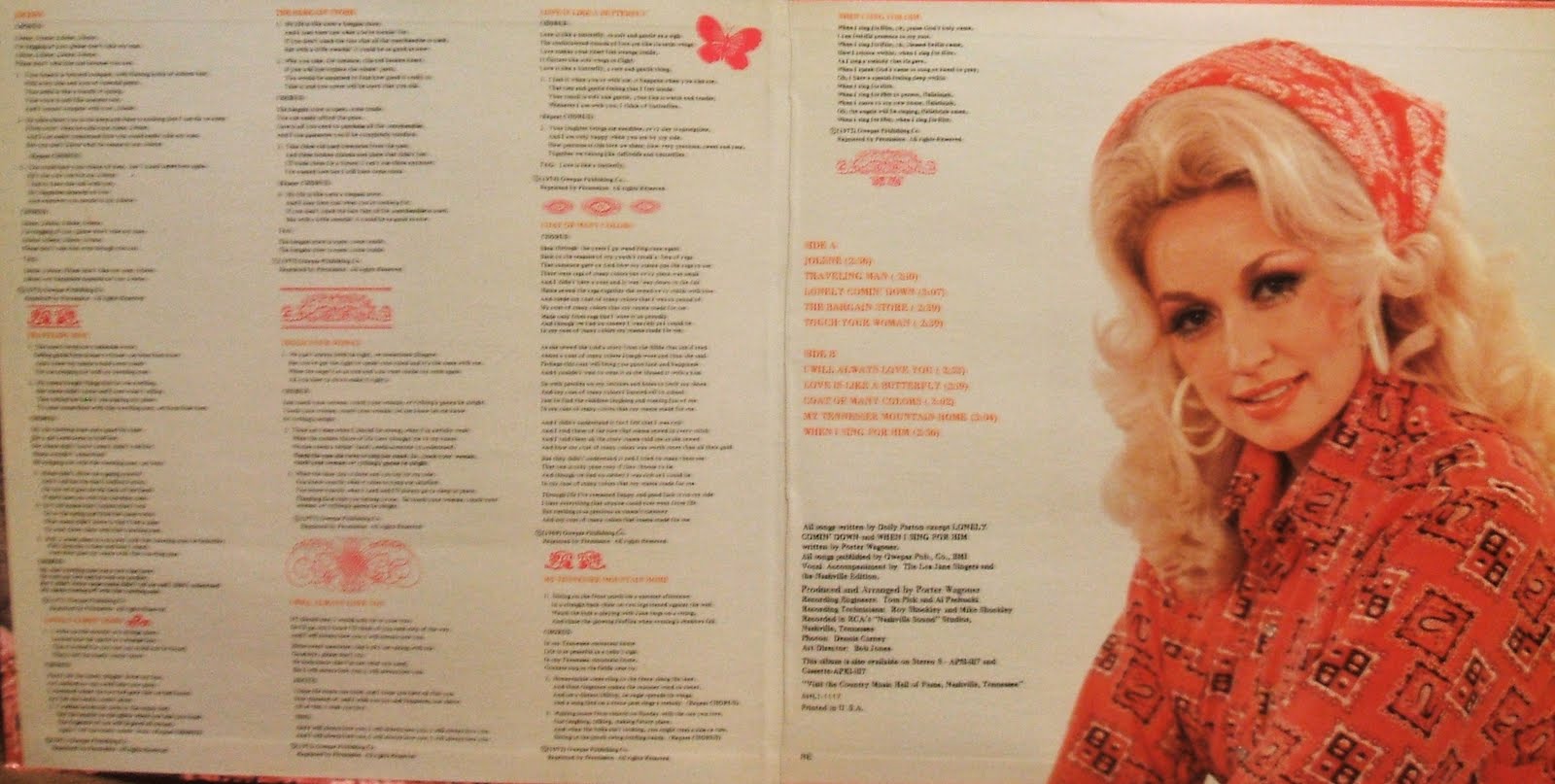
Best of Dolly Parton - Dolly Parton
Dolly Parton
RCA AHL1-1117
1975
The CD era has rendered a lot of vinyl compilation albums obsolete. You can cram more songs on a CD although I suppose it is debatable whether a lot of performers need more than 40 minutes to compile their “greatest hits”. This album will never be obsolete though. It is a perfect record, one of my favorites of all time. I’m not a big country music fan, but that doesn’t matter because this is a great pop album that transcends genre. Ten pristine tracks of Parton at her peak, before Hollywood and her regrettable attempt for mainstream success. If you like Buddy Holly or Paul McCartney you should like “Jolene” regardless of how you feel about country music. This album features heartfelt singing and brilliant songwriting throughout - pure American music at its finest. Plus if you are lucky you might find a copy with a nifty poster of Parton inside. I don’t know where to begin in singling out specific songs, they are all wonderful. “Lonely Coming Down” gives me chills whenever I hear it and you’d have to be pretty heartless not to be moved by “Coat of Many Colors.” "The Bargain Store" shows her typically inspired use of metaphors. "My Tennessee Mountain Home" is warm and inviting, it makes me want to take a road trip to the Smoky Mountains. I like the frankness of "Touch Your Woman," Parton lyrics are always worth paying attention to, she definitely has something to say. The sweet sincerity of Parton’s original version of “I Always Will Love You” is infinitely superior to Whitney Houston’s histrionic cover version. People might dismiss Parton because of her goofy persona and the mediocre music she made in the late 1970s and 1980s, but this record is proof positive that from 1969 to 1974, she was one of the great artists in American music, period, right up there with John Fogerty and Bob Dylan. A great, great record. Recommended to anyone who has a heart.
Subscribe to:
Posts (Atom)