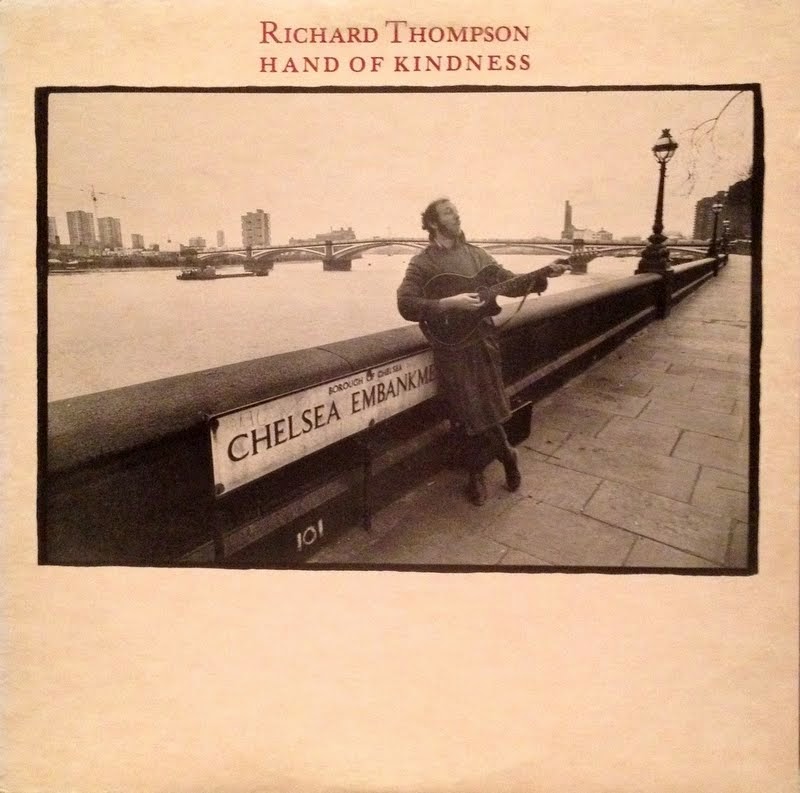
Hand of Kindness
Richard Thompson
Hannibal Records HNLP 1313
1983
I saw Richard Thompson perform with his power trio at the Levitt Pavilion last summer. It was a typically fantastic show and for me the highlight was his rocked up performance of "Tear Stained Letter" which was the lead track on this album. We were all singing along with him having a blast. That prompted me to pull out this album and give it a few spins having not heard it for several years. It still sounds terrific. Actually I have to admit when I first heard it back in the 1980s I was a little disappointed. It was issued in the wake of his break-up with Linda Thompson, his wife and musical partner. I missed Linda's voice and the music lacked much of the drama and intensity that characterized his preceding album, the classic "Shoot Out The Lights." Over time I succumbed to its many charms and now it is among my favorites in his extensive catalog. Like its predecessor it features a reunion of the "Full House" line up of Fairport Convention minus Dave Swarbrick: Thompson, Simon Nicol, Dave Pegg, Dave Mattacks and producer Joe Boyd. My favorite track is "Tear Stained Letter" which is a propulsive country rocker driven by John Kirkpatrick on accordion and Pete Zorn and Pete Thomas on saxophone. Thompson offers up some rockabilly style guitar solos that are smoking hot. The song is about the travails of breaking up and heartache. It is tempting to interpret this as a response to his marriage breaking up but Thompson has always written about this sort of stuff. "How I Wanted To" covers the same territory but without the humor and without the beat. The song is slow and mournful, notable mostly for Thompson's heartfelt vocal and ringing guitar lines. "Both Ends Burning" is a jaunty tune about a race horse. The song is highlighted by Kirkpatrick's accordion and the honky-tonk sax solos at the end of the song. The redoubtable Fairport rhythm section drives the vindictive "A Poisoned Heart and a Twisted Memory" which is a majestic folk-rocker with a very strong vocal from Thompson. I love his howling guitar solo at the end of the song. Side two begins with "The Wrong Heartbeat" which has a riff that reminds me of a 1960s English beat group sound with a ska flavor as well. "Hand of Kindness" sounds like an outtake from "Shoot Out The Lights" with its dark hypnotic groove and cutting guitar sound as well as its desperate lyrics. It is another one of my favorite tracks and features more dynamic guitar work from Thompson on top of a rock solid foundation from Pegg and Mattacks. Very compelling stuff. "Devonside" is an even darker song although the music is more upbeat. It is a fatalistic portrait of a pair of doomed lovers that displays Thompson's gift for evocative and poetic lyrics. The song features a lovely fiddle solo from Aly Bain. The album closes on a humorous note with the rollicking "Two Left Feet" which is a folk-rock dance tune with a Cajun flavor which features some memorable playing from the two Petes on sax and Kirkpatrick on his accordion as well as some all too brief electrifying runs from Thompson himself. It gets me bopping big time and give the record an exhilarating finish. If you are a Richard Thompson fan, this is an essential record and if you are not a fan, you should be. Great guitar playing, strong vocals, brilliant songwriting, what's not to like? Recommended to people who think "Full House" would have been a better record if Thompson had been singing lead instead of Dave Swarbrick.
Pour Down Like Silver
Richard and Linda Thompson
Island Records ILPS 9348
1975
I had the good fortune to catch Richard Thompson closing out his Electric Trio tour at the Ford Amphitheatre in Hollywood last May. It was a real treat to see the great man rocking out with a power trio - I'm not kidding about that, they even did a convincing cover of Cream's "White Room." He also reached into the past to perform "For Shame of Doing Wrong" off this album. It was his fourth album after leaving Fairport Convention and his third album as a duo with his then wife, Linda Thompson. It was the second album of Thompson's that I bought, I picked it up in an import bin at a Berkeley record store around 1980. When I saw the cover, I was shocked. I had read that the Thompsons had embraced Sufism, but I didn't know exactly what that was. Then I saw this album and there was my hero looking more like a blue-eyed Arab mystic than an English rocker. I was pretty dismayed. I wasn't anti-Muslim (although with the Iran hostage crisis still fresh in my memory I wasn't particularly pro-Muslim either) but I was trying to shake loose from my own religious upbringing and here was my idol jumping off the deep end into religious zealotry. It upset me nearly as much as Dylan's recent (at the time) conversion to Christianity. I bought the album anyway and when I gave it a spin I was reassured because it sounded a lot like Thompson's secular music. It is permeated with religious spirituality but contains no overt religious references. There is no trace of the preachiness or sanctimony that made Dylan's Christian records so hard to swallow. In fact the opening number "Streets of Paradise" would fit quite comfortably on his earlier albums "Hokey Pokey" or "I Want To See The Bright Lights Tonight." It is driven by a slow stately riff powered by the Fairport rhythm section of Dave Pegg and Dave Mattacks and colored by John Kirkpatrick's accordion runs. The song is full of Thompson's typically sardonic humor as he sings about a poor man contemplating his future in paradise. "For Shame of Doing Wrong" is a heartbreak song sweetly sung by Linda. The song's downbeat lyrics are countered by an upbeat, almost cheerful melody. Kirkpatrick dominates the song until the end where Thompson lays down some tasty guitar licks that end all too soon for my liking. "The Poor Boy Is Taken Away" is the grimmest song on the album. It is a bleak heartbreak song full of hopelessness achingly sung by Linda with minimal instrumental color aside from Thompson's mandolin and acoustic guitar. Side one ends with the magnificent "Night Comes In" which is one of the more spiritual songs on the album. It is full of evocative imagery and deep feeling but there is no explicit mention of a deity. Thompson's heartfelt vocal expresses feelings of redemption but it is vague enough that the redemption could just as reasonably be coming from love as it could from religion. It features Thompson's most impressive guitar playing on the record. He starts out playing lovely decorative figures but as the song builds in strength he picks up energy delivering heavier runs. It reminds me of his great work on "Sloth" on Fairport's "Full House." (There is a tremendous live version of "Night Comes In" on his "(guitar, vocal)" album.) Side two kicks off with "Jet Plane in a Rocking Chair" which is easily the most upbeat song on the record, a joyous love song that is rather unusual in Thompson's typically dark oeuvre. The charming lyrics are jointly delivered by Richard and Linda and the tune features more instrumentation than most of the other songs on the album. The comparatively stark "Beat The Retreat" is more typically Thompsonian. It is a song of defeat and surrender. I presume that Thompson is singing about returning to his God, but again the song is vague enough that it could be interpreted to mean returning to a loved one or a family. There is no trace of piety in "Hard Luck Stories" which is vintage Thompson as he rips into a whining acquaintance with great vigor and humor. It is one of the nastiest songs he's ever written. Linda delivers the lyrics with plenty of invective that is slightly leavened by the amiable melody led by Kirkpatrick's perky accordion playing. Religion returns for "Dimming of the Day/Dargai" which ends the album on a somber note. "Dimming of the Day" features a powerful, emotional vocal from Linda supported by spare instrumentation that focuses one's attention on her quavering voice. The lyrics express neediness and a desire for support in highly poetic terms. They are clearly directed at a person, but I suspect that Thompson is finding his solace in a higher power. The song is linked to "Dargai" which is a gorgeous solo guitar instrumental that is credited to Thompson on the album, but it is adapted from a mournful fiddle tune by Scottish composer James Scott Skinner. It provides a somber, but beautiful coda for the album. I think this is one of Thompson's best albums although it can't match the consistent greatness of "I Want To See The Bright Lights Tonight" or the drama and dynamic tension of "Shoot Out The Lights." It is subdued but all the music is memorable and I don't think Thompson has ever made such a heartfelt and plaintive record. I'm not spiritual but I respect spirituality in others when it is sincere and intelligent and it doesn't get much more sincere and intelligent than this. This album has an aura to it, it is remarkably atmospheric and moving. It also has a feeling of finality to it. After recording this album the Thompsons withdrew from the commercial music world and lived on a Muslim commune in England. It would be three years before they would release a new album. Recommended to people who think that "John Wesley Harding" is a more spiritual album than "Slow Train Coming."
No Roses
Shirley Collins and the Albion Country Band
Antilles AN-7017
1971
This is the 1976 American release of an album originally released on Pegasus in England. I consider it one of the best English folk-rock albums and it was made by an all-star line-up of English folk performers including the "Liege and Lief" line-up of Fairport Convention minus Dave Swarbrick and Sandy Denny. Ashley Hutchings (who had just married Collins) was the driving force behind the record which sounds a lot like his work with Fairport and Steeleye Span, but Collins herself had a long history as a progressive figure in English folk. Her 1964 collaboration with Davy Graham "Folk Roots, New Routes" is a favorite of mine and is often cited as a pioneering work in liberating English folk from its traditional strait-jacket as is her 1969 album "Anthems in Eden" in which (in collaboration with her sister Dolly) Collins explored new instrumental settings for traditional music. Still neither of those albums approach rock, which this album delivers in spades. The album kicks off with the beat of the drums and Collins launches into "Claudy Banks" which is a familiar folksong about a man who unrecognized by his lover tests her fidelity by telling her that her boyfriend is dead and observing her reaction. It sounds like Fairport Convention until the sax and bassoon kick in. It is followed by the charming "The Little Gypsy Girl" in which the title character induces a wealthy squire to marry her. It is driven by Tony Hall on the melodeon. The stately "Banks of the Bann" follows with some beautiful piano lines from Dolly Collins. It is about a poor boy in love with a wealthy girl whose parents reject him. "Murder of Maria Marten" is an amazing song reminiscent of early Neil Young and Crazy Horse. Three electric guitars rock out accompanied by a fiddle and a hurdy-gurdy supported by the rock solid rhythm section of Ashley Hutchings and Dave Mattacks. Richard Thompson takes the lead supported by Simon Nicol and Quiver's Tim Renwick and the result sounds a lot like the Fairport classic "Sloth" from "Full House." Collins' passionate vocal relates a dark ballad based on a sensational 19th Century murder case and the song alternates between chugging folk-rock and a mournful drone. It is a true folk-rock synthesis and displays the full possibilities of the genre. Side two opens with "Van Dieman's Land" which continues in a similar vein as Collins sings of poachers being exiled to Tasmania as punishment. It has a solid folk-rock backing with pipes and a concertina adding instrumental color as well as an ophicleide. "Just As The Tide Was A'Flowing" reminds me of the first Steeleye Span album, "Hark! The Village Wait," a resemblance heightened by Maddy Prior's presence as a harmony vocalist. It is a sweet song about a bride who misses her sailor husband away at sea. It sounds to me like phasing is applied to the concertina on the song and I'll bet that Hutchings got the idea from the Byrds. Folk singing stalwarts Lal and Mike Waterson as well as Royston Wood of the Young Tradition join Collins on the hunting song "The White Hare." It sounds more folk than rock as does the May Day dance song, "Hal-An-Tow." Rock returns full force on the closing song, "Poor Murdered Woman" with the redoubtable team of Hutchings and Mattacks laying down a forceful rhythm track on which Nicol and Thompson pile on ringing guitar chords with Dolly Collins adding gorgeous piano lines and Dave Bland playing the concertina. This tragic song of murder and class conflict gradually builds in intensity in the best Fairport style and Collins delivers one of her most emotionally powerful vocals. The song gives me chills. It is a great conclusion to a classic record, one of the most fully-realized and satisfying folk-rock records ever, it offers the best of both genres. Recommended for fans of "Liege and Lief" and "Full House."
The North Star Grassman and The Ravens
Sandy Denny
A&M SP 4317
1971
My favorite Sandy Denny solo album. If you combined the best cuts on this with the best songs on Fairport Convention's "Full House", you would have a terrific follow-up to Fairport Convention's "Liege and Lief". If only she had stayed with the Fairports long enough to pull them out of their obsession with traditional English music, we might have been spared some of the mediocre folk-rock albums that tarnished the band's name. But then again Richard Thompson probably would have still left and that was really the death of the band. This album is actually closer to Fairport's "Unhalfbricking" than it is to "Liege and Lief". There is only one traditional song (the very fine "Blackwaterside") and there is a nice Dylan cover "Down in the Flood" as well as a sexy and rockin' cover of Brenda Lee's "Let's Jump the Broomstick" - the sort of eclecticism that made the early Fairport so charming and fun. Denny's original songs are often criticized for being too obscure and I have to admit there are plenty here that I can't figure out even when I stare at a lyric sheet although they do sound very nice. I was shocked when I read Rob Young's "Electric Eden" and saw his interpretation of the gloomy and doom-laden "Late November" as being a reference to the van crash that nearly destroyed Fairport Convention which she apparently foresaw in a dream. I was equally surprised to learn from Young that "Next Time Around" was about her former boyfriend Jackson Frank and their days hanging around in Theo Johnson's folk club. You can appreciate either song without knowing their significance to her yet I find it amazing that she fills the songs with so many telling, yet impossibly obscure and personal clues that only a close friend would ever be able to figure them out. I love both songs but this insular quality is a little alienating to me. I would certainly prefer a more direct connection to what she is trying to say. The exception to this is "John the Gun" which is one of the most compelling songs she ever wrote, a beautiful synthesis of traditional folk style and a modern sensibility. Anyway although I don't understand some of the songs, I love Denny's voice so much I'd listen to this record even if the songs were written in Klingon. She is supported by an excellent backing band featuring most notably Richard Thompson who plays on the entire album and helped produce it as well. Recommended for Fairport Convention fans who rue the day Dave Swarbrick joined the band.