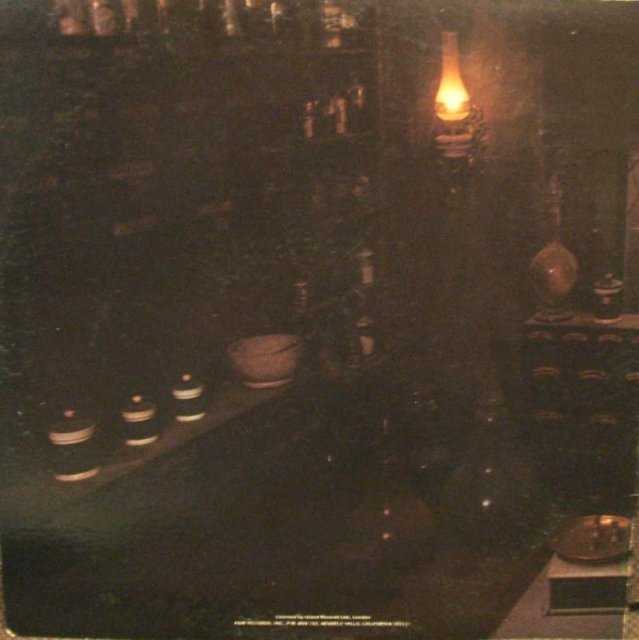
Led Zeppelin IV
Led Zeppelin
Atlantic SD 19129
1971
I've opted for the conventional moniker of "Led Zeppelin IV" for this album, which as you probably know has no official title aside from 4 symbols representing the band members which leads many people to call it "The Runes Album." I rarely play it, but last month I attended a pops concert by the high school orchestra that my kid plays in. One of the songs they tackled was "Stairway to Heaven" which I found amazing since that would never have happened when I was in high school. In my high school Led Zeppelin was actually considered kind of dangerous. It was common knowledge that Jimmy Page was a Satanist and the band's bad behavior on the road was well-documented. This sounds ludicrous nowadays, but my school was in a conservative suburb and fundamentalist Christians outnumbered the stoners by a ratio of at least two to one. The first time I heard this album in its entirety was at a high school party. That also seems kind of ludicrous since this is a terrible party record. It is loud and gloomy, has no groove and you can't dance to it. It is mostly suitable for standing around drinking beer and acting like you are older than you really are, so I guess it wasn't a bad choice for the kind of stupid parties I used to go to. The kid who played it was a total dork, but he gained credibility in my mind for spinning it at his party which just goes to show how naive I was. I didn't even realize that the record was already more than five years old at the time, it sounded cutting edge to me. Given that none of us were aware of punk/New Wave yet, maybe it still was edgy. It is not like Blue Oyster Cult or Aerosmith were any better. I've never been a big fan of the group although I have all of their original studio albums. I always resented that they were so much more successful than the Yardbirds from which they emerged and I hated the rock star bombast associated with them. When I want to hear some heavy hard rock I'm more likely to reach for Nirvana or Sleater Kinney. I have to admit though that this album is impressive and truly deserves its classic status. My favorite track is "The Battle of Evermore" in which Robert Plant duets with the immortal Sandy Denny. It is a folk-flavored tune with Tolkienesque lyrics, it sounds like a cross between Fairport Convention and the Incredible String Band. English folk rock is also the basis for the most famous song on the record, "Stairway to Heaven." I loved this song back in the 1970s. I played it over and over when I bought this album. Unfortunately it has been the object of so much parody that it is hard to take it seriously and I've heard it so many times that I don't really hear it anymore when I listen to it. I still think it is a brilliant song though, a true folk rock synthesis with some dazzling guitar work. Folk-rock is also prevalent in "Going To California" which has some of my favorite Led Zeppelin lyrics. My other favorite track on the album is Memphis Minnie's "When The Levee Breaks" which I think is the band's best blues song and perhaps the most underrated song in the Led Zeppelin canon. It boasts a great Plant vocal and thunderously powerful music - I love Page's wailing guitar. Of course the band did not abandon their heavy metal roots completely. "Black Dog" and "Rock and Roll" are lumpen-rockers driven by John Bonham's ferocious ham-fisted drumming and killer riffs that will appeal to any fan of "Led Zeppelin II." Arguably they were the most dynamic and exciting songs of 1971 but they have been playing incessantly on classic rock radio since I was a teenager and I'm truly sick of them. Nonetheless I freely admit they are among the band's greatest songs and genuine heavy metal landmarks. However when it comes to rockers on this record I prefer "Four Sticks." I don't know why that song is not more popular, it sure beats "Misty Mountain Hop" which I find tedious. I even dig Bonzo's drumming on it. To me this record seems as much a hippie relic as "Sgt. Pepper" but people still seem to love it. I don't, but I respect it enormously and if I'm in the right mood I will easily succumb to its power and verve. Recommended to Fairport Convention fans who prefer "Tam Lin" to "Who Knows Where The Time Goes."
Unhalfbricking
Fairport Convention
A&M SP 4206
1969
I bought this in Berkeley around 1980. It was the third album by Fairport Convention. I wish I had held out for an import copy of the Island Records version of this record with the charming cover image of Sandy Denny's parents in front of their home. Presumably some genius at A&M decided that an image of old people on a record cover would discourage youthful record buyers and substituted a picture of circus elephants instead - brilliant! By 1980 Fairport records were getting tough to find so I grabbed this when I had the chance. This is one of my favorite records, I've played it a lot in the last 30 years. I would have a tough time choosing between "Unhalfbricking" and the second Fairport album (entitled "Fairport Convention" in the American market) as to which one is better, I love them both and consider them both masterpieces. This was the last Fairport album to feature original members Iain Matthews (only on "Percy's Song") who quit for a solo career, although not without some pushing from elements in the band, and Martin Lamble who was killed when the band's van crashed shortly after the album was recorded. It also marks the debut of future member Dave Swarbrick as a guest performer on nearly half the album. Swarbrick would go on to have a big influence on the future direction of the band, a direction I'm not a big fan of, but I appreciate his contributions to this record and at least he doesn't sing. There are only eight songs and every one is a gem. The record begins with Richard Thompson's "Genesis Hall" which I think is among the best of his early songs. This is followed by one of three Dylan covers on the record, "Si Tu Dois Partir", a French language version of "If You Gotta Go, Go Now." It is a rollicking, jug band styled interpretation that produced the group's only hit single in the UK. Sandy Denny's "Autopsy" comes next. It is a rather cold song, particularly the first verse which is almost vicious. I like the jazzy feel of the backing though. Side one closes with "A Sailor's Life" which is the song that gets this album labeled a transitional album so often. It is the only traditional song on the album, the rest of which adheres to the style of the second Fairport album (which actually had two traditional songs on it.) It is an extraordinary performance, Sandy Denny sings with great passion and the guitar-fiddle interplay between Richard Thompson and Dave Swarbrick is as mesmerizing as anything you will ever hear on a rock album. Thompson's soloing is just magnificent, he established himself as a front rank guitarist with this song. As all folk-rock fans know, the contemporary treatment of traditional music was not new, but "A Sailor's Life" took it to a new level, the rock/folk synthesis is dazzling in its effectiveness. In my opinion nothing on "Liege and Lief" surpasses this epic song, in fact I would venture to say that no song in the folk-rock canon surpasses this song. When I first heard it, it floored me and to this day when I listen to it, I'm enthralled, by the time it is over I'm mentally spent. Just a great, great song. Side two kicks off with Thompson's "Cajun Woman" which is lots of fun, I love the slide guitar and the accordion, it demonstrates the eclecticism that made the early Fairport so awesome. Sandy Denny's signature song "Who Knows Where the Time Goes" is next, if it is not the best song she ever wrote, it is certainly the most famous. I sometimes find Denny's lyrics to be excessively remote or obscure, but that is not the case with this song, a genuine classic and truly beautiful. Dylan covers close out the record. "Percy's Song" boasts a tremendous heartfelt vocal from Denny that lifts what would otherwise be a rather mundane and tedious song. I may be in the minority in that opinion, but it is easy for me to see why Dylan never released the song himself (until "Biograph" anyway.) The gloom of that song is lifted by "Million Dollar Bash" which is another rollicking, humorous song. It is the only song where Denny is not the lead singer, various band members take turns with the verses as well as guest singer Marc Ellington. It is a great way to close the album. Thus ends the happiest chapter in the Fairport saga, tragedy, break-up and mediocrity lay ahead. This is a classic album, one that everyone should hear. Recommended for people who think folk music is boring and old-fashioned, prepare to be blown away.
Fairport Convention
Fairport Convention
A&M SP 4185
1969
I bought this in Berkeley around 1980 and instantly fell in love with it. This was the second Fairport Convention album which was entitled "What We Did On Our Holidays" in England with an entirely different cover. I normally don't approve of record companies mucking about with album art, but I have to confess that I really like this cover. It is my favorite picture of the group and I had it on display in my room for many years. I am particularly moved by the happy countenance of Martin Lamble in the picture, in less than a year he would be killed in the van crash that nearly put an end to the band. Aside from the altered artwork, the album is the same as its British counterpart. It is a classic album, a folk-rock landmark and one of the best albums of its era. This is my favorite Fairport line-up with new addition Sandy Denny and Iain Matthews handling vocals. Matthews would be pushed out of the group during the sessions for the next record, which I suppose made sense but I miss his contribution to the group. I thought his vocal interplay with Denny worked really well particularly on the lovely "Book Song." This is one of the most graceful and charming pop records I have ever heard, it is full of wonderful singing and exquisite instrumental passages, particularly Richard Thompson's inspired guitar work. Ever since I first heard it, I have considered the haunting "She Moves Through the Fair" to be the most beautiful pop song in existence. Denny's vocal on that song makes me quiver every time I hear it. Denny's own "Fotheringay" is also astonishingly atmospheric and moving and features some wonderful acoustic guitar interplay. Anyone who has ever heard the early Fairport's BBC recordings knows what a great cover band they were and this record is no exception with memorable covers of Dylan's "I'll Keep It With Mine" and Joni Mitchell's "Eastern Rain. Richard Thompson asserts himself as an unusually talented songwriter with "Book Song," "No Man's Land," "Tale in a Hard Time," and the classic "Meet on the Ledge." It is hard to believe that Thompson was only about 20 years old when he wrote "Meet on the Ledge," it is such a mature and wise song. I can't hear it without thinking about Lamble and Denny. I find it moving and uplifting every time I listen to it. Even at this early stage in his career Thompson displays his gift for language and a distinctive point of view in all of his songs. The traditional song "Nottamun Town" points towards Fairport's future although its exotic instrumentation is unusual for them. It has a raga-like sound reminiscent of the Incredible String Band which may not be a coincidence since both bands shared Joe Boyd as a producer. There is also a rare foray into the blues with Ashley Hutchings' "Mr. Lacey" which has its charms but also makes me glad that they stuck to folk-rock. The odd mechanical noises in the instrumental break were created by robots made and operated by the titular character who was once a neighbor of Hutchings. This is such a great album, I don't think you will ever find a more intelligent and beautiful pop record. It is so unfortunate that the core line-up of Fairport was so short-lived, they were so talented and had so much potential, at their peak with this album and "Unhalfbricking" they were among the best rock bands in the world. I'd pick this record over "Abbey Road," "Let It Bleed," "Led Zeppelin," "Tommy" or just about any other album from 1969 any day of the week. Recommended for anyone who seeks beauty and sincere emotion in pop music.
Fairport Chronicles
Fairport Convention
A&M SP 3530
1976
The boring suburban town I spent my teenage years in did not have a record store most of the time I lived there. I had to travel to a mall in another town where I bought most of my first albums in a typical chain record store. It didn't stock much of a back catalog or carry anything out of the ordinary which is why I was flabbergasted when I went in there and saw this sitting in the bin. I only knew Fairport Convention because of their entry in "The Illustrated Encyclopedia of Rock" by Nick Logan and Bob Woffinden which was basically my bible at the time. Their description of Fairport as the English Jefferson Airplane fascinated me since I was heavily into the Airplane. I was dying to hear them and I was thrilled to pick this up. By a lot of standards this is kind of a crappy compilation, it ignores much of their career including their debut album, their only hit single "Si Tu Dois Partir" and nearly all of the traditional songs they covered including such crucial ones as "A Sailor's Life," "Matty Groves" and "Sir Patrick Spens." Yet somehow it still works. The compilers have an agenda of sorts, basically championing the original vision of the band as a contemporary folk-rock outfit, celebrating the musical content of their second and third albums ("Fairport Convention" and "Unhalfbricking") before "Liege and Lief" changed them forever. They even throw in songs from splinter groups Fotheringay and the Bunch - all contemporary covers - that reflect this perspective as well as a song from Sandy Denny's solo album, "Sandy." 20 songs in total, only two traditional numbers and six covers. Only one song from "Angel Delight" and 2 from "Full House." 9 songs from the second and third album though. A greatest hits album without any hits. Instead it is a pointed and intelligent selection of songs from a hard luck band that never got the success it deserved. I loved it at the time and I love it still. It flows beautifully, it feels like an organic and cohesive whole even though it jumps all over the place temporally. All the songs are first rate. The liner notes are extensive, smart and informative. It is a wonderful introduction to Fairport. I've been a fan ever since I first heard it. Recommended to fans of the Band who wish they had been fronted by an enchanting woman singer with the most divine voice ever to grace a rock group.
The North Star Grassman and The Ravens
Sandy Denny
A&M SP 4317
1971
My favorite Sandy Denny solo album. If you combined the best cuts on this with the best songs on Fairport Convention's "Full House", you would have a terrific follow-up to Fairport Convention's "Liege and Lief". If only she had stayed with the Fairports long enough to pull them out of their obsession with traditional English music, we might have been spared some of the mediocre folk-rock albums that tarnished the band's name. But then again Richard Thompson probably would have still left and that was really the death of the band. This album is actually closer to Fairport's "Unhalfbricking" than it is to "Liege and Lief". There is only one traditional song (the very fine "Blackwaterside") and there is a nice Dylan cover "Down in the Flood" as well as a sexy and rockin' cover of Brenda Lee's "Let's Jump the Broomstick" - the sort of eclecticism that made the early Fairport so charming and fun. Denny's original songs are often criticized for being too obscure and I have to admit there are plenty here that I can't figure out even when I stare at a lyric sheet although they do sound very nice. I was shocked when I read Rob Young's "Electric Eden" and saw his interpretation of the gloomy and doom-laden "Late November" as being a reference to the van crash that nearly destroyed Fairport Convention which she apparently foresaw in a dream. I was equally surprised to learn from Young that "Next Time Around" was about her former boyfriend Jackson Frank and their days hanging around in Theo Johnson's folk club. You can appreciate either song without knowing their significance to her yet I find it amazing that she fills the songs with so many telling, yet impossibly obscure and personal clues that only a close friend would ever be able to figure them out. I love both songs but this insular quality is a little alienating to me. I would certainly prefer a more direct connection to what she is trying to say. The exception to this is "John the Gun" which is one of the most compelling songs she ever wrote, a beautiful synthesis of traditional folk style and a modern sensibility. Anyway although I don't understand some of the songs, I love Denny's voice so much I'd listen to this record even if the songs were written in Klingon. She is supported by an excellent backing band featuring most notably Richard Thompson who plays on the entire album and helped produce it as well. Recommended for Fairport Convention fans who rue the day Dave Swarbrick joined the band.