Showing posts with label English Folk-Rock. Show all posts
Thursday, June 4, 2015
Fly on Strangewings - Marian Segal with Silver Jade
Fly On Strangewings
Marian Segal with Silver Jade
DJM Records DJM 9100
1971
This is the American release of the sole album by Jade originally released in England in 1970. The group's name was altered because there was already a group in America called Jade. Collectors might want to pursue the British version of this album which was released in a more attractive gatefold sleeve which I believe is also the case with modern reissues of the album. I've mentioned in past posts my fondness for British folk-rock and this is an excellent example of the contemporary version of that genre. All the songs are originals, composed by Marian Segal, but they show the influence of traditional musical styles throughout similar to the work of Richard Thompson, John Martyn and Sandy Denny. It is a delightful album that deserves to be better known. It opens with "Amongst Anemonies" featuring sterling work from guest performers Terry Cox on drums and guitarist James Litherland contributing to a robust instrumental sound. The vocal interplay between Segal and her bandmates Dave Waite and Rod Edwards is quite dynamic. The song contrasts life in the rural countryside with a dream of the sea. Edwards drives the delicate "Raven" with his harpsichord and organ work. It is a cryptic song with gothic imagery that examines a May-December relationship. Waite and Segal trade verses and then duet on the final verse. "Fly on Strangewings" reminds me of Sandy Denny, particularly "Who Knows Where The Time Goes." This soaring song about separation is one of my favorite cuts. The song features a lovely vocal from Segal and engaging piano work from Edwards bolstered by a tasteful string arrangement by Phil Dennys. "Mayfly" sounds like the traditional song "The Cuckoo." It is a jaunty country-flavored song that laments the short life span of the title insect. "Alan's Song" commemorates a childhood friend of Segal's who died in an accident as a teen. It is a nostalgic song that looks back on the aspirations of childhood. "Bad Magic" is a percussion heavy song that mixes rock and chamber pop courtesy of Edwards on his harpsichord. It reminds me of Donovan or early Traffic. The song advises the listener to avoid the witch-like woman who is the subject of the song. Side two opens with "Clippership" which describes a woman living vicariously through the past experiences that her singer-lover recounts to her. It is a propulsive song in the best folk-rock manner with pleasing vocal harmonies. "Five of Us" recounts Segal's experiences sharing a rustic cottage with four friends. It reminds me of the first Fairport Convention album but it has a chamber pop sound as well. Segal's vocal is especially appealing to me on this track. This is another one of my favorite songs on the record. "Reflections on a Harbour Wall" is precisely that, a description of the experience of being in a harbor town. It is a guitar driven track that starts slow and picks up speed as it goes along. James Litherland has a nice lyrical guitar solo. "Mrs. Adams" is about the death of the title character. John Harper's violin playing and the structure of the tune create a traditional folk sound as does the repetition of the lyrics. The song is given a forceful folk-rock push by the rhythm section of Pete Sears on bass and Mick Waller on drums. "Fly Me to the North" is a sensitive and gentle song about running away from heartbreak and sadness. Segal and Waite trade verses and then duet supported by another pretty string arrangement from Dennys. The record ends with "Away From the Family" which is also about escape, this time making it on one's own away from one's family. It is the hardest rocking song on the record with a heavy guitar riff and honky tonk piano from Rod Edwards. This lumbering tune obtrusively departs from the sound of the rest of the record, but it does end the record with a bang. I am a big fan of this album. Segal is a fine songwriter. Her lyrics are personal and intelligent with evocative imagery. Although influenced by folk tradition, the music sounds contemporary and is eclectic in style and instrumentation. The record is never boring and it consistently engages me emotionally and sonically. If you are a fan of folk-rock, it is well worth seeking out. Recommended to fans of early Fairport Convention and Trader Horne.
Sunday, April 12, 2015
Sir John Alot of Merrie Englandes Musyk Thyng & Ye Grene Knyghte - John Renbourn
Sir John Alot of Merrie Englandes Musyk Thyng & Ye Grene Knyghte
John Renbourn
Reprise Records RS 6344
1969
The great English guitarist John Renbourn passed away last month much to my sorrow. As I've mentioned in many past posts, I became interested in English folk music following my discovery of Fairport Convention as a teenager. I started with Fairport and branched off into Steeleye Span and Pentangle which is where I learned of Renbourn. This was the first Renbourn solo album that I bought. It was originally released in 1968 in England on Transatlantic Records. At the time I had never heard a record like it. The mixture of folk, jazz and classical in Renbourn's work and his skill and dexterity on guitar impressed me a great deal. Since then I've heard plenty of folk and jazz guitar records and I still think this record sounds pretty amazing. It starts with the courtly "The Earle of Salisbury" which is listed as a traditional song but it is normally attributed to the English Renaissance composer William Byrd. I hadn't heard much music from this era at the time and I adored Renbourn's stately playing of this delicate tune. It prompted me to explore Renaissance music with many happy results and I'm still a fan of that music. The song is followed by "The Trees They Do Grow High" which features Ray Warleigh on flute. Renbourn is listed as the composer but it is a traditional song that is known by many other titles generally featuring the words "Daily Growing." This was the first place that I heard the song, but Renbourn also recorded it with vocals on Pentangle's album "Sweet Child" (which I did not have at the time.) That is my favorite version, but this instrumental one has a lot of appeal, particularly Warleigh's jazzy flute lines. "Lady Goes to Church" was written by Renbourn but it sounds more like something a Renaissance troubadour might have composed. It is very elegant with some remarkable fret work from Renbourn. Side one concludes with "Morgana" which is one of my favorite tracks on the record. It begins with Warleigh playing a Renaissance style air on his flute supported by Renbourn and then Terry Cox joins in on drums and the song takes off with some propulsive runs from the players. They proceed to run through several more Renaissance style tunes all of which are highly engaging. It blew me away as a teenager and it still sends me. Side one focuses on ancient music, but side two concentrates on jazz and blues and is more likely to appeal to rock fans. It opens with "Transfusion" by the jazz saxophonist Charles Lloyd and it was originally recorded by the Chico Hamilton Quintet in 1962. Renbourn has retained the frenetic quality of the original with a lot of help from Terry Cox on African drums. Renbourn's fingers are flying throughout the cut. It is one of my favorite tracks on the record and it ends way too soon. "Forty-Eight" is credited to Renbourn and Cox and it is a more sedate track although it still has a jazzy feel to it. Cox plays glockenspiel and drums on it. Renbourn wrote "My Dear Boy" which is a short but kinetic exercise with a ragtime flavor. "White Fishes" is a collaboration with Ray Warleigh who also plays flute on the song. Both men deliver some exciting jazz-influenced runs, it is another stand-out track. Next Renbourn covers Booker T and the MGs' "Sweet Potato." The song lacks the seductive groove of the original but Renbourn increases the tempo slightly and with help from Cox on percussion the song rocks quite nicely. Lots of fun. The album concludes with "Seven Up" by Renbourn and Cox. It is a raga-influenced track with dynamic interplay between Renbourn and Cox that is very invigorating to listen to. A fantastic track that ends the album on a high note. I've yet to acquire all of Renbourn's solo albums, but this is my favorite of the ones I have. There is not a mediocre cut on it and most of it is simply outstanding, a great acoustic guitarist at the peak of his powers. Between his solo work and Pentangle, Renbourn made a lot of great music that has delighted me for several decades now and for which I am immensely grateful. Recommended to fans of Bert Jansch and Davy Graham.
Tuesday, March 17, 2015
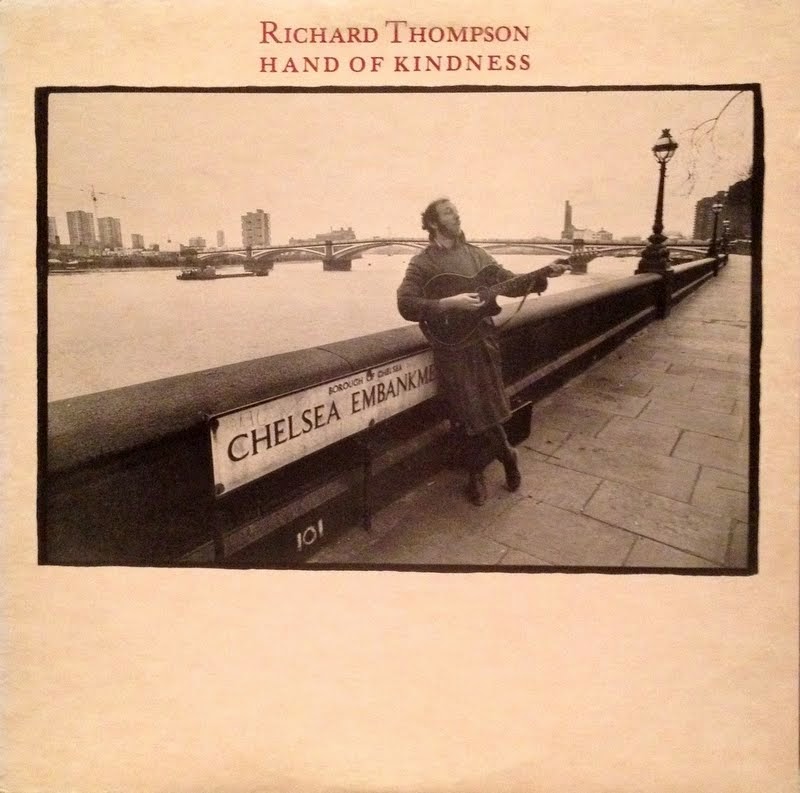
Hand of Kindness - Richard Thompson
Hand of Kindness
Richard Thompson
Hannibal Records HNLP 1313
1983
I saw Richard Thompson perform with his power trio at the Levitt Pavilion last summer. It was a typically fantastic show and for me the highlight was his rocked up performance of "Tear Stained Letter" which was the lead track on this album. We were all singing along with him having a blast. That prompted me to pull out this album and give it a few spins having not heard it for several years. It still sounds terrific. Actually I have to admit when I first heard it back in the 1980s I was a little disappointed. It was issued in the wake of his break-up with Linda Thompson, his wife and musical partner. I missed Linda's voice and the music lacked much of the drama and intensity that characterized his preceding album, the classic "Shoot Out The Lights." Over time I succumbed to its many charms and now it is among my favorites in his extensive catalog. Like its predecessor it features a reunion of the "Full House" line up of Fairport Convention minus Dave Swarbrick: Thompson, Simon Nicol, Dave Pegg, Dave Mattacks and producer Joe Boyd. My favorite track is "Tear Stained Letter" which is a propulsive country rocker driven by John Kirkpatrick on accordion and Pete Zorn and Pete Thomas on saxophone. Thompson offers up some rockabilly style guitar solos that are smoking hot. The song is about the travails of breaking up and heartache. It is tempting to interpret this as a response to his marriage breaking up but Thompson has always written about this sort of stuff. "How I Wanted To" covers the same territory but without the humor and without the beat. The song is slow and mournful, notable mostly for Thompson's heartfelt vocal and ringing guitar lines. "Both Ends Burning" is a jaunty tune about a race horse. The song is highlighted by Kirkpatrick's accordion and the honky-tonk sax solos at the end of the song. The redoubtable Fairport rhythm section drives the vindictive "A Poisoned Heart and a Twisted Memory" which is a majestic folk-rocker with a very strong vocal from Thompson. I love his howling guitar solo at the end of the song. Side two begins with "The Wrong Heartbeat" which has a riff that reminds me of a 1960s English beat group sound with a ska flavor as well. "Hand of Kindness" sounds like an outtake from "Shoot Out The Lights" with its dark hypnotic groove and cutting guitar sound as well as its desperate lyrics. It is another one of my favorite tracks and features more dynamic guitar work from Thompson on top of a rock solid foundation from Pegg and Mattacks. Very compelling stuff. "Devonside" is an even darker song although the music is more upbeat. It is a fatalistic portrait of a pair of doomed lovers that displays Thompson's gift for evocative and poetic lyrics. The song features a lovely fiddle solo from Aly Bain. The album closes on a humorous note with the rollicking "Two Left Feet" which is a folk-rock dance tune with a Cajun flavor which features some memorable playing from the two Petes on sax and Kirkpatrick on his accordion as well as some all too brief electrifying runs from Thompson himself. It gets me bopping big time and give the record an exhilarating finish. If you are a Richard Thompson fan, this is an essential record and if you are not a fan, you should be. Great guitar playing, strong vocals, brilliant songwriting, what's not to like? Recommended to people who think "Full House" would have been a better record if Thompson had been singing lead instead of Dave Swarbrick.
Wednesday, July 31, 2013
Pour Down Like Silver - Richard and Linda Thompson
Pour Down Like Silver
Richard and Linda Thompson
Island Records ILPS 9348
1975
I had the good fortune to catch Richard Thompson closing out his Electric Trio tour at the Ford Amphitheatre in Hollywood last May. It was a real treat to see the great man rocking out with a power trio - I'm not kidding about that, they even did a convincing cover of Cream's "White Room." He also reached into the past to perform "For Shame of Doing Wrong" off this album. It was his fourth album after leaving Fairport Convention and his third album as a duo with his then wife, Linda Thompson. It was the second album of Thompson's that I bought, I picked it up in an import bin at a Berkeley record store around 1980. When I saw the cover, I was shocked. I had read that the Thompsons had embraced Sufism, but I didn't know exactly what that was. Then I saw this album and there was my hero looking more like a blue-eyed Arab mystic than an English rocker. I was pretty dismayed. I wasn't anti-Muslim (although with the Iran hostage crisis still fresh in my memory I wasn't particularly pro-Muslim either) but I was trying to shake loose from my own religious upbringing and here was my idol jumping off the deep end into religious zealotry. It upset me nearly as much as Dylan's recent (at the time) conversion to Christianity. I bought the album anyway and when I gave it a spin I was reassured because it sounded a lot like Thompson's secular music. It is permeated with religious spirituality but contains no overt religious references. There is no trace of the preachiness or sanctimony that made Dylan's Christian records so hard to swallow. In fact the opening number "Streets of Paradise" would fit quite comfortably on his earlier albums "Hokey Pokey" or "I Want To See The Bright Lights Tonight." It is driven by a slow stately riff powered by the Fairport rhythm section of Dave Pegg and Dave Mattacks and colored by John Kirkpatrick's accordion runs. The song is full of Thompson's typically sardonic humor as he sings about a poor man contemplating his future in paradise. "For Shame of Doing Wrong" is a heartbreak song sweetly sung by Linda. The song's downbeat lyrics are countered by an upbeat, almost cheerful melody. Kirkpatrick dominates the song until the end where Thompson lays down some tasty guitar licks that end all too soon for my liking. "The Poor Boy Is Taken Away" is the grimmest song on the album. It is a bleak heartbreak song full of hopelessness achingly sung by Linda with minimal instrumental color aside from Thompson's mandolin and acoustic guitar. Side one ends with the magnificent "Night Comes In" which is one of the more spiritual songs on the album. It is full of evocative imagery and deep feeling but there is no explicit mention of a deity. Thompson's heartfelt vocal expresses feelings of redemption but it is vague enough that the redemption could just as reasonably be coming from love as it could from religion. It features Thompson's most impressive guitar playing on the record. He starts out playing lovely decorative figures but as the song builds in strength he picks up energy delivering heavier runs. It reminds me of his great work on "Sloth" on Fairport's "Full House." (There is a tremendous live version of "Night Comes In" on his "(guitar, vocal)" album.) Side two kicks off with "Jet Plane in a Rocking Chair" which is easily the most upbeat song on the record, a joyous love song that is rather unusual in Thompson's typically dark oeuvre. The charming lyrics are jointly delivered by Richard and Linda and the tune features more instrumentation than most of the other songs on the album. The comparatively stark "Beat The Retreat" is more typically Thompsonian. It is a song of defeat and surrender. I presume that Thompson is singing about returning to his God, but again the song is vague enough that it could be interpreted to mean returning to a loved one or a family. There is no trace of piety in "Hard Luck Stories" which is vintage Thompson as he rips into a whining acquaintance with great vigor and humor. It is one of the nastiest songs he's ever written. Linda delivers the lyrics with plenty of invective that is slightly leavened by the amiable melody led by Kirkpatrick's perky accordion playing. Religion returns for "Dimming of the Day/Dargai" which ends the album on a somber note. "Dimming of the Day" features a powerful, emotional vocal from Linda supported by spare instrumentation that focuses one's attention on her quavering voice. The lyrics express neediness and a desire for support in highly poetic terms. They are clearly directed at a person, but I suspect that Thompson is finding his solace in a higher power. The song is linked to "Dargai" which is a gorgeous solo guitar instrumental that is credited to Thompson on the album, but it is adapted from a mournful fiddle tune by Scottish composer James Scott Skinner. It provides a somber, but beautiful coda for the album. I think this is one of Thompson's best albums although it can't match the consistent greatness of "I Want To See The Bright Lights Tonight" or the drama and dynamic tension of "Shoot Out The Lights." It is subdued but all the music is memorable and I don't think Thompson has ever made such a heartfelt and plaintive record. I'm not spiritual but I respect spirituality in others when it is sincere and intelligent and it doesn't get much more sincere and intelligent than this. This album has an aura to it, it is remarkably atmospheric and moving. It also has a feeling of finality to it. After recording this album the Thompsons withdrew from the commercial music world and lived on a Muslim commune in England. It would be three years before they would release a new album. Recommended to people who think that "John Wesley Harding" is a more spiritual album than "Slow Train Coming."
Wednesday, October 19, 2011
Full House - Fairport Convention
Full House
Fairport Convention
A&M SP 4265
1970
I bought this in Berkeley around 1980. This was the fifth album by Fairport Convention and the final studio album with original member Richard Thompson. His departure for a solo career effectively marked the end of the group as an artistically significant unit. They would keep plugging away to this very day (with various hiatuses) and release many more albums of course, some pretty good and one close to awful ("Gottle O'Geer".) However as much as I love the band, I wish they had quit after this one, not even the brief return of Sandy Denny in the mid 1970s could save them from irrelevance. Kudos to them though for hanging in there all these years despite all the adversity. It is rather amazing that this record is as good as it is. The band had to survive the departure of two critical members of the group following the release of "Liege & Lief." Founding member, bassist Ashley Hutchings, was replaced by Dave Pegg who was more than an adequate replacement musically but didn't replace the artistic direction and inspiration offered by Hutchings who had largely been responsible for the band's venture into playing English folk-rock in the first place. Still it was the departure of lead vocalist Sandy Denny that was the more serious problem. In the course of two albums the band went from having two first rate vocalists to having none. Denny was more than just a vocalist, she contributed many key songs and was both the face and arguably the heart of the band. She was irreplaceable although the band's decision not to bring in a new vocalist at all is questionable. Dave Swarbrick assumed most of the vocalist duties and as a vocalist, Swarbrick is an excellent fiddler. Personally I find his voice rather grating and I would have preferred to have Thompson and Simon Nicol do all the singing. Thompson was a little raw at the time, but would develop into a very fine, expressive singer in the coming years. Still the music on this record is so good that even Swarbrick's singing can't detract too much from it and besides a good portion of it consists of instrumentals. The jaunty opening song "Walk Awhile" features Swarbrick, Thompson, Pegg and Nicol all taking turns at the mike. Although composed by Swarbrick and Thompson the song does have a strong traditional feeling to it and it is a lively and humorous song that displays the band's instrumental strength to good effect. This is particularly evident on the next cut, "Dirty Linen." On "Liege & Lief" the band had inaugurated the practice of performing a medley of traditional instrumental dance tunes on their records and there are two such medleys on this album. "Dirty Linen" is my favorite of all the ones the band has ever done. The band's new rhythm section of Pegg and Dave Mattacks kicks ass, Thompson's fingers fly up and down the fretboard and Swarbrick saws away on top of it all like a maniac. It is an incredibly propulsive set of tunes guaranteed to turn the most stubborn wallflower into a lord of the dance. I get happy feet every time I listen to it. On a BBC recording of the song, Nicol says they chose the name for the medley because when they first started doing the song live they were bluffing their way through it, but I find that hard to believe considering how great the recording is. The side concludes with another Thompson/Swarbrick song, the epic "Sloth." Lyrically the song is a bit slight, a few verses decrying war and numerous repetitions of the simple chorus, for some reason the song makes me think of the American Civil War, but it is vague enough to apply to just about any war. This simple song is stretched out by lengthy instrumental passages including some of Thompson's best guitar work with Fairport. The interplay between Thompson and Swarbrick on the solos is mesmerizing and the robust rhythm section relentlessly drives the song to its climax. The song is an absolute classic and it remained in Fairport's repertoire even after Thompson left the band, although frankly none of the other instrumentalists in the band ever came close to matching Thompson's ability. The man is a true wizard of the guitar. "Sloth" joins "A Sailor's Life" as the best example of the band's instrumental brilliance, fully the rival of any jam band from that era. Side two opens with the traditional song "Sir Patrick Spens." The band members trade vocals although Swarbrick sings most of it. The band first attempted the song during the "Liege & Lief" sessions and there are at least two recordings of Sandy Denny singing the song with Fairport which give a tantalizing glimpse of how great this album could have been if she had stuck around. Even with the low-fi nature of the recordings I prefer those Denny versions. Still the official version is very impressive. It has a dynamic arrangement with lots of sterling instrumental work, a fine example of the potential of English folk-rock. On the BBC performance of "Sir Patrick Spens" Simon Nicol notes that the band was unhappy with the original tune ("a bit AC/DC" he says but I have no idea what he means by that) and substituted the tune of another Child ballad, "Hughie the Graeme." I had trouble understanding the song when I first heard it. I had to go to the library and look it up in the Child ballads just to figure out all the words and realize it is about a conspiracy to kill a bunch of Scottish lords. Next up is "Flatback Caper" another dance tune melody. It is not as exciting as "Dirty Linen" but it is sure to get your toe tapping. I might question the wisdom of including a second instrumental on the album, but if it keeps Swarbrick from singing I'm fine with it. "The Doctor of Physick" is the final Thompson/Swarbrick song on the album and it is one of my favorite songs on the album. It is a sinister song about Doctor Monk who preys upon girls who think "improper" thoughts and steals their maidenheads. It features a superb riff and the group shares the vocal. I've always wondered if this song is derived from Chaucer, but I've never seen anything to confirm this. In "The Canterbury Tales" one of the characters is a Doctor of Physick and his tale concerns a father who beheads his daughter rather than allowing a corrupt judge to rape her. Regardless of the inspiration for it, it is a terrific song full of atmosphere and another example of the band's unparalleled skill at replicating traditional music styles. The album concludes in a gloomy manner with the mournful traditional song, "Flowers of the Forest" which laments the loss of life in an ancient English victory over Scotland. It might have been moving if Sandy Denny were singing it, but Swarbrick dominates the group vocal and to me having him sing a slow dirge is almost like fingernails scraping a chalkboard. It is easily my least favorite Fairport song on their first five albums. There was originally an eighth song intended for this album, Thompson/Swarbrick's "Poor Will and the Jolly Hangman" but Thompson had it withdrawn prior to pressing. That is unfortunate because it would have been the best song on this album and lifted it to a higher status in my opinion. Thompson would later add some overdubs with his then wife, Linda Thompson, and release it on "(guitar, vocal)" and the Fairport version would later surface on archival releases as well as the CD re-issue of this album. It is one of my favorite Fairport songs and another fine example of Thompson's skill at utilizing traditional elements in contemporary songwriting. Even without this song though, I still admire this album and I've played it a lot through the years without getting the least bit tired of it. As an added bonus this album has some of the most interesting liner notes I've ever seen. On the back of the cover Richard Thompson has written up the imaginary results of a bunch of games, most of them old and forgotten involving characters from folklore such as Allison Gross as well as characters from the album like the Doctor of Physick. I've never heard of most of the games and I spent a good deal of time back when I got the record looking up the games and characters, no easy task in those pre-internet days. Thompson's account is both amusing and sardonic with lots of violence. I have no desire to try my hand at Badger in the Bag or Sparrow-Mumbling that's for sure. Recommended for folklorists looking for proof that their work has relevance.
Wednesday, September 21, 2011
No Roses - Shirley Collins and the Albion Country Band
No Roses
Shirley Collins and the Albion Country Band
Antilles AN-7017
1971
This is the 1976 American release of an album originally released on Pegasus in England. I consider it one of the best English folk-rock albums and it was made by an all-star line-up of English folk performers including the "Liege and Lief" line-up of Fairport Convention minus Dave Swarbrick and Sandy Denny. Ashley Hutchings (who had just married Collins) was the driving force behind the record which sounds a lot like his work with Fairport and Steeleye Span, but Collins herself had a long history as a progressive figure in English folk. Her 1964 collaboration with Davy Graham "Folk Roots, New Routes" is a favorite of mine and is often cited as a pioneering work in liberating English folk from its traditional strait-jacket as is her 1969 album "Anthems in Eden" in which (in collaboration with her sister Dolly) Collins explored new instrumental settings for traditional music. Still neither of those albums approach rock, which this album delivers in spades. The album kicks off with the beat of the drums and Collins launches into "Claudy Banks" which is a familiar folksong about a man who unrecognized by his lover tests her fidelity by telling her that her boyfriend is dead and observing her reaction. It sounds like Fairport Convention until the sax and bassoon kick in. It is followed by the charming "The Little Gypsy Girl" in which the title character induces a wealthy squire to marry her. It is driven by Tony Hall on the melodeon. The stately "Banks of the Bann" follows with some beautiful piano lines from Dolly Collins. It is about a poor boy in love with a wealthy girl whose parents reject him. "Murder of Maria Marten" is an amazing song reminiscent of early Neil Young and Crazy Horse. Three electric guitars rock out accompanied by a fiddle and a hurdy-gurdy supported by the rock solid rhythm section of Ashley Hutchings and Dave Mattacks. Richard Thompson takes the lead supported by Simon Nicol and Quiver's Tim Renwick and the result sounds a lot like the Fairport classic "Sloth" from "Full House." Collins' passionate vocal relates a dark ballad based on a sensational 19th Century murder case and the song alternates between chugging folk-rock and a mournful drone. It is a true folk-rock synthesis and displays the full possibilities of the genre. Side two opens with "Van Dieman's Land" which continues in a similar vein as Collins sings of poachers being exiled to Tasmania as punishment. It has a solid folk-rock backing with pipes and a concertina adding instrumental color as well as an ophicleide. "Just As The Tide Was A'Flowing" reminds me of the first Steeleye Span album, "Hark! The Village Wait," a resemblance heightened by Maddy Prior's presence as a harmony vocalist. It is a sweet song about a bride who misses her sailor husband away at sea. It sounds to me like phasing is applied to the concertina on the song and I'll bet that Hutchings got the idea from the Byrds. Folk singing stalwarts Lal and Mike Waterson as well as Royston Wood of the Young Tradition join Collins on the hunting song "The White Hare." It sounds more folk than rock as does the May Day dance song, "Hal-An-Tow." Rock returns full force on the closing song, "Poor Murdered Woman" with the redoubtable team of Hutchings and Mattacks laying down a forceful rhythm track on which Nicol and Thompson pile on ringing guitar chords with Dolly Collins adding gorgeous piano lines and Dave Bland playing the concertina. This tragic song of murder and class conflict gradually builds in intensity in the best Fairport style and Collins delivers one of her most emotionally powerful vocals. The song gives me chills. It is a great conclusion to a classic record, one of the most fully-realized and satisfying folk-rock records ever, it offers the best of both genres. Recommended for fans of "Liege and Lief" and "Full House."
Friday, September 16, 2011
Five Leaves Left - Nick Drake
Five Leaves Left
Nick Drake
Antilles AN-7010
1969
I recently read Patrick Humphries' biography of Nick Drake. It is not a fun read but worthwhile if you are a Drake fan. I had all kinds of questions about the man, but after reading the book he remains a cipher to me. Apparently no one ever really understood him or his problems. I became interested in Drake through Fairport Convention. In my late teens I was obsessed with Fairport and after exhausting the original albums I branched off into their various offshoots. Drake wasn't technically an offshoot, but he was discovered by Ashley Hutchings, was managed and produced by Joe Boyd (who performed the same function with Fairport) and various Fairporters played on his first two albums. This is the American version of Drake's debut album released on Island Records' subsidiary label Antilles in 1976. The original Island release in the U. K. featured a gatefold cover with a different back cover. The picture on the back cover here was originally in the gatefold and the front cover of the Island release was a lighter shade of green. This album was not released in the U. S. during Drake's lifetime although a few of its tracks appear on a rare comp entitled "Nick Drake" that was the only American release of his music while he was alive. One of the things that impressed me in the book was Island's treatment of Drake. Even though he refused to tour and did almost no publicity for his records, they kept him on their roster, gave him complete creative freedom and kept his records in the catalogue despite dismal sales. What American record company would have done that in the 1970s? Kudos to Island and Chris Blackwell! I bought this album around 1980 in Berkeley. I was enormously impressed by it and it has remained a favorite ever since. The album opens with "Time Has Told Me" which is a fatalistic love song which with hindsight seems revealing of his mentality both in its passivity and references to mental unease. Drake's acoustic guitar playing is very distinctive and lovely on this song. According to Humphries, Drake achieved his unique style through unusual tunings and a complicated picking style. He is supported by Richard Thompson on electric guitar although he seems superfluous considering the richness of Drake's own playing. "River Man" is one of Drake's best known songs. It has a haunting melody and enigmatic lyrics. I'm not crazy about the string arrangement, Drake would later complain about the over-production on his first two albums and I can see his point listening to this song. "Three Hours" is one of my favorite songs on the album. It has a Middle Eastern feel to it and a dazzling guitar performance from Drake as well as one of his most compelling vocals. According to Humphries, the song is about a school friend of Drake although the song is enigmatic enough to apply to anyone looking for escape. On "Way To Blue" Drake is accompanied only by a string arrangement by his college friend Robert Kirby. In this case I think the strings do enhance the yearning quality of the song. The lyrics describe someone seeking something, enlightenment or some sort of fulfillment. Again with hindsight it is tempting to see it as a more personal song than it probably really is. The A side concludes with "Day Is Done" featuring Kirby's strings along with Drake on guitar. As with many of the lyrics on the album, Drake uses nature to express his reflections on people and their lives. It is a beautiful, but gloomy song that describes an existential perspective on the insignificance of our daily lives. I love "'Cello Song" which features more splendid guitar work from Drake supported by a hypnotic bass riff from Danny Thompson (of Pentangle) and lovely cello passages courtesy of Clare Lowther. From an instrumental standpoint, I think it is the best song on the record. Lyrically it is yet another song about transcendence and escape. "The Thoughts of Mary Jane" is the most upbeat song on the record. The title character is a bit twee, but it is a relief from the dark tone on most of the other songs. I particularly like the high tempo guitar passage at the end. The jazzy "Man In the Shed" continues the upbeat feeling musically with some propulsive piano support from Paul Harris and typically strong bass lines from Danny Thompson. The lyrics are peculiar, almost silly, although the line "please stop my world from raining through my head" has a lot of resonance considering Drake's future mental problems. "Fruit Tree" is one of Drake's more famous songs and deservedly so. His musings on the transience of fame and particularly on posthumous fame foreshadows Drake's career although he couldn't possibly have known it as the time. Humphries' bio suggests that his lack of success was one of the prime contributors to Drake's mental illness and "Fruit Tree" indicates that it was a subject of considerable significance to Drake. This melancholy song features another string arrangement from Robert Kirby that greatly enhances its emotional impact. The album concludes with "Saturday Sun" which has a jazzy arrangement with Drake on piano and Tristam Fry on vibraphone. The lyrics speak of confusion and missed opportunities, I can hardly resist applying them to Drake's life although I imagine that Drake was just making general observations about life. I'm constantly tempted to filter this album through the myth of Nick Drake that has grown around him since his death, but this album was written and recorded before his mental illness took hold of him, back when he was basically a normal person albeit a withdrawn and shy one. When I first bought this record, I felt Drake was a kindred soul, his lyrics really spoke to me, but now I'm mostly just drawn to the music. I still admire some of his words and his evocative imagery but I don't relate very strongly to his perspective. I think that is just part of getting older. When I was in my teens and twenties, I felt confusion and bewilderment about life and my place in the world, which is now largely gone. Lyrically I relate more to grizzled veterans like Richard Thompson, Leonard Cohen and Bob Dylan now. But I will always have a soft spot for Drake, I spent many melancholy evenings spinning this album and feeling reassured that someone understood the way I felt back then. He has become such a popular artist, loved by so many people, it is heartbreaking to think that he died in such obscurity, feeling like an abject failure. Recommended for mixed-up college students.
Tuesday, May 3, 2011
Unhalfbricking - Fairport Convention
Unhalfbricking
Fairport Convention
A&M SP 4206
1969
I bought this in Berkeley around 1980. It was the third album by Fairport Convention. I wish I had held out for an import copy of the Island Records version of this record with the charming cover image of Sandy Denny's parents in front of their home. Presumably some genius at A&M decided that an image of old people on a record cover would discourage youthful record buyers and substituted a picture of circus elephants instead - brilliant! By 1980 Fairport records were getting tough to find so I grabbed this when I had the chance. This is one of my favorite records, I've played it a lot in the last 30 years. I would have a tough time choosing between "Unhalfbricking" and the second Fairport album (entitled "Fairport Convention" in the American market) as to which one is better, I love them both and consider them both masterpieces. This was the last Fairport album to feature original members Iain Matthews (only on "Percy's Song") who quit for a solo career, although not without some pushing from elements in the band, and Martin Lamble who was killed when the band's van crashed shortly after the album was recorded. It also marks the debut of future member Dave Swarbrick as a guest performer on nearly half the album. Swarbrick would go on to have a big influence on the future direction of the band, a direction I'm not a big fan of, but I appreciate his contributions to this record and at least he doesn't sing. There are only eight songs and every one is a gem. The record begins with Richard Thompson's "Genesis Hall" which I think is among the best of his early songs. This is followed by one of three Dylan covers on the record, "Si Tu Dois Partir", a French language version of "If You Gotta Go, Go Now." It is a rollicking, jug band styled interpretation that produced the group's only hit single in the UK. Sandy Denny's "Autopsy" comes next. It is a rather cold song, particularly the first verse which is almost vicious. I like the jazzy feel of the backing though. Side one closes with "A Sailor's Life" which is the song that gets this album labeled a transitional album so often. It is the only traditional song on the album, the rest of which adheres to the style of the second Fairport album (which actually had two traditional songs on it.) It is an extraordinary performance, Sandy Denny sings with great passion and the guitar-fiddle interplay between Richard Thompson and Dave Swarbrick is as mesmerizing as anything you will ever hear on a rock album. Thompson's soloing is just magnificent, he established himself as a front rank guitarist with this song. As all folk-rock fans know, the contemporary treatment of traditional music was not new, but "A Sailor's Life" took it to a new level, the rock/folk synthesis is dazzling in its effectiveness. In my opinion nothing on "Liege and Lief" surpasses this epic song, in fact I would venture to say that no song in the folk-rock canon surpasses this song. When I first heard it, it floored me and to this day when I listen to it, I'm enthralled, by the time it is over I'm mentally spent. Just a great, great song. Side two kicks off with Thompson's "Cajun Woman" which is lots of fun, I love the slide guitar and the accordion, it demonstrates the eclecticism that made the early Fairport so awesome. Sandy Denny's signature song "Who Knows Where the Time Goes" is next, if it is not the best song she ever wrote, it is certainly the most famous. I sometimes find Denny's lyrics to be excessively remote or obscure, but that is not the case with this song, a genuine classic and truly beautiful. Dylan covers close out the record. "Percy's Song" boasts a tremendous heartfelt vocal from Denny that lifts what would otherwise be a rather mundane and tedious song. I may be in the minority in that opinion, but it is easy for me to see why Dylan never released the song himself (until "Biograph" anyway.) The gloom of that song is lifted by "Million Dollar Bash" which is another rollicking, humorous song. It is the only song where Denny is not the lead singer, various band members take turns with the verses as well as guest singer Marc Ellington. It is a great way to close the album. Thus ends the happiest chapter in the Fairport saga, tragedy, break-up and mediocrity lay ahead. This is a classic album, one that everyone should hear. Recommended for people who think folk music is boring and old-fashioned, prepare to be blown away.
Wednesday, March 9, 2011
Fairport Convention - Fairport Convention
Fairport Convention
Fairport Convention
A&M SP 4185
1969
I bought this in Berkeley around 1980 and instantly fell in love with it. This was the second Fairport Convention album which was entitled "What We Did On Our Holidays" in England with an entirely different cover. I normally don't approve of record companies mucking about with album art, but I have to confess that I really like this cover. It is my favorite picture of the group and I had it on display in my room for many years. I am particularly moved by the happy countenance of Martin Lamble in the picture, in less than a year he would be killed in the van crash that nearly put an end to the band. Aside from the altered artwork, the album is the same as its British counterpart. It is a classic album, a folk-rock landmark and one of the best albums of its era. This is my favorite Fairport line-up with new addition Sandy Denny and Iain Matthews handling vocals. Matthews would be pushed out of the group during the sessions for the next record, which I suppose made sense but I miss his contribution to the group. I thought his vocal interplay with Denny worked really well particularly on the lovely "Book Song." This is one of the most graceful and charming pop records I have ever heard, it is full of wonderful singing and exquisite instrumental passages, particularly Richard Thompson's inspired guitar work. Ever since I first heard it, I have considered the haunting "She Moves Through the Fair" to be the most beautiful pop song in existence. Denny's vocal on that song makes me quiver every time I hear it. Denny's own "Fotheringay" is also astonishingly atmospheric and moving and features some wonderful acoustic guitar interplay. Anyone who has ever heard the early Fairport's BBC recordings knows what a great cover band they were and this record is no exception with memorable covers of Dylan's "I'll Keep It With Mine" and Joni Mitchell's "Eastern Rain. Richard Thompson asserts himself as an unusually talented songwriter with "Book Song," "No Man's Land," "Tale in a Hard Time," and the classic "Meet on the Ledge." It is hard to believe that Thompson was only about 20 years old when he wrote "Meet on the Ledge," it is such a mature and wise song. I can't hear it without thinking about Lamble and Denny. I find it moving and uplifting every time I listen to it. Even at this early stage in his career Thompson displays his gift for language and a distinctive point of view in all of his songs. The traditional song "Nottamun Town" points towards Fairport's future although its exotic instrumentation is unusual for them. It has a raga-like sound reminiscent of the Incredible String Band which may not be a coincidence since both bands shared Joe Boyd as a producer. There is also a rare foray into the blues with Ashley Hutchings' "Mr. Lacey" which has its charms but also makes me glad that they stuck to folk-rock. The odd mechanical noises in the instrumental break were created by robots made and operated by the titular character who was once a neighbor of Hutchings. This is such a great album, I don't think you will ever find a more intelligent and beautiful pop record. It is so unfortunate that the core line-up of Fairport was so short-lived, they were so talented and had so much potential, at their peak with this album and "Unhalfbricking" they were among the best rock bands in the world. I'd pick this record over "Abbey Road," "Let It Bleed," "Led Zeppelin," "Tommy" or just about any other album from 1969 any day of the week. Recommended for anyone who seeks beauty and sincere emotion in pop music.
Tuesday, February 15, 2011
Hark! The Village Wait - Steeleye Span
Hark! The Village Wait
Steeleye Span
Mooncrest Crest 22
1970
A 1974 re-issue of the original RCA release. This was their debut album and is my favorite Steeleye Span album. It features the unique Steeleye Span line-up of Ashley Hutchings, Maddy Prior, Tim Hart, Gay Woods and Terry Woods who only stayed together long enough to make this album. I was into British folk-rock for awhile, largely because I loved Fairport Convention so much and was trying to find something comparable to "Liege and Lief." Of course I never did, but this came pretty close. It basically follows the classic folk-rock pattern of adding electric guitars and a rock rhythm section to traditional songs. Unlike later Steeleye Span albums which leaned more towards rock, this one is still pretty much a folk album, emphasizing mood, harmony and beauty. When the Woods left after this album, the group cranked up the volume and I was never completely satisfied with the results. For example the version of "The Blacksmith" on here is subtle and moving, whereas the remake on "Please to See The King" is loud and powerful yet also a bit irritating, the song just does not invite that kind of heaviness. This record is full of wonderful singing arguably the best singing on any of Steeleye Span's albums. Maddy Prior is a fine singer but at times I do find her voice kind of overbearing and harsh, almost shrill. Gay Woods has a gentler, sweeter voice and their duet on "Fisherman's Wife" sounds heavenly. Their voices blend superbly, they complement each other so well. Woods' harmonies in support of Prior's lead vocals on "One Night As I Lay On My Bed" and "All Things Are Quite Silent" add warmth and depth to the songs. Her own leads on "Lowlands of Holland" and "Dark-Eyed Sailor" are sublime. I also like "Blackleg Miner" sung in a nasally vocal by Tim Hart which describes labor strife. (There is also an excellent version of this song on Richard Thompson's "1000 Years of Popular Music.") Terry Woods has a passionate vocal on the hunting song, "The Hills of Greenmore," which is one of the more powerful songs on the album. It is a shame that this line up of the band didn't last longer. This is an excellent album, one of the best British folk-rock albums I've ever heard. Really only the absence of a first rate instrumental virtuoso such as Richard Thompson keeps this record from surpassing Fairport Convention's own work in this vein. The songs are well chosen and tastefully performed, there is not a bad song on the record. It is a consistently enjoyable and interesting album that stays with you long after it is over. Recommended to Fairport fans who wonder what might have happened if Ashley Hutchings had stuck around and recruited a good singer to replace Sandy Denny when she left.
Friday, February 4, 2011
Fairport Chronicles - Fairport Convention
Fairport Chronicles
Fairport Convention
A&M SP 3530
1976
The boring suburban town I spent my teenage years in did not have a record store most of the time I lived there. I had to travel to a mall in another town where I bought most of my first albums in a typical chain record store. It didn't stock much of a back catalog or carry anything out of the ordinary which is why I was flabbergasted when I went in there and saw this sitting in the bin. I only knew Fairport Convention because of their entry in "The Illustrated Encyclopedia of Rock" by Nick Logan and Bob Woffinden which was basically my bible at the time. Their description of Fairport as the English Jefferson Airplane fascinated me since I was heavily into the Airplane. I was dying to hear them and I was thrilled to pick this up. By a lot of standards this is kind of a crappy compilation, it ignores much of their career including their debut album, their only hit single "Si Tu Dois Partir" and nearly all of the traditional songs they covered including such crucial ones as "A Sailor's Life," "Matty Groves" and "Sir Patrick Spens." Yet somehow it still works. The compilers have an agenda of sorts, basically championing the original vision of the band as a contemporary folk-rock outfit, celebrating the musical content of their second and third albums ("Fairport Convention" and "Unhalfbricking") before "Liege and Lief" changed them forever. They even throw in songs from splinter groups Fotheringay and the Bunch - all contemporary covers - that reflect this perspective as well as a song from Sandy Denny's solo album, "Sandy." 20 songs in total, only two traditional numbers and six covers. Only one song from "Angel Delight" and 2 from "Full House." 9 songs from the second and third album though. A greatest hits album without any hits. Instead it is a pointed and intelligent selection of songs from a hard luck band that never got the success it deserved. I loved it at the time and I love it still. It flows beautifully, it feels like an organic and cohesive whole even though it jumps all over the place temporally. All the songs are first rate. The liner notes are extensive, smart and informative. It is a wonderful introduction to Fairport. I've been a fan ever since I first heard it. Recommended to fans of the Band who wish they had been fronted by an enchanting woman singer with the most divine voice ever to grace a rock group.
Tuesday, January 11, 2011
The North Star Grassman and The Ravens - Sandy Denny
Sandy Denny
A&M SP 4317
1971
My favorite Sandy Denny solo album. If you combined the best cuts on this with the best songs on Fairport Convention's "Full House", you would have a terrific follow-up to Fairport Convention's "Liege and Lief". If only she had stayed with the Fairports long enough to pull them out of their obsession with traditional English music, we might have been spared some of the mediocre folk-rock albums that tarnished the band's name. But then again Richard Thompson probably would have still left and that was really the death of the band. This album is actually closer to Fairport's "Unhalfbricking" than it is to "Liege and Lief". There is only one traditional song (the very fine "Blackwaterside") and there is a nice Dylan cover "Down in the Flood" as well as a sexy and rockin' cover of Brenda Lee's "Let's Jump the Broomstick" - the sort of eclecticism that made the early Fairport so charming and fun. Denny's original songs are often criticized for being too obscure and I have to admit there are plenty here that I can't figure out even when I stare at a lyric sheet although they do sound very nice. I was shocked when I read Rob Young's "Electric Eden" and saw his interpretation of the gloomy and doom-laden "Late November" as being a reference to the van crash that nearly destroyed Fairport Convention which she apparently foresaw in a dream. I was equally surprised to learn from Young that "Next Time Around" was about her former boyfriend Jackson Frank and their days hanging around in Theo Johnson's folk club. You can appreciate either song without knowing their significance to her yet I find it amazing that she fills the songs with so many telling, yet impossibly obscure and personal clues that only a close friend would ever be able to figure them out. I love both songs but this insular quality is a little alienating to me. I would certainly prefer a more direct connection to what she is trying to say. The exception to this is "John the Gun" which is one of the most compelling songs she ever wrote, a beautiful synthesis of traditional folk style and a modern sensibility. Anyway although I don't understand some of the songs, I love Denny's voice so much I'd listen to this record even if the songs were written in Klingon. She is supported by an excellent backing band featuring most notably Richard Thompson who plays on the entire album and helped produce it as well. Recommended for Fairport Convention fans who rue the day Dave Swarbrick joined the band.
Subscribe to:
Posts (Atom)