My Tennessee Mountain Home
Dolly Parton
RCA APL1-0033
1973
I bought this several years ago in an antique store in Jamestown, ND - the home of the World's Largest Buffalo (it is a giant statue.) I sometimes buy country albums from the 1970s for artists I really like even though almost all of them were primarily singles artists. If I were smart I'd just buy compilations. The two big exceptions to that are Willie Nelson and Dolly Parton. Since they mostly wrote their own material, their albums have a higher quality than the single plus filler formula most of their peers employed. Parton made many fine albums in the 1970s but this is my favorite. It is a concept album focused on her childhood. The cover of the album depicts the house she grew up in and there is a picture of the home she was born in inside the gatefold along with pictures of her as a child as well as some family members. It also has liner notes written by her father and mother. The album begins with "The Letter" in which she recites a touching letter she wrote home when she first came to Nashville in 1964. The only music is a harmonica playing "Home Sweet Home." "I Remember" is a heartfelt tribute to her parents. It is enhanced by her gift for evocative descriptions. "Old Black Kettle" is a lively tune that describes cooking with the kettle of the title and provides a rosy picture of growing up in the country. "Daddy's Working Boots" as you probably can guess pays homage to her hard-working father. Parton has always had a way with symbols and metaphors and the boots serve that function in this song. "Dr. Robert F. Thomas" is an ode to the doctor who delivered her as a baby. The song celebrates his good deeds and perseverance as a country doctor. Side one concludes with "In the Good Old Days (When Times Were Bad)" which is a remarkable song that vividly describes her hardships growing up with mixed feelings of nostalgia and relief as reflected in the chorus when she sings "no amount of money could buy from me the memories that I have of then, no amount of money could pay me to go back and live through it again." The song is an old song that she originally released as a single in 1968 but it fits the theme of the record so well it is hard to blame her for wanting to re-record it for this album. On a record suffused with nostalgia, it provides some much needed realism. Side two begins with "My Tennessee Mountain Home" which was the single off the album. It is an idealized vision of her childhood that has great resonance. Its emotional impact is a testament to her genius as a songwriter and a performer and it is one of my favorite songs in her enormous catalog. "The Wrong Direction Home" describes how she misses her mountain home. In "Back Home" she joyously does return home. "The Better Part of Life" is more nostalgia enlivened by her richly expressive remembrances. "Down on Music Row" recounts her early experiences in Nashville. The story she tells is very detailed and celebrates RCA which is a little misleading since she did not sign with RCA until years later. Still it makes for a happy ending and gives the album some satisfying closure. I have to admit that the sentimentality and nostalgia that permeates this album would probably annoy me in the hands of a lesser artist. Parton's skill with imagery and her incomparable sincerity as a vocalist are able to convince a city-slicker like me that she really did have a wonderful childhood growing up impoverished in the country. It also helps that her musical accompaniment is so tasteful and subdued, allowing her voice and the lyrics to convey the feelings in the song. She is so full of love for the subjects of her songs, that she charms me and persuades me of the truth of her vision. This is a flawless album that is essential for Parton fans and recommended to anyone looking for a little warmth and affection to brighten up their lives.
It Keeps Right On A-Hurtin'
Johnny Tillotson
Cadence CLP 3058
1962
Several years ago I was browsing the vinyl in a thrift store when I came across a couple of Johnny Tillotson records in very good condition. I flipped one of them over and was irked to see there was writing on it until I realized it was autographed. I'm not a big enough Tillotson fan to get excited about that, but I felt a pang when I saw the record was autographed to Teddy. Teddy obviously was a big fan and since this vintage original pressing was in such good condition presumably treasured this album. The fact that the record was in a thrift store suggested to me that Teddy had died and Teddy's heirs disposed of this record in the easiest manner available to them aside from the trash. There was no way I was going to leave this record to rot in a thrift store, so I bought both albums to give them a good home for a few more decades (hopefully.) I've always thought of Tillotson as a pop artist, but this album consists largely of country music classics. The liner notes aptly describe the record as "Johnny Tillotson's Favorite Songs of Loneliness" as it is loaded with heartbreak songs. I'm not adverse to a good heartbreak song, but a steady stream of 12 of them makes for pretty dreary listening. Tillotson is a good singer with a tender expressive voice, but he lacks the depth to put over many of these songs. He is hopelessly outclassed by Hank Williams on "I'm So Lonesome I Could Cry" and "I Can't Help It (If I'm Still in Love with You)" and fares even worse taking on Patsy Cline with "I Fall to Pieces" and Cline and Andy Williams on "Lonely Street." He does better with Brenda Lee's "Fool #1" but I still prefer her version. He's not mature enough to put over songs like "Funny How Time Slips Away," Faron Young's "Hello Walls" or Jim Reeves' "Four Walls." He benefits from the more pop-flavored arrangements of "Take Good Care of Her" and especially Hank Locklin's "Send Me the Pillow You Dream On" which was a top 20 hit for him. He does great with Irving Berlin's oldie "What'll I Do" which proves surprisingly suitable for a country arrangement to which Tillotson adds a little teenage melodrama to give it extra oomph. The best song is easily Tillotson's own composition "It Keeps Right On A-Hurtin" which was a big hit single on both the country and pop charts. It is a classic heartbreak song that Tillotson sings with convincing feeling. Aside from the title track this is a marginal record but I do enjoy it. The songs are all good and the arrangements by Archie Bleyer are tasteful and restrained by countrypolitan standards. Tillotson is a very likeable singer with a pleasant voice. However with his boyish tone and smooth style I do think that he is much better at singing pop. Recommended to fans of Ricky Nelson.
Better Day
Dolly Parton
Dolly Records 1-528216
2011
Here is a post for Dolly Parton in honor of her recent 70th birthday. I'm a little mortified that she is already 70 but I'll bet she is fine with it. Nothing seems to faze her or diminish her indomitable positivity. I bought this album after seeing Parton during her tour promoting it back in 2011. I liked the new songs when I heard them in concert and I'm happy to say that the rest of the album is good as well. Parton wrote all the songs and is in fine form throughout. The album is appropriately pressed on sunny orange vinyl and is a double album even though it is barely more than 40 minutes long and could have fit on a single album which irks me since it requires getting up to flip the record every 10 minutes. That aside, I'm very happy with it. The record opens with "In The Meantime" which introduces the basic theme of the album - uplifted spirits and an optimistic attitude. It is a "don't worry, be happy" type song which downplays thoughts about the end of the world in favor of exalting our achievements and the good aspects of life. It is a propulsive country rocker with a typically charismatic vocal from Parton. "Just Leaving" asks for God's help in leaving a bad situation and looking for a better life. The song has a strong country flavor driven by a fiddle and a banjo. Despite the anxiety and unhappiness expressed in the lyrics, it is an upbeat song with a warm, comforting vocal from Parton. Side one concludes with "Somebody's Missing You" which is a sweet love song. Parton has always excelled at this type of romantic song. Alison Krauss and Emmylou Harris sing background vocals on the tune which sounds lovely. It is one of my favorite tracks on the album. Side two begins with "Together You and I" which is a love song that uses images from nature to celebrate her relationship. It has a more pop-oriented sound although the fiddle gives it some country flavor. "Country is as Country Does" was co-written with Mac Davis. The song is a humorous paean to her country roots and her core country values. It is a rollicking honky-tonk type song that is very entertaining. The side ends with "Holding Everything" which is an intensely romantic song that resembles her classic "I Will Always Love You" in the verses. The chorus is straight pop delivered with plenty of exuberance. Kent Wells, the album's producer and guitarist, duets with Parton on the song. It is a bit too pop for my liking but it is well done. Side three begins with "The Sacrifice" which I think is one of the oddest songs she has ever written. In it she recalls all the sacrifices she has made in order to be rich and successful. She compares her sacrifice with Jesus' sacrifice and concludes that it was all worth it. I admire her drive and determination but I find her reasoning a little dubious. I don't recall any parts of "The Bible" where Jesus extols the pursuit of riches. In keeping with the spirit of the lyrics, the music is upbeat and energetic. "I Just Might" is about recovering from heartbreak and optimistically moving on. It is a classic country-style ballad with a swelling chorus that derives its strength from Parton's emotional vocal. The side ends with "Better Day" in which she reassures us that though the present may seem bleak, better days lie ahead. She recites the first verse before launching into the song which is a mixture of gospel and rhythm and blues in style. The song shows off her vocal chops and is one of my favorites on the album. "Shine Like the Sun" is another "there will be a better tomorrow" type song that emphasizes moving forward and escaping the people and things that are bringing you down. The song is bouncy sunshine pop that reinforces the song's positive outlook. In "Get Out and Stay Out" she kicks out her unworthy lover and moves on for a better life. The words are surprisingly vindictive and harsh for Parton but true to her good nature, she sings them so sweetly it sounds more like a love song. I guess she just doesn't have it in her to be completely mean in a song. In "Let Love Grow" she encourages someone who has been burned by love in the past to give her a chance to show him how good love can be. The song is slick country-pop but Parton's heartfelt vocal gives the song emotional depth and makes for a stirring conclusion to the album. I don't think any of these songs can match the quality of her work in the early 1970s but all of them are good, making this a consistently satisfying album. I like its personal quality, it strongly reflects her personal philosophy as well as her dignity and strength. I've long admired her as an artist and I'm very pleased to see her still making meaningful records full of spirit and vitality so late in her career. Recommended to people looking for something to cheer them up - if Dolly Parton can't do it, you have some serious blues.
The Astounding 12-String Guitar of Glen Campbell
Glen Campbell
Capitol ST 2023
1964
I recently saw the excellent documentary "Glen Campbell: I'll Be Me" which is a behind the scenes look at his farewell tour emphasizing the devastating effect of Alzheimer's Disease on him. I saw one of the shows on that tour and I was astonished to see in the film how far gone he already was. Sitting in the audience at his show I thought he seemed in control and confident. In reality not only could he not remember the words to songs he has sung thousands of times (he used a teleprompter for the lyrics), he could barely remember his kids' names. Amazingly he could still play like the virtuoso guitarist he has always been. I guess that part of his brain is different from the part ravaged by his disease. This album showcases his instrumental skill. It was his third album. It seems likely that the weasels at Capitol Records did not know what to do with him. Here's this good-looking kid with a wonderful voice and they tried to turn him into Chet Atkins. It is a testament to his immense talent that he made this record work with his engaging and energetic fret work. My favorite cut is a performance of Bob Dylan's "Walkin' Down the Line" which starts out as a sprightly instrumental and then almost as if he can't help himself, Campbell bursts into song to sing a couple of verses. The record really jumps to life at that moment and you can see why the guy who wrote the liner notes felt that Campbell was going to "gain equal fame" as a vocalist. My favorite cuts among the instrumentals are a pair of duets with Roy Clark on the banjo, "Lonesome Twelve" and "The Ballad of Jed Clampett." The dynamic interplay between Clark and Campbell is very stimulating and frenetic. The album is worth picking up just for those two cuts alone. Campbell's own compositions "12-String Special" and the rocking "Bull Durham" are almost as good with lots of fine country-style picking. Campbell also tackles a bunch of folk hits. He is joined by Clark again for "Wimoweh" which isn't as exciting as the other two Clark cuts but still enjoyable. On "Puff (The Magic Dragon)" and "This Land Is Your Land" he plays the first verse straight then starts to embellish the songs with some terrific jazzy flights before coming back to earth to finish. Great stuff. He uses the same formula for "Blowin' In the Wind," "500 Miles (Away From Home)" and "Green, Green" but the improvised sections are more sedate. He's joined by Earl Palmer on bongo for "La Bamba" which gives the cut plenty of propulsion upon which Campbell lays down some of his finest guitar work on the record. I'm fond of this record, Campbell was a natural entertainer and that goes for his guitar solos as well. There is not a boring moment on this record. The man was certainly among the best guitar players of his generation. It makes me sad to think that not only has the great man's voice been silenced, but that I'll never get to hear another one of his lightning fast guitar runs again either. At least I have this record to remind me of his tremendous ability. Recommended to fans of the "pickin' and grinnin'" segments on "Hee-Haw."
Mama Tried
Merle Haggard and the Strangers
Capitol ST8-2972
1968
This is a modern reissue on 180 gram vinyl. I did not like country music very much until my 20s. Even when I started to appreciate it, I ignored Haggard who I associated with "Okie From Muskogee," a song I absolutely hated. It took the Everly Brothers to bring me around. They covered his songs "Sing Me Back Home" and "Mama Tried" on their classic album, "Roots" and I loved both songs. I started buying Haggard's music. I'm not a big fan, but I pick up his records when I see them at a good price. With a few exceptions like Dolly Parton, most country artists in the 1960s and 1970s were singles artists, their albums are mostly filler, compilations are the smart buy to get their best tunes. I don't think Haggard is any different but on this album the filler is pretty good. Haggard wrote four songs for the record and by far the best one is the title track. It is a moving song with autobiographical elements about a son who rebels against his mother and ends up in prison full of regret. I prefer the Everlys' version for its superior arrangement but Haggard's version has a lot of drive and feeling. I'm no expert on the man, but this is easily the best song I've ever heard him do. I also like his vindictive "I'll Always Know" which is one of the liveliest cuts on the record. "The Sunny Side of My Life" is the most upbeat song on the record, a welcome change from the doom and gloom that permeates the album although the song is ordinary at best. It still beats the fourth song Haggard wrote for the album, "You'll Never Love Me Now" which is pretty much the definition of filler - generic and mundane. The best of the non-originals is his cover of Dolly Parton's "In the Good Old Days" which recounts a youth spent enduring hardship. I prefer Parton's original (which you can find on "The Best of Dolly Parton") but Haggard's performance is very strong, arguably his best vocal on the album. Haggard grew up a dust bowl refugee so I think the song probably had a lot of resonance for him. Given that he spent time in San Quentin, I would have expected him to relate to Johnny Cash's "Folsom Prison Blues" as well, but his performance instead sounds uninspired to me. He does better with "Green Green Grass of Home" but plenty of guys have done it better than him. With its depiction of a condemned inmate recalling his family and home, it fits well with the theme of the album. I do prefer his version of "Little Ole Wine Drinker Me" over Dean Martin's hit version. It is one of my favorite tracks on the album. Mel Tillis' mournful "I Could Have Gone Right" revisits the theme of the title track as an imprisoned son apologizes to his mother for going wrong. It lacks the vitality of "Mama Tried" but Haggard sings it well. He has an even better vocal on Leon Payne's "Teach Me To Forget" although I find the song kind of tedious. Dallas Frazier's "Too Many Bridges to Cross Over" is not much better but at least it is faster. "Run 'Em Off" is the oddest song on the record. It was a country hit for Lefty Frizzell in 1954. It sounds old fashioned and its humor makes it stand out awkwardly from the rest of the tunes. I count four really good cuts on this album and two pretty good near misses which adds up to half the album which is a better than average percentage for a 1960s country album. Unless you are a big fan, you can probably pass it up, but I'm not sorry I bought it. Recommended to Johnny Cash fans.
Cowboyography
Ian Tyson
Sugar Hill Records SH-1021
1986
This is the 1987 American release of the Ian Tyson solo album originally released on Stony Plain Records in Canada. I have been reading Tyson's memoir "The Long Trail." I was primarily interested in reading about Ian and Sylvia, but Tyson has very little interest in that period of his life and career as it is confined to a little more than a chapter. Most of the book is devoted to his childhood, his solo career and most particularly his experiences with horses. He distances himself from Ian and Sylvia suggesting that it was not really his style or vision, observing that "our duo was based on Sylvia's concept of harmony." I was not happy reading about his ambivalence about that music, because I idolize Ian and Sylvia and treasure their albums. This is the album Tyson seems most proud of and I like it too, but I would not trade any of my Ian and Sylvia albums for it. As you can probably tell from the title, the record is about cowboys and their lives and beliefs, something Tyson greatly identifies with. The record opens strongly with "Navajo Rug" which Tyson co-wrote with the country singer, Tom Russell. In the song, Tyson reminisces about a love affair with a diner waitress that took place on the titular rug. It has a jaunty tune and a warm vocal from Tyson. Ian and Sylvia cut a folk rock version of "Summer Wages" in 1967 on "So Much For Dreaming" and then a country rock version in 1971 on "Ian and Sylvia." Tyson delivers a straight country version of it on this album. I prefer the 1971 one myself but I don't mind him taking another crack at it, it is one of the best songs he ever wrote. The fiddling on this tune is very pretty. "Springtime" is a detailed description of life on his ranch and in the cattle country on the eastern slope of the Canadian Rockies up in Alberta. In "Fifty Years Ago" Ian sings about a guy nostalgically recalling a youth spent busting broncos and wooing the prostitute he was in love with back then. It is an upbeat song driven by some lovely piano lines. Tyson slows things down for the similarly themed "Rockies Turn Rose" in which the subject of the song finds himself in Texas missing the girl he once loved up in Calgary. Tyson's evocative vocal reminds me of the great Lefty Frizzell. The side concludes with "Claude Dallas" written by Tyson and Tom Russell. It is based on a true story in which a poacher, Claude Dallas, murdered two game wardens in Idaho and then escaped from prison after being convicted. The song is sympathetic to Dallas and suggests that he may not have been in the wrong. I suppose that might be true, aside from Dallas the only guys who really know what happened are dead. Nonetheless my sympathies are with the families of the men Dallas murdered, I have no use for songs that glorify criminals. I don't care for the lyrics, but musically this is one of the best songs on the record. It has a compelling melody that gives it a lot narrative drive. Side two opens with "Own Heart's Delight" which Tyson wrote about his second wife, Twylla, and their life together on his ranch. It is a romantic song sweetened with lyrical steel guitar and fiddle lines. "The Gift" was inspired by a painting by Charles Marion Russell that Tyson viewed in the Montana state capitol building in Helena. The song celebrates Russell's life and his art. In "Cowboy Pride" he admonishes a fellow cowboy who has left his wife and ranch to run off with an underage waitress to go back home. He attributes his behavior to his "cowboy pride" but it sounds more like a mid-life crisis to me. There may be a little autobiography in this song, Tyson did a little wild living in his 40s and Twylla was 17 when he met her in a bar where she served the food. The tune is a little too mellow for my taste, but it gives Tyson plenty of opportunities to display the wonderful resonant tones of his voice. "Old Cheyenne" is about rodeos and bull-riding. It is another remake, dating back to the final Ian and Sylvia album, "You Were on My Mind." I prefer the original which is more uptempo, but I think Tyson sings better in the remake. The rider in this song is shaken after seeing his friend get killed riding a bull and he's looking for his lover's help to get out of that life. Tyson sings the song with a lot of feeling and Adrian Chornowol's piano playing at the end of the song gives the song a graceful finish. The album ends with "The Coyote & The Cowboy" in which a cowboy compares his life with that of the coyote with the coyote coming out on top. The song is done as a quasi-live sing-a-long with plenty of comments and noises from the audience. It ends the album on a warm, light-hearted note. This is a very likeable record with a consistent theme and tone that I find very appealing, that is one of things I like about albums. It is almost a concept album in that regard. Musically I like my country music to be a little rawer and have more bite, this is kind of slick, but Tyson is such a great singer that he can deliver some of the punch that the music lacks. Recommended to people who think that if a country singer wears a cowboy hat, he ought to know something about being a cowboy. I doubt that there are any in Nashville that know more about it than Tyson.
Light of the Stable
Emmylou Harris
Warner Bros. BSK 3484
1979
Along with "A Very She & Him Christmas" I have been playing this album a lot this Christmas. I have had it since the 1980s but I have not played it much since then. I pulled it out because I have started listening to my Emmylou Harris albums again after seeing her perform a fabulous show with Rodney Crowell over the summer. It reminded me what a great singer she is and shame on me for not keeping up with her. My initial interest in Harris stemmed from her work supporting Gram Parsons and I found I liked her own albums too. I never really embraced this record though. My favorite Christmas music is secular and needless to say on this record the light in the stable is not Rudolph's nose. This record is all about Jesus, not Santa or chestnuts roasting on an open fire. The only secular song on this album is Tex Logan's "Christmas Time's A-Coming" which is my favorite song on the record. It is among the most country-style songs on the record with some fine pickin' on mandolin and banjo from Ricky Skaggs. Skaggs also enlivens a lovely performance of "O Little Town of Bethlehem" with his mandolin. I've never cared much for "Away In a Manger" but I have to admit that Harris' duet with Nancy Ahern on this song is gorgeous, the best version of this that I've ever heard with a terrific mandolin solo from Albert Lee. Rodney Crowell's "Angel Eyes" is not a Christmas song but it does fit in with the religious flavor of the rest of the album. Willie Nelson sings back up on the song, making it a bit less sappy than it might otherwise be. The side ends with an a cappella performance of "The First Noel" supported by Sharon Hicks and Cheryl Warren. My other favorite song on the record is A. L. Phipps' "Beautiful Star of Bethlehem" which is a traditional country style song with some tasty fiddling from Ricky Skaggs. "Little Drummer Boy" was my favorite Christmas song when I was a child, but now I just find it tedious. The song has the most robust instrumental arrangement of any of the songs on the record, which makes it a lot easier for me to listen to. "Golden Cradle" is a traditional Irish lullabye sung as a duet with Nancy Ahern backed only by Brian Ahern on guitar. This also isn't a Christmas song although with its lyrics describing an infant being watched over by angels in a cradle it is applicable to the baby Jesus and in that sense is consistent with the theme of the album. "Silent Night" is beautifully sung and tastefully played, one of the best versions I've ever heard. The album concludes with "Light of the Stable" by Steven and Elizabeth Rhymer. It was originally released as a single in 1975 and features stellar harmony vocals from Dolly Parton, Linda Ronstadt and Neil Young. It is not a particularly memorable song, but it sounds terrific and does give the album a strong finish. As Christmas albums go, this one has its limitations. My wife and son dislike it and I would not put it on for a Christmas party, but I like listening to it late at night while looking at the Christmas tree lights blinking. My Christian days are long behind me (thank God) but I still appreciate spiritual sincerity which this album has in spades. Plus it just sounds so lovely that I can't resist it, it is hard to believe these are the same tunes we used to butcher in church and elementary school. Recommended to people tired of the crass commercialism of Christmas.
George Jones & Gene Pitney
George Jones and Gene Pitney
Musicor MS 3044
1965
The recent passing of George Jones wasn't a big surprise to me. Having read his autobiography, I'd say that the bigger surprise was that he lived as long as he did. He was one of my favorite country singers, but I only have a tiny portion of his discography, mostly compilation albums. My favorites are the duet albums he did with his wife, Tammy Wynette, they had a lot of chemisty together. He also made some nice music with Melba Montgomery in the 1960s. I think his most unusual duet partner had to be this guy though, pop star Gene Pitney. I suppose Musicor was trying to expand Pitney's audience beyond teenyboppers with this album much like his forays into Italian music and easy listening crooner stuff. It works better than you might think, with his high quavery voice Pitney assumes the role that a female singer would have taken opposite Jones' rougher deep voice. The record is hampered by the selection of the songs which leans heavily on covers of earlier country hits, but the quality of the singing is first rate. I do find the album a bit maudlin, there are a lot of slow tear-jerkers. I prefer Jones when he is singing uptempo songs like "White Lightning" or "Why Baby Why." The only song in that vein on this record is a cover of Faron Young's "I've Got Five Dollars and Its Saturday Night" which was a top 20 country hit single for the duo. It is my favorite cut on the album although I have to admit that Jones sounds a lot more convincing singing about hell-raising than Pitney does. My other favorite songs are a couple
of songs that Jones sings solo which were released as the A and B side of a single in
1965 that reached the 9th spot on the "Billboard" country chart. The
songs are "Wearing My Heart Away" which was co-written by Jones and
"Things Have Gone To Pieces" which was written by Leon Payne and
recorded by Johnny Cash back in 1959. The latter song offers such a string of woes that it is likely to leave you feeling better about your day no matter how bad it was. I also like the jaunty "I've Got a New Heartache" which was a 1956 hit for Ray Price and Dorsey Dixon's classic
"Wreck on the Highway" which is the oldest song on the album dating back to
the late 1930s. It was made famous by Roy Acuff in the 1940s. Religious songs were hardly Jones' forte, but the song has a more authentic feel to it than anything on the album. The duo also cover Bob Wills' wonderful "My Shoes Keep Walking Back To You" which was a big hit for Ray Price. Pitney's harmony vocal on this one really sends me. All the other songs are engaging, although not particularly memorable. "I'm a Fool To Care" was a hit for Les Paul and Mary Ford and later for Joe Barry. "Sweeter Than The Flowers" had been a hit for Moon Mullican back in the 1940s and was later a single by the Stanley Brothers. "One Has My Name" also goes back to the 1940s and was recorded previously by the song's co-writer, Eddie Dean as well as Jimmy Wakely and Bob Eberle. I'm not crazy about the song, but it has some of the most effective vocal interplay between Pitney and Jones on the album with Pitney's high voice harmonizing so well with Jones' vocal that I find myself almost thinking he is a woman. "Don't Rob Another Man's Castle" was a hit for Eddy Arnold in 1949 as well as Ernest Tubbs with the Andrews Sisters. Pitney has a couple of solo songs. "I Really Don't Want to Know" was also covered by Les Paul and Mary Ford as well as Eddy Arnold back in the 1950s. Pitney takes this kind of creepy song about a guy who is insecure about his girlfriend's past lovers and makes it sound like a romantic teen ballad with his emotional vocal. "Born to Lose" was a big hit for Ted Daffan in 1942 but I think the definitive version is the cover by Ray Charles and Pitney doesn't come close to challenging him. Given the paucity of new songs or original material on the album, its major appeal is the novelty of Pitney and Jones singing together which is more than enough for me. I'd listen to Jones sing just about anything with anyone, the man was one hell of singer. He sings with such feeling and strength, he makes even the corniest song sound real. Recommended to people who recognize that pop music has just lost a titan of a singer.
Bobbie Gentry & Glen Campbell
Bobbie Gentry and Glen Campbell
Capitol ST8-2928
1968
I picked up this album last year after hearing it mentioned at the tribute to Glen Campbell concert at the Hollywood Bowl last summer. I went to the show on the spur of the moment. My mom was a fan of Campbell and we watched his variety show on television when I was a kid, but I had never followed his career very closely. Given that the show was part of his farewell tour, I knew this was my last chance to see him and I liked some of the artists in the tribute portion of the show, so I went. At first I regretted going when I saw that I was surrounded by old people. Usually when I go to a show, I'm one of the old people so that was pretty weird. Courtney Taylor-Taylor of the Dandy Warhols came out to start the show and did some Monkees and Beach Boys songs that Campbell had played guitar on as a session man. When the geezers around me saw him strut out and deliver the songs in his typical lugubrious drawl, they were practically apoplectic. He was followed by Lucinda Williams who did a few Campbell songs in her own inimitable style which resulted in the codger behind me loudly proclaiming that she couldn't sing. Then Kris Kristofferson hobbled out and croaked out a few Campbell cuts that he could barely remember the words to and all the seniors were ecstatic - at last someone they could relate to. At that point I really regretted coming, but fortunately the show picked up after that with Jenny Lewis and Dawes doing some fine work and of course the man of the hour himself delivering a remarkable show. He can still play guitar like a virtuoso issuing lightning fast runs with seemingly effortless ease. He can still sing remarkably well too, it is hard to believe that Alzheimer's disease has him in its grip. He went through his back catalog and delivered a life affirming and inspiring show. I was very impressed. Earlier in the evening Jenny Lewis and Jackson Browne did a cut from this album, "Let It Be Me," which Browne mentioned was from a duet Campbell did with Bobbie Gentry. This was when I became aware of this record. I like duet albums so the next time I was in a record store I looked for it and bought it. It isn't a very good record and pretty skimpy on top of that with 11 cuts running well under 30 minutes - typical Capitol Records. Gentry and Campbell don't have a lot of chemistry and he is a lot better singer than she is. I like her low husky voice, but her range limitations and lack of emotion are really exposed next to Campbell's full-throated ability. The man has the power to blow the doors off the barn and he hits the high notes a lot easier than she does. On most of their duets, I wish he would just sing the lead and let her supply the harmony. Most of the songs are pretty pedestrian but listenable aside from the music hall style "Terrible Tangled Web" which I hate. "Gentle on My Mind" sounded a lot better when Campbell sang it by himself and I do not need to hear another version of "Little Green Apples" - heck I really don't want to hear any version of that song. "My Elusive Dreams" sounded better when Tammy Wynette sang it with David Houston. The cover of Simon and Garfunkel's "Scarborough Fair/Canticle" is pretty much as awkward and weird as you'd expect but to his credit Campbell does sing his part very convincingly. A few songs on the album do stand out for me. Campbell's "Less of Me" was one of my favorite cuts on the Everly Brothers' "Roots." This version is nearly as good but is undermined by the overblown arrangement. He also wrote "(It's Only Your) Imagination" which is slight but enjoyable. I like Gentry's own laid back love song "Mornin' Glory" which is full of domestic charm. Margo Guryan's "Sunday Mornin'" does the same thing a whole lot better though, it is my favorite cut on the album although if I wanted to hear it, I'd be more inclined to play Guryan's own version. The above mentioned "Let It Be Me" is best known in the Everly Brothers' classic version and this version is not going to change that although it has its moments. I guess there are enough decent cuts that I don't mind having the record and I like the cover photo - you can't see it very well in my picture but Campbell is sporting a peace symbol on his necklace - groovy! Campbell was a multi-faceted and abundantly talented performer, I wish I had appreciated him more during his heyday. Recommended to people who don't believe that Campbell was a terrific singer.
The Best of Dolly Parton
Dolly Parton
RCA LSP-4449
1970
Earlier I blogged about a 1975 Parton album also entitled "Best of Dolly Parton" This one was released 5 years earlier and covers the period of 1968 to 1970 when Parton was first becoming a country star. The songs are not as famous as the ones on the 1975 album but it is still an excellent record. I recently saw Parton's show at the Hollywood Bowl. She is a great entertainer, her versatility is amazing. She covered Katrina and the Waves, the Beatles, Led Zeppelin, Sly and the Family Stone, Ike and Tina Turner, Miley Cyrus and rapped as well. Actually the rap was pretty embarrassing but the covers were surprisingly good. However I would have preferred it if she had done more country music. She did perform a bunch of the classics from the 1975 comp, but only one from this one, "Mule Skinner Blues." That's too bad because there are plenty of songs on here that are just as good or better than the pop songs she did at her show. This album kicks off with her wonderful version of Jimmie Rodgers' "Mule Skinner Blues" which was deservedly a big country hit for her in 1970. She changed the lyrics a bit to make it more personal and she gives a very robust performance. It is a lot of fun to listen to and yes she can yodel just fine. It is followed by my favorite song on the record, the moving "Down From Dover" also from 1970. I consider it the best song of her early work. It tells the story of a pregnant girl abandoned by her boyfriend and her parents who eventually gives birth to a stillborn baby. Pretty grim stuff but not untypical of the dark themes that she explored in her music early in her career and to Parton's credit the song is never maudlin, her narrator always keeps her dignity. It is a haunting song driven by a strong bass line with a heartbreaking vocal from Parton, her quiet desperation reminds me of "Jolene." The gloom continues in "My Blue Ridge Mountain Boy" about a New Orleans prostitute missing the boyfriend she left back in Tennessee. It is an amazingly poignant song, no matter how melodramatic her lyrics may be, Parton always manages to infuse them with sincerity. There is no relief in "In the Good Old Days" which recalls her childhood hardships with an unrelenting stream of harrowing details. It is like the dark flipside of her later hit "My Tennessee Mountain Home" without the optimism and nostalgia. It gives some hint of the forces that drive her. The jaunty tune for "Gypsy, Joe and Me" suggests that it will be more cheerful, but instead she narrates the deaths of her dog, boyfriend and finally herself. You would think this stream of tragic songs would be hard to listen to, but Parton's indomitable spirit permeates each song and makes them almost life affirming in their effect. She recognizes life's tragic side, but is determined to go forward with a positive outlook. Side two begins with her cover of "In the Ghetto." Her version is more subdued than Elvis' hit version but she stills sings it with plenty of feeling. The feminist "Just Because I'm A Woman" is my other favorite song on the record. It criticizes the double standard and Parton's passionate vocal really sends me. It is a terrific song, among her very best. "Daddy Come and Get Me" is another dark song. The narrator pleads for her father to come rescue her from the mental hospital that her unfaithful husband has committed her to. It is a bit over the top, but Parton manages to keep it from sounding too ridiculous with her powerful vocal. I like her version of "How Great Thou Art" almost as much as Elvis' version but I dislike the corny choral background arrangement that intrudes on the beauty of her vocal. The album finishes strong with the upbeat "Just The Way I Am" which celebrates her uniqueness and her refusal to conform to the expectations of others. It makes me want to give her a hug. This album showcases that Parton was a gifted songwriter with a terrific voice, even at this early stage in her career. This collection is not quite up to the standard of the songs on the classic 1975 compilation, but it is still essential music that anyone who is interested in pop music ought to hear. Recommended for people who think that "Jolene" is a better song than "9 to 5."
Sentimentally Yours
Patsy Cline
MCA 90
1962
This was Patsy Cline's third studio album originally released on Decca Records. I picked this up in the 1980s. I recently saw the Living Sisters tribute to Patsy Cline at Disney Hall in Los Angeles and was reminded of how great Cline was and how much her music meant to me. It was a terrific concert - I never would have imagined I would ever see John Doe or Shirley Manson covering Patsy Cline (beautifully done too.) I came to Patsy Cline pretty late. As a child I hated country music. My father had a Hank Williams record that he liked to blast on his stereo and whenever he did, I would leave the room or if possible the house. I thought it was horrible, though fortunately I've since realized I was wrong. I still have dismal memories of road trips on Interstate 80 crossing Nevada as a child with only country music stations on the radio and my sisters and I writhing in agony and praying for a top 40 station to come in at some point. Eventually in my late teens I came to like country music mostly because of country rock records by the Byrds, the Flying Burrito Brothers and especially Linda Ronstadt's "Silk Purse." Nonetheless I remained lukewarm about it until 1985 when I saw the Patsy Cline biopic "Sweet Dreams." I saw it in a nice theater with really good sound and hearing her incredible voice just blew me away. What a sublime gift she had. I dedicated myself to collecting everything of hers I could find on vinyl and the tapes I made from those records were the soundtrack for my road trips for many years. Aside from her "Greatest Hits" record, this is my favorite of Cline's albums. It is split between country songs and pop standards, but since she brings a country feel to the pop songs and a pop sensibility to the country songs the songs flow together very smoothly. I love the entire record but I guess my favorite cut would be "Lonely Street." My father had Andy Williams' album of the same name, so I know the song quite well, but Cline really makes the song her own with just a stupendous vocal performance. It gives me the chills. She sings with so much feeling and sincerity, the heartache she brings to the music is almost palpable in songs like "She's Got You," "Strange," "I Can't Help It (If I'm Still In Love With You)" and "You Were Only Fooling (While I Was Falling In Love)". You'd have to have a heart of stone not to melt when she sings "You Belong To Me" or "That's My Desire." Even a corny old chestnut like "You Made Me Love You (I Didn't Want To Do It)" sounds fresh and powerful when she sings it. Every time I hear this record I fall in love with her all over again. Recommended for anyone who has ever had a broken heart, meet your patron saint.
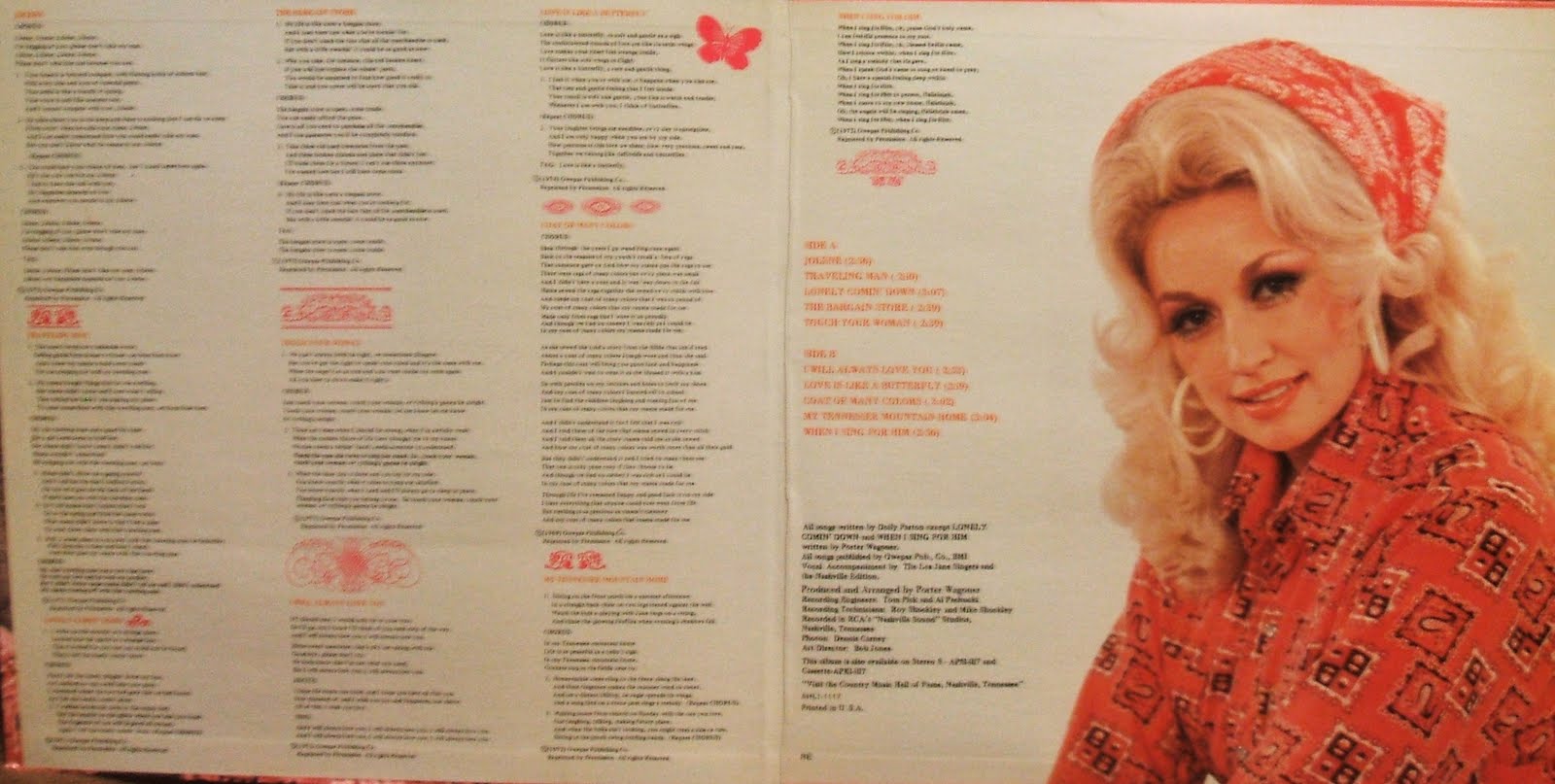
Best of Dolly Parton
Dolly Parton
RCA AHL1-1117
1975
The CD era has rendered a lot of vinyl compilation albums obsolete. You can cram more songs on a CD although I suppose it is debatable whether a lot of performers need more than 40 minutes to compile their “greatest hits”. This album will never be obsolete though. It is a perfect record, one of my favorites of all time. I’m not a big country music fan, but that doesn’t matter because this is a great pop album that transcends genre. Ten pristine tracks of Parton at her peak, before Hollywood and her regrettable attempt for mainstream success. If you like Buddy Holly or Paul McCartney you should like “Jolene” regardless of how you feel about country music. This album features heartfelt singing and brilliant songwriting throughout - pure American music at its finest. Plus if you are lucky you might find a copy with a nifty poster of Parton inside. I don’t know where to begin in singling out specific songs, they are all wonderful. “Lonely Coming Down” gives me chills whenever I hear it and you’d have to be pretty heartless not to be moved by “Coat of Many Colors.” "The Bargain Store" shows her typically inspired use of metaphors. "My Tennessee Mountain Home" is warm and inviting, it makes me want to take a road trip to the Smoky Mountains. I like the frankness of "Touch Your Woman," Parton lyrics are always worth paying attention to, she definitely has something to say. The sweet sincerity of Parton’s original version of “I Always Will Love You” is infinitely superior to Whitney Houston’s histrionic cover version. People might dismiss Parton because of her goofy persona and the mediocre music she made in the late 1970s and 1980s, but this record is proof positive that from 1969 to 1974, she was one of the great artists in American music, period, right up there with John Fogerty and Bob Dylan. A great, great record. Recommended to anyone who has a heart.