Showing posts with label 1968. Show all posts

Sunday, July 27, 2025

Thank U Very Much - The Scaffold


Thank U Very Much
The Scaffold
Bell Records 6018
1968

I'm baffled as to how this ever got released in the U.S. much less on a crassly commercial label like Bell.  Like most non-British people I was attracted to this group because trio member Mike McGear was Paul McCartney's brother.  He shared his brother's good looks and fondness for music hall tunes but not his pop genius.  Which is fine, because the band was basically a comedy group that dabbled in music.  I have their 1968 English debut album, "Live at the Queen Elizabeth Hall" which consists largely of poetry readings and comedy routines.  Bell cobbled this album out of the group's British singles, it has no British equivalent.  The title track was a big hit in England and I'm guessing Bell thought they could break it here as well but it never came near the top 40 here and I'm surprised it even made it as high as 69 on the Billboard chart.  The album opens with "Long Strong Black Pudding"which was the b-side of the group's second single released in 1966.  It is delivered acapella in the style of a Gregorian chant.  It is presumably intended to be humorous but I just find it annoying.  "Goodbat Nightman" was the a-side of the second single.  Mercifully it features musical accompaniment.  It is driven by a staccato riff that seems to be inspired by Neal Hefti's theme song for "Batman" which is fitting since the song is about the "Batman" character and borrows from the TV show's tropes.  It is one of my favorite tracks on the record.  "2 Days Monday" was the a-side of the Scaffold's debut single from 1966.  It is a music hall style song in the vein of a silly children's song working through the activities of a week delivered in a Cockney accent.  "3 Blind Jellyfish" was the flipside of the first single.  It is another silly children's song using the music of "Three Blind Mice."  "Thank U Very Much" was the group's third single released in 1967 and it made it into the top ten in England.  It was penned by Mike McGear in music hall style featuring silly lyrics and is very catchy, to the point of ear worm status.  I can hear why it became a hit but I also understand why it flopped here.  "Ide B the First" was the b-side.  Much like the a-side it is a music hall style song with silly lyrics, but is not nearly so memorable.  Side two opens with the band's fourth single "Do You Remember?" from 1968.  The piano that drives it is straight out of the music hall, although the song has some contemporary pop touches that I find appealing.  "Knees Up Mother Brown (Knees Down Mother Brown)" made its first appearance on this album.  It is built around the 19th Century pub song of the same title, but Roger McGough has built up a framing story about a disastrous Oxford graduation.  I find it more amusing than most of their stuff.  "1-2-3" was the band's fifth single released in 1968.  It is an inane bubblegum song that seems like a blatant attempt by McGear to repeat the success of "Thank U Very Much."  It does build to a kinetic climax which is the closest this record comes to rock and oddly peters out with a sitar which I presume is satirical rather than an attempt at hipness.  "Today" was the b-side of the fifth single.  I prefer it to the a-side even though it almost as dumb, but it has a jazzy flavor as well as some nice contemporary pop touches that show some of the McCartney pop smarts rubbed off on his brother.  It is one of my favorite cuts.  "Please Sorry" made its debut on this album.  It is another McGear retread of "Thank U Very Much" that mixes music hall with contemporary pop and a bunch of childish silly lyrics.  "Jelly Covered Cloud" also premiered on this album.  I believe it is a satire of psychedelia and although it doesn't jettison the music hall entirely it has some British psych-pop flavor.  It is one of my favorite tracks and gives the album a pleasant conclusion.  I'm not a big fan of these guys but they are definitely different and they mix music hall with contemporary pop about as well as anyone I've heard, although I'm not sure that is actually a good thing.  I frequently find their songs a little irritating, but they never bore me.  McGough was a bona fide intellectual and they all seem like clever lads which makes their penchant for childish nonsense lyrics surprising, but I assume it is an attempt at humor.  I generally don't find their comedy routines very funny and their songs even less, but I'm happy to have some of their albums.  Recommended to Bonzo Dog Band fans who hate rock.

Sunday, September 1, 2024

The Collectors - The Collectors


The Collectors
The Collectors
Warner Bros.  WS 1746
1968

This is the debut album by the Canadian band the Collectors who released two albums in the late 1960s before evolving into the better known band Chilliwack. I'm interested in Canadian pop music so I took note of this album in the bins, but it tends to be a bit pricey so I didn't splurge on it until I fell in love with the song "Lydia Purple" which I first heard on Giant Crab's "A Giant Crab Comes Forth."  I bought the album for that song alone, but fortunately the entire album is worthwhile.  The album opens with "What Is Love" which was self-penned by the group, like all the songs on the album aside from "Lydia Purple."  It is a slow moody song with a chamber pop flavor that speculates on the nature of love.  It gradually swells to a dramatic climax before returning to the slowness it started with. "She (Will-O-the-Wind)" is a trippy portrait of the title character.  It is driven by a raga like riff and features lovely vocals and a dynamic flute solo worthy of Ian Anderson.  It is one of my favorite tracks. "Howard Christman’s Older" is the most overtly psychedelic track on the album. It is a portrait of a child genius that is driven by swelling organ riffs and howling guitars. The song evokes the majestic sound of Vanilla Fudge without the bombast.   It is followed by the fabulous "Lydia Purple" by Don Dunn and Tony McCashen which is delivered in a wonderfully atmospheric chamber pop arrangement with strings and elaborate multi-part vocals.   I think one could make a case that the song is condescending to the point of cruelty in its portrait of the alienated and delusional main character, a poor man's "Eleanor Rigby," but I'm not the one to make that case because I love it to death.   I've heard several other versions of the song but this is easily the best one and I find it endlessly compelling.   I played it over and over when I got this album and it still sends me every time I play it.   If there was any justice the song would have been a hit and I consider it one of the best songs of its era.  Side one concludes with "One Act Play" which is a striking depiction of a deteriorating relationship.  The solemn chamber pop sound of the song serves it well and it builds in power to give side one a satisfying conclusion.   Side two is devoted to "What Love (Suite)."  I am generally not a fan of 20 minute rock songs unless they are jams, but this is a pretty solid one.   It is a return to the opening track of side one but elongated and more elaborate.   The song begins with a slow, chamber pop section similar to "What is Love" but with a strong middle-eastern flavor added that gives the lyrics mystical resonance.  Unfortunately the lyrics are not worthy of the exalted music as they explore the deficiencies of human love with half-baked philosophizing that make the Moody Blues sound like Plato.  Lyrics like "what the hell is fate, screw the world, it's raped" or "blood is masculine violence" make me think someone in the band was a big Jim Morrison fan.  To some extent the bad poetry is covered up by outstanding music that moves from chamber pop to psychedelic blasts of organ driven cacophony to a jazzy sax solo and even a groovy flute solo.   The song is melodramatic and pretentious but it holds my interest and I find the changes in texture stimulating. Nonetheless I often just play side one whenever I feel like listening to the Collectors.  I am fond of this record, but I feel like it is a near miss.  It is very ambitious but ultimately it comes up short of being a psychedelic classic.  I mostly blame "What Love (Suite)" for this because side one is uniformly excellent.  This album reminds me of Love's "Da Capo" which similarly had it's brilliant first side undermined by a self-indulgent suite on the second side.  However I am the sort of music fan who respects bands who take chances even if I don't like the results.  I listen to so many albums that I like when someone messes with the formula if only because it is something different.  I recommend this album to Doors fans with a healthy appetite for chamber pop.

Saturday, August 3, 2024

Yardbirds '68 - The Yardbirds


Yardbirds '68

The Yardbirds

Jimmy Page  JPRLPBX3

2017


I appreciate the irony that, after many decades of blaming Jimmy Page for the suppression of Epic Records' album of the Yardbirds 1968 performance at the Anderson Theater in New York entitled "Live Yardbirds," I ended up buying a remastered version of the concert from the great man's own website.  I've always assumed that Page was embarrassed by it and perhaps even by his association with the band itself prior to his rise to superstardom with Led Zeppelin.  However this labor of love produced by Page himself shows otherwise.  It is a very lavish revision of the project with a wonderful booklet full of photos and memorabilia from Page's tenure in the Yardbirds as well as reminiscences from the three surviving band members, Page, Chris Dreja and Jim McCarty.  Page's comments demonstrate his pride in the band's work and his respect for the other members of the group.  I was deeply touched reading the booklet.  Then there is the record itself which is a dramatic improvement over the original Epic album.  Naturally the absence of the overdubbed crowd noise and applause is a big improvement although I can understand why the clowns at Epic decided to add it, much of the time the band sounds like they are playing in an empty auditorium and Dreja mentions in the booklet that the attendance at the show was poor.  Dreja attributes that to Vanilla Fudge playing down the street the same night although anyone who would pass up a Yardbirds show for Vanilla Fudge ought to have their rock fandom card revoked.  Page and his technicians have also done wonders with the sound itself.  "Live Yardbirds" sounds pretty good for a 1960s live album, but it is still kind of tinny and murky.  The new version sounds astonishingly good, almost as though it was recorded last week.  There is much better separation between instruments and the drums, harmonica and vocals in particular sound much clearer to me.  It is truly a joy to hear it with such clarity.  It literally jumps right out of the speakers.  I find this particularly noticeable on "Dazed and Confused" which sounds so much better that I wondered if it was a different recording.  "Shapes of Things" and "I'm a Man" also sound greatly improved.  The new mix brings out the robustness of Keith Relf's vocals which I've never appreciated before.  I would say he benefits the most from the new release although curiously most of his stage patter has been edited out.  He was not a big talker but I find his comments rather charming on "Live Yardbirds."  I can't believe they were overdubs added by Epic so I'm guessing Page likes his live albums streamlined.  I do not approve but I love this new version so much that I'm not going to complain.  Page even deletes the bit before "Shapes of Things" where Relf calls him "Jimmy Magic Fingers, Grand Sorcerer of the Magic Guitar" so I know he's not being petty or self-serving.  Page has already earned my eternal gratitude by this point for making such a great sounding record of one of my all time favorite concerts, but he doesn't stop there.  There is a second record documenting the Yardbirds' final recording sessions from 1968 in New York City.  Four of these tracks appeared on the CD "Cumular Limit" back in 2000 but I believe the rest have never been released before.  They give a tantalizing glimpse of what might have been the group's best studio album if they could have hung in there a little longer.  My favorite track is the hard rocking "Avron Knows" pumped along by McCarty's crisp drumming and some ferocious guitar work from Page.  It reminds me of  "Think About It" and it demonstrates the power that band packed even in their final days.  "Spanish Blood" is a moody ballad with lovely acoustic guitar work from Page.  It sounds a bit like "Only the Red Rose" on "Little Games" although in this case Relf recites the lyrics rather than singing.  "Knowing That I'm Losing You" will be familiar to Led Zeppelin fans because it is an early version of "Tangerine" from "Led Zeppelin III" although this version has no lyrics.  "Taking a Hold On Me" is a punchy rocker driven by a solid riff from the Grand Sorcerer.  The band revisits "Drinking Muddy Water" which they had done previously for the "Little Games" album.  I never had a problem with the earlier version and I don't think this one is any great improvement although it does have a rawer feel to it that I like.  The Mort Shuman/Jerry Ragovoy song "My Baby" that was popularized by Garnet Mimms in 1966 was a part of the Yardbirds' stage act during the Page era as demonstrated by the Anderson Theater show.  The band does a studio version here, but I don't think Relf can match Mimms as a vocalist.  In any case I prefer the live version.  The record concludes with instrumental versions of "Avron Knows" and "Spanish Blood" that are basically superfluous although I like both songs enough that I'm happy to hear them again.  Listening to this second record, it is so full of creativity and vitality that you would never guess the band was on its last legs.  It would have been so nice if like the Zombies, they could have gone out with a bang.  Belatedly Jimmy Page has finally made that happen.  This final statement from the band is in many ways definitive.  I think most people feel that the Jeff Beck era of the band was their high point and I agree with that, but the albums from that era are not all that satisfying.  I think if I could only have one Yardbirds album I would select this one.  The live album has some of the most exciting and exhilarating performances the band ever recorded and now they exist in pristine condition.  The studio stuff is interesting and very appealing.  The whole package is assembled with love and care - a far cry from the crass approach Epic Records took in assembling their Yardbirds albums.  I salute you James Patrick Page, you've done a magnificent job in creating what is destined to remain one of my favorite albums.  Recommended to anyone who has ever listened to "Live Yardbirds" and wished they could have been there.  This is the next best thing.

Sunday, April 17, 2022

A Giant Crab Comes Forth - Giant Crab


A Giant Crab Comes Forth
Giant Crab
UNI 73037
1968

When I was in college I thought I knew everything I needed to know about 1960s rock after I read a bunch of rock encyclopedias and histories of the era.  How many good records could have come out in the decade?  I figured I could get them all.  I was wrong.  40 years later and I am still working on it.  By the time I was in my thirties I assumed I had all the essential classics but then the internet came along and I found out there were a lot more worthwhile records out there that I had never heard of.  The Santa Barbara based band Giant Crab was not in any of the books I read as a youth.  I first heard them on a specialty program on my favorite college radio station KXLU.  I loved the song I heard and checked out the band on the internet.  Eventually I was able to find their two albums.  This is their excellent debut album.  It begins with a spoken intro by Johnny Fairchild who was a Santa Barbara disc jockey who helped the band get on the radio.  It simulates a dramatic news flash although its impact is diminished by an attempt to work all the song titles from the album into the intro which makes it sound contrived.  Most of the album was written by the band's talented leader Ernie Orosco with occasional help from his band mate and brother Ruben (or maybe his other brother Raymond - it is not clear on the song credits) as well as the album's producer Bill Holmes.  Most of the songs are catchy sunshine pop like "It Started with a Little Kiss," "Groovy Towne," "Thru the Fields," "Believe It or Not" and "The Answer is No."  These songs feature charming vocal harmonies and elaborate arrangements often bolstered by punchy horn support from band members Dennis and Kenny Fricia.  "Directions," "Intensify Your Soul" and "The Chance You Take" are harder in sound with a soulful flavor and heavier instrumentation.  They remind me of the Rascals.  "Watch Your Step" is pop-psych with hypnotic keyboard riffs driving it.  "Hot Line Conversation" is also pop-psych and the heaviest song on the album.  Its lumbering riff and organ washes make me think of early Iron Butterfly.  The album closer is a slow and majestic ballad called "Why Am I So Proud?" that gives the record an emotional finish.  There are also four covers on the album.  "Enjoy It" was written by Scott English and Claus Ogerman and it plays to the bands' sunshine pop strengths.  English also wrote "Hi Ho Silver Lining" with Larry Weiss and it was a British hit for Jeff Beck and I think it should have been one here as well.  The cover version doesn't stray too far from the Beck version.  The Beck version is more energetic and I miss his guitar solo but since singing was hardly Beck's strength, I welcome Ernie Orosco taking a crack at the song.  Both versions are worthwhile.  "I Enjoy Being the Boy" was written by Marc Bellack and bubblegum stalwart Joey Levine.  It is less inane than a lot of Levine's stuff and features a lovely arrangement that makes it seem less lightweight than the lyrics would suggest.  My favorite of the covers and my favorite track overall is "Lydia Purple" by Don Dunn and Tony McCashen.  It appeared on the debut album by the Collectors earlier in the year.  Giant Crab's version is heavier and more propulsive which I appreciate but I think the song's moodiness and portrayal of alienation was better served by the Collectors' chamber pop arrangement.  I still love the Giant Crab version though.  This is such a good album that I'm surprised it is not better known.  It deserved a better fate.  I was already middle-aged when I finally got a copy which I regret.  I would have eaten this up back when I was a teenager worshipping the Turtles and the Hollies.  Even in my dotage it still is immensely appealing to me.  It is records like this that humble me and keep me from getting too cocky about my knowledge of rock history.  If you dig pop-psych or sunshine pop this album is essential.  I've played it a bunch of times in recent years and it still makes me happy whenever I give it a spin.  Recommended to fans of the Strawberry Alarm Clock.

Saturday, January 29, 2022

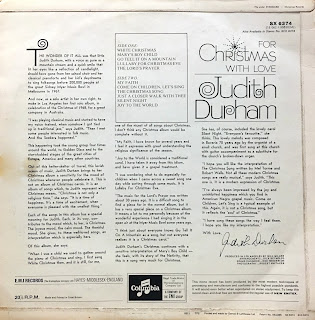
For Christmas With Love - Judith Durham


For Christmas With Love
Judith Durham
Columbia SX 6374
1968

This is a mono pressing of the British version of Judith Durham's Christmas record.  It differs from the Australian version by having one additional track "Just a Closer Walk With Thee."  Curiously the song features a 1965 copyright on the inner label which is also the date that the song appeared on The Seekers' album "A World of Our Own" but it is not that version.  I believe it is the version she released on a 1967 single in Australia.  I prefer The Seekers' version which features harmonies from the boys and a folk style arrangement to this version with its gospel organ and piano accompaniment although she sings both great.  Although this album was recorded at Capitol Records studio in Los Angeles I don't believe it was ever released here.  This was her first solo album after leaving The Seekers and being a big fan of that group I have long coveted it.  I finally found a copy last year but I was disappointed when I played it.  Arguably it is more of a gospel record than a Christmas record.  Every song is religious aside from "White Christmas," "Lullaby for Christmas Eve" and "The Christmas Song."  "The Lord's Prayer," "My Faith" and "Come On Children, Let's Sing" are not Christmas songs at all.  Her piety is obviously sincere and her singing is heartfelt, but this is not my cup of tea and it sounds nothing like The Seekers so I shelved it after a couple of spins.  I brought it back out at Christmas and played it while trimming the tree and I liked it better probably because my expectations were different.  "White Christmas" opens the album in an orchestrated easy listening style version.  Durham delivers a pleasant vocal but the track is otherwise unremarkable.  "Mary's Boy Child" was written by Jester Hairston and was released as a single by Harry Belafonte in 1956.  His version had a slight calypso flavor to it which is not present in this stiff orchestrated version.  The song lacks the warmth of the Belafonte recording even though Durham sings it impeccably.  The album finally comes to life with a jumping gospel style performance of "Go Tell It On a Mountain" driven by piano and organ.  Durham showed an interest in gospel with The Seekers but really shows her affinity for it here and I love the way she hits the high notes at the end.  This is one of my favorite tracks.  The record loses this energy with the heavily orchestrated "Lullaby for Christmas Eve" which had been a single for Jack Jones in 1964.  Nonetheless it is a sweet song and at least it isn't religious.  Durham's soaring vocal on "The Lord's Prayer" impresses me but I dislike the song and the heavy inspirational arrangement.  "My Faith" is even worse.  Durham sings it like she means it, but the song is just too sappy for me to tolerate.  The record picks up with the lively gospel song "Come On Children, Let's Sing" which was recorded by Mahalia Jackson in 1960.  I love Durham's voice and she sings it well but she can't compete with Jackson.  She sounds stilted by comparison.  I wish there were more songs like "The Christmas Song" on the record.  She seems more inspired by the religious stuff, but she still sings this well and it is a much more appealing song to me.  "Just a Closer Walk with Thee" fits well with the rest of the album both in terms of sound and content even though it was recorded earlier.  As I said before I prefer The Seekers' version but this is still pretty compelling.  Most of the arrangements on this album are stodgy and conservative, so it is surprising that "Silent Night" is given an up-tempo treatment including drums, probably the most dynamic version of the song that I have ever heard.  I'm not sure that the song is well-served by such treatment but I like it anyway especially with Durham's exquisite vocal.   The album concludes strongly with a kinetic gospel arrangement of "Joy to the World" that inspires Durham to loosen up and have some fun.  It is my other favorite track on the album.  Although there are parts of this album that I enjoy, I have to admit there is no way I would keep it if Durham was not singing on it.  I like her voice so much I would listen to her sing just about anything even a bunch of hymns, but I'm not going to listen to it very much.  I'm alienated by religion and I prefer folk arrangements to easy listening ones so I'll just stick with my Seekers albums.  Recommended to religious Judy Collins fans who dislike folk music.

Sunday, December 23, 2018

1968 - France Gall


1968
France Gall
Polydor 530 916-2
1968

I did not want to let 2018 slip away without acknowledging the passing of my favorite French singer, France Gall, back in January of this year.  This is my favorite of her albums aside from compilations.  It is a 2018 reissue of a record originally released by Philips as 844.706 BY.  I bought it on CD many years ago and was delighted to finally get it on vinyl this year.  It was a transitional record for the 20 year old Gall as she moved away from the girlish sound of her Ye-Ye period in search of a more mature sound.  The record begins with her 1967 single, "Toi que je veux" in which she declares her desire for her lover.  Despite her ardor she worries about the end of their relationship but nonetheless savors her passion.  Her declaration that "Je me suis ouverte aujourd'hui à la vie" sums up the flavor of the song and the album as well.  The music of the song is exuberant with a chamber pop flavor that suits Gall's voice very well.  Her vocal on the song really sends me.  "Chanson Indienne" expresses the unhappiness of an expatriate from India who misses her country.  The song was written by Gall's father Robert and David Whitaker who directed the orchestra and arranged most of the record.  The song features a sitar and Indian style percussion which gives it an exotic sound.  Gall's voice cuts through the elaborate arrangement expressing the emotions in the song very convincingly.  My French is not good enough to figure out "Gare a toi... Gargantua" which appears to be inspired by the play on words in the title.  Gargantua is presumably the Rabelais' character and the song makes numerous references to his ravenous appetite which apparently extends beyond food to women as well.  I believe the song is full of double entendres that warn Gargantua to not extend his consumption habits to other women.  It seems like a very sexy song unless I'm completely misunderstanding it which is certainly possible.  In contrast to the racy subject matter, musically the song recalls the childish style of the songs Gall was singing as a teenager which creates some interesting tension.  In "Avant la bagarre" to celebrate her 20th birthday the singer's boyfriend takes her to a restaurant that she used to go to and they run into her former flame and the two men get into a fight.  The song is a straight ahead rocker driven by a pulsing bass line and electric organ riffs.  It is one of my favorite tracks on the album.  "Chanson pour que tu m'aimes un peu" is a pathetic plea for the singer to be loved a little by someone who does not even pay attention to her.  The song was written by her father and her brother Patrice and I find it weird that her father would create such a degrading song for her to sing.  Musically the song is very appealing, guided by a hypnotic acoustic guitar riff and a sensitive vocal from Gall that makes it easier to swallow the unpleasant lyrics.  Side one concludes with Serge Gainsbourg's magnificent "Néfertiti" which is one of my all time favorites in Gall's catalog.  It was released as a single in 1967.  It is a sensual ode to the Egyptian queen which with typical Gainsbourgian perversion even rhapsodizes about the odor of her mummified body.  The music is very alluring with a Middle Eastern flavor and a seductive vocal from Gall that melts me.  Side two begins with "La fille d'un garçon" which is about a summer romance on vacation that fades in the winter.  The music is appropriately idyllic driven by a throbbing bass line and tasteful strings.  Gall's vocal is absolutely radiant reflecting the warmth of a glowing heart.  In "Bébé requin" Gall describes herself as a baby shark seeking to devour her lover's heart.  It was a single in 1967.  It is a catchy little tune driven by a staccato bass riff and punchy bursts of brass with a music hall flavor as well.  "Teenie Weenie Boppie" is another Gainsbourg opus which vividly describes a fatally bad LSD trip that includes a hallucination of Mick Jagger drowning in the Thames.  In contrast to the lurid lyrics, the music evokes the bubble gum sound of Gall's records of the mid-1960s.  The song is loaded with hooks and the sweetness of Gall's vocal would suggest a trip to the candy store rather than a drug trip.  "Les yeux bleus" is a love song by Robert Gall and Claude-Henri Vic.  The song has a jazzy sound and Gall handles the demanding vocal with ease and grace.  "Made in France" compares France and England focusing mostly on cultural differences.  It is a charming song that again recalls Gall's Ye-Ye period.  Gall trades verses with the background singers and sings the chorus herself.  Gall's vocal plays up the humor in the lyrics and combined with the engaging tune, it makes this song irresistible.  It is another one of my favorite tracks.  "La petite" is a duet with Maurice Biraud in which an older man is attracted to the daughter of his friend.  Biraud expresses the opinion of the man and Gall sings from the perspective of the daughter.  The old man is romantic and protective, the daughter is unsentimental and eager to learn the ways of love.  I find the song to be creepy particularly since Robert Gall helped write it and the girlish quality France Gall brings to her vocal makes it even more disturbing.  The song's only saving grace is that the music is very enjoyable but it still gives the album an unsavory finish.  It is the only blemish on an otherwise wonderful album.  Even though she did not write any of the songs, I think this record was a personal record for Gall.  Its recurring themes of growing emotionally, learning to love and awakening sensuality probably had some resonance for her.  She certainly sings the songs with sincerity and purpose.  This record is an expression of her opening up to life and embracing adulthood.  I've always found her voice enchanting, but hearing her sing more sophisticated songs with the earnestness and passion of youth really gets to me.  I've been crazy about this album ever since I first heard it.  I like all of Gall's albums, but this one seems especially unique to me, I love the way it merges the music of her youth with the music of her adulthood.  I think it is really special, as was she.  I'm going to miss her very much.  Recommended to fans of Lulu.

Thursday, April 26, 2018

Odessey and Oracle - The Zombies


Odessey and Oracle
The Zombies
Big Beat  WIKD 181
1968

This is a 1997 English re-issue of the classic Zombies album originally released on CBS Records in England with lacquers cut from the original tapes.  It sounds terrific.  I saw a concert a couple of years ago where the four surviving members of the band played the album in its entirety from beginning to end.  It was one of the greatest musical experiences of my life, at times my eyes were in tears at the joy of hearing this music live.  As I mentioned in my post on "Time of the Zombies" this music thrilled me when I first heard it as a teenager.  This entire album is on the second record in that album.  For many years I figured that was a good enough format to have it in, especially since original copies of the album were so expensive and hard to find.  Then it started getting re-issued.  I still resisted buying it particularly since I had also acquired it on CD via the "Zombie Heaven" box set.  But ultimately I succumbed, it was just too important to me not to have it by itself.  As a teenager back in the 1970s I mostly learned about pop music from the radio.  At first I listened to top 40 AM radio and then when I finally got an FM radio I listened to album oriented rock, which we now call "classic rock."  Even as a young person I realized that this music was mostly crude and idiotic.  I heard an endless stream of stupidity that drove me back to the music of the 1960s.  In retrospect there was plenty of intelligent music in the 1970s, I just wasn't hearing it on the radio.  It was much later that I heard groups like Big Star, Roxy Music, King Crimson and Sparks.  That is why when I heard this album, it blew me away.  It was so unlike anything I had ever heard, even my beloved Beatles.  At first I didn't even know what to make of it, the lyrics were so unusual and the music was so delicate.  I was almost embarrassed that I loved it so much, it was so different from the music that my friends liked.  But ultimately I didn't care, this record spoke to me like no other.  I treasured it.  It is a flawless masterpiece, 12 brilliant and diverse songs that convey experiences and feelings with unwavering intelligence.  It begins with Rod Argent's upbeat "Care of Cell 44" which joyously recounts a person looking forward to the return of their imprisoned lover.  Swelling mellotron lines and a big bouncy bass riff drive this engaging song which also features a sweet vocal from Colin Blunstone supported by very appealing background vocals.  Somehow this song stiffed when it was released as a single but I find it endlessly enticing.  The record shifts gears for the melancholy of Argent's "A Rose For Emily," a tale of loneliness delivered with a sensitive vocal from Blunstone supported by simple piano accompaniment from Argent.  Chris White's "Maybe After He's Gone" displays a stimulating soft/loud dynamic with an atmospheric arrangement that expresses the confused emotions depicted in the lyrics.  White's "Beechwood Park" is a beautiful nostalgic song enhanced by a chamber pop arrangement that gives it extra resonance.  White also wrote "Brief Candles" which is one of the songs that most impressed me when I first heard this record.  The song's poetic portrait of a disintegrating relationship still sends me and I admire the exhilarating shifts from the piano driven chamber pop of the verses to the soaring mellotron bolstered choruses.  White, Blunstone and Argent all take turns at the mike.  Side one concludes with Argent's "Hung Up On a Dream."  This album is sometimes labeled as being psychedelic which I don't think is true, but this song is definitely in that vein.  The impressionistic lyrics are hallucinogenic and the dreamy music is driven by jangly guitars and surging mellotron runs.  The evocative lead vocal gives credibility to the flower power imagery of the lyrics and the beautiful background vocals enhance the atmosphere of the song in the best British psychedelic style.  This has always been one of my favorite Zombies tracks and when I first got "Time of the Zombies," I played this song over and over.  Side two opens with White's "Changes" which is a gloomy chamber pop track lamenting the changes money has made in a woman the singer used to know.  It is particularly notable for the elaborate ensemble vocal arrangement in the choruses.  The record perks up with Argent's ebullient "I Want Her She Wants Me."  The song is so catchy that it verges on sunshine pop and it inevitably perks me up when I hear it.  This is equally true of White's "This Will Be Our Year" which should have been a hit single.  The song's sunny optimism, cheerful piano runs and Blunstone's heartfelt vocal it make it the emotional highlight of the album.  The album takes a darker turn with White's creepy "Butcher's Tale (Western Front 1914)."  It is an anti-war song with lyrics that vividly evoke the horrors of World War I sung by White in a shaky voice that conveys the pain expressed by the song.  It is driven by Argent's ghostly harmonium playing adding to the menace of the lyrics.  The song shocked me when I heard it as a teen and I still find it very powerful.  When I saw the band performing it live, White's vocal gave me chills.  Sunshine pop returns with White's jubilant "Friends of Mine" which celebrates the romances of the couples that the singer knows.  This charming song also should have been a hit single.  The album concludes with the band's actual hit single, Argent's "Time of the Season."  As you probably know the song has a hypnotic melody punctuated by Argent's jazzy keyboard runs which rank among the finest instrumental work in his Zombie career.  It is an outstanding finish to an outstanding album.  This record is now 50 years old but it still sounds fresh and innovative to me.  I loved it in my youth and I love it just as much now.  I consider it one of the most influential and important albums in my life.  I'm so grateful that I stumbled across that copy of "Time of the Zombies" all those years ago and decided to take a chance on it.  Hearing this album opened my eyes to the artistic potential of pop music and along with the Beatles changed my life for the better.  Recommended to people who believe that good music should have something to say.    

Friday, December 30, 2016

That Christmas Feeling - Glen Campbell


That Christmas Feeling
Glen Campbell
Capitol ST 2978
1968

I bought this a couple of years ago when I became interested in Campbell after seeing him perform at the Hollywood Bowl.  It turned out to be a dud.  Campbell sings fine but the arrangements by Al de Lory are sappy and uninspired.  There is a mix of Christmas classics and newer songs including two brand new ones by the redoubtable team of Sammy Cahn and James Van Heusen.  Unfortunately they are among the worst tracks on the album.  "Christmas is for Children" is tediously slow and a bit inane in its description of adults becoming kids again on Christmas day.  "It Must Be Getting Close to Christmas" is a little better although I hate the heavy-handed strings and the choirThe song is about how children behave better as Christmas draws near.  The melody is more lively and memorable although the song is never going to compete with the classic Christmas carols.  My least favorite track is Howlett Smith's "Little Altar Boy" which was a minor hit for Vic Dana in 1961.  It is a maudlin song about a guy asking an altar boy for help in finding redemption from God.  The song suggests that altar boys are pure and holy, which as a former altar boy myself, I think is a dubious assertion.  The song is not really a Christmas song and I loathe it although Campbell sings it with a lot of feeling which is the only thing that makes it bearable for me.  "There's No Place Like Home" isn't a Christmas song either, but Sammy Cahn wrote some new lyrics to make it one.  I hate the schmaltzy arrangement but I can't deny that Campbell sings it beautifully.  The standards are better but still underwhelming.  "Have Yourself a Merry Little Christmas" is probably the best of them.  The arrangement is pedestrian but the song suits Campbell pretty well.  His performances of "Blue Christmas" and "The Christmas Song" are surprisingly lackluster and pale in comparison to the classic recordings by Elvis and Nat King Cole.  I believe Campbell's version of "I'll Be Home for Christmas" is even slower than Bing Crosby's version and sounds lifeless in comparison.  I'm unfamiliar with "Christmas Day" by Jimmy Holiday and L. White which has a 1963 copyright.  It is a nice song although I'd like it a whole lot better if Campbell sang it at a faster tempo.  Predictably the two best tracks are the country songs where Campbell seems most comfortable.  Roger Miller's "Old Toy Trains" is easily my favorite track on the album.  It is by far the most dynamic and lively performance that Campbell gives on the album.  Willie Nelson's "Pretty Paper" is a great song although I prefer Roy Orbison's version as well as Nelson's own versions, especially the one he cut in 1979.  Are three good cuts enough to make an album worthwhile?  Probably not, especially when there is also a stinker like "Little Altar Boy" on it.  I'm not sorry I have it, but I'm not going to suggest you look for it unless you are a big Campbell fan.  Recommended for people who don't have many Christmas albums. 

Wednesday, December 14, 2016

The New Possibility: John Fahey's Guitar Soli Christmas Album - John Fahey


The New Possibility: John Fahey's Guitar Soli Christmas Album
John Fahey
Takoma TAK 7020
1968

This is a reissue of John Fahey's Christmas album dating from the period when Chrysalis owned and distributed the Takoma label in the late 1970s and early 1980s.  I gave it a spin while I was trimming the tree this year.  Fortunately I was alone at the time or I'm sure my family would have demanded something else.  Fahey is definitely not for everyone.  I'm a fan but there are times when I have no patience for his highly structured and deliberate guitar work, not to mention the lethargic tempos he often employed.  On this album Fahey takes a bunch of mostly familiar Christmas classics and renders them in his distinctive folk-blues style.  They are all fine, but my favorite track is not a carol but rather derived from an obscure hymn by John Henry Hopkins.  It is entitled "Christ's Saints of God Fantasy" and while all the rest of the cuts on the album are short (generally under three minutes) this is a ten minute long extravaganza that features Fahey's most invigorating picking on the record.  The song begins with an ethereal sound which gradually shifts into a more dynamic passage with more fast-paced playing than is typical with Fahey.  The song shifts gears again as Fahey switches to a more measured and stately approach to the tune before jumping into a lively country-flavored style.  There is another tempo change and Fahey slows the song down and heads back into the mesmerizing music from the beginning.  Truly a remarkable track that allows Fahey to spread his wings and show the full range of his musical skill.  My other favorite cut is a country-blues style performance of the traditional African-American spiritual "Go I Will Send Thee" where Fahey's robust style of playing brings out the feeling of the song admirably.  I also like Fahey's adaptation of the 16th Century German hymn "Lo How a Rose E'er Blooming" which mixes ancient and modern creating a delightful hybrid.  "Auld Lang Syne" is of course more of a New Year's Eve song than a Christmas song.  Fahey plays it at a glacially slow pace that reveals the beauty of the tune to me for the first time.  The Christmas classics are less interesting to me but I like them all.  My particular favorites are a bluesy take on "Silent Night" that features interesting tuning and an evocative slide guitar sound.  On some tracks like "The Bells of St. Mary's," "What Child is This?" and "It Came Upon a Midnight Clear" he slows down the songs so much that they almost become abstract despite their familiarity which I find appealing.  On his medley of "Hark the Herald Angels Sing" and "O Come All Ye Faithful" Fahey adds a jaunty contrapuntal melody to the familiar songs giving the track a charming country flavor.  "God Rest Ye Merry Gentleman Fantasy" also begins with a country style arrangement that is just a starting point for an extended deconstruction of the song by Fahey.  It is another track that I admire.  You may notice that there are no secular Christmas songs on this record.  Fahey apparently did not approve of Santa Claus.  The original pressing of this album featured liner notes by Fahey in which he explained the title of the record and his motivations in recording it.  "The New Possibility" came from a term by the German theologian Paul Tillich referring to the birth of Jesus as "the gift of reconciliation between God and man."  In his notes Fahey rejected the commercialism and pagan aspects of Christmas and stressed his attempt to musically celebrate and rejoice in the birth of Christ.  Personally I like the pagan side of Christmas, but I respect Fahey's perspective and even sympathize with it even though I am no longer a believer myself.  When it comes to spiritual Christmas albums this is one of the best ones I've ever heard.  It is completely lacking in displays of sanctimonious piety and stuffiness nor is its religious expression heavy-handed and preachy.  Fahey brings out the feeling in the music without beating the listener over the head with it.  The music is refined and elevated, no trace of the vulgarity of most commercial Christmas records.  However Fahey's playing is so tasteful and lovely that even a hardened atheist is likely to find pleasure in it.  Recommended for a New Age Christmas party.