Music From Big Pink
The Band
Capitol ST 2995
1968
I was watching Bob Dylan's show down in Irvine last year which was part of his Americana Tour and got to thinking that there was probably no more anonymous job in music than playing in Dylan's back-up band. Bashful Bob keeps the lights down low when he plays and refuses to allow cameras to broadcast his set. He has his boys all in matching outfits and doesn't bother to introduce them to the audience. I could have run into any of them in the parking lot and would not have had a clue I'd been watching them on stage. I guess playing with Dylan is its own reward. I'd happily do it if I were good enough. Near the end of his set, Dylan brought out Jim James and Jeff Tweedy and they all launched into a moving cover of the Band's "The Weight" which reminded me that there was at least one Dylan back-up band that wasn't anonymous at all. The Band was widely revered in the Bay Area when I was growing up there and that was where they chose to end their career as documented in the film "The Last Waltz." I remember all the hoopla about that show which puzzled me at the time. I did not understand all the fuss about the group, I thought they were kind of boring. The group was celebrated as being a return to the roots of rock when they came out with this album in 1968, a reaction against the excesses and pretensions of the psychedelic era. I on the other hand adored the psychedelic era and disliked the unadorned simplicity of this music. Although I still prefer psychedelic music to roots rock, I've come to admire this album as I've gotten older particularly after I became a fan of country and folk music which informs so much of their sound. My copy of the record is a British import because I have a collector's fetish thing for imports. I should have bought the domestic version though because that is a gatefold cover that has pictures of the band and the pink house that inspired the title of the record. One of these days I'll pick up one. This is my favorite album by the Band. It opens brilliantly with "Tears of Rage" by Dylan and Richard Manuel (uncredited on my copy of the record.) I love the version Dylan cut with the Band on "The Basement Tapes" but this is the definitive version of the song. Manuel's tortured vocal is so powerful as he expresses the "King Lear" inspired lyrics of parent-child discord, so resonant of the generational conflicts that helped fuel the fires of the 1960s. The Band somberly plays the tune like they are performing at a funeral, yet still imbue the music with passion. They pick up the pace for Robbie Robertson's "To Kingdom Come" which features some sizzling guitar work from Robertson. The lyrics feature the Biblical influence that permeates the imagery of the album but the song is largely a secular tale of moral ambiguity and karma. Manuel's "In a Station" is a keyboard driven oblique love song. I have no idea what Robertson's "Caledonia Mission" is about but is sounds pretty nice, a countryish tune with a forceful chorus. Side One concludes with one of the Band's best known songs, Robertson's "The Weight." I have to confess I disliked the tune as a teen. I did not understand what they trying to say in the song and I was repelled by the roughness of the vocals. I'm still not really sure what it is about, but I've come to admire the song as much as most people do. The song offers a series of vignettes of small town Southern life liberally sprinkled with Biblical references that make the song seem deeper than it really is. The powerful Gospel influenced music adds to the gravity of the song as well. It is a great performance, but my favorite version of the song is the one by Aretha Franklin on "This Girl's in Love with You." Side two opens with Manuel's "We Can Talk" which features Manuel, Danko and Levon Helms sharing the vocal. The song sounds silly to me but it does benefit from a strong rhythm and blues style melody. "Long Black Veil" was originally a hit for Lefty Frizzell who has my favorite version of it. I'm not a big fan of the song, I think it is maudlin and contrived. It is sung from the point of view of a dead guy who preferred to be executed rather than reveal that he'd been making love to his best friend's wife at the time of the murder he was convicted of. The Band solemnly play the song at a lethargic pace that makes it even more oppressive to listen to. Robertson's "Chest Fever" opens with a fancy organ solo that sounds like prog rock but fortunately that leads into a heavy riff that drives one of the hardest rocking songs on the album. The song is about a guy with woman trouble. The energy level plummets with Manuel's "Lonesome Suzie" which is a glacially slow ballad about an unhappy woman who needs a friend. Manuel's plaintive vocal is the only thing I like about the song. There are lots of covers of "This Wheel's on Fire" (listed as "Wheels on Fire" on the sleeve of my album) but this one is my favorite. The song was written by Dylan and Rick Danko (who is uncredited on my record) and dates back to "The Basement Tapes" sessions. Danko's vocal gives the song a feeling of urgency supported by the group's robust playing. The lyrics are typically full of the evocative language and imagery of Dylan in the 1960s. The record concludes with Dylan's "I Shall Be Released" which in the hands of the Band sounds like a gospel song. Manuel's high quavery vocal is very effective and it gives the album an emotional finish. In retrospect it was not a good omen for the future of the Band that three of the four best songs on the record were written by Bob Dylan. I feel like they did their best work collaborating with Dylan. On their own, their songwriting was their weakness. They could play and sing great, but aside from their follow-up album "The Band," their albums were hampered by pedestrian songwriting, especially as Manuel's output diminished. However on this album, the group is terrific. The record is loaded with good songs and strong performances. This album has aged very well, it still sounds like a classic album, heartfelt, authentic and full of integrity. Recommended to fans of Wilco and Ryan Adams.
Le Pop: Les Filles
Various Artists
Le Pop Musik LPM 20-1
2008
I am a big fan of French pop in the 1960s and early 1970s but I haven't kept up with their music scene since then. What I've seen in French films and the occasional TV show (my wife used to subscribe to a French cable channel) did not make me think I was missing much. However when I stumbled across a bargain-priced copy of this album, I picked it up to see what was going on over there. It is part of a series of albums issued by a German record company that survey contemporary French music. This one offers a generous sampling of 16 tracks focusing on female singers. I'd only heard of two of them prior to buying this album - Coralie Clément who I know as an actress and Mélanie Pain who I know from the group Nouvelle Vague which I am a fan of. My favorite track is Poney Express' "Paris de Loin" which is pure indie rock driven by a great bass riff. It has a lot of pop appeal and it gets me bopping. The group is a duo featuring Ana Berthe on vocals and Robin Feix on bass. My other favorite song is Fredda's "Barry White" which features a slinky vocal over a hypnotic melody as she recalls her youth dancing in discos in Marseille. I also really like Barbara Carlotti's "Mademoiselle Opossum" which benefits from a propulsive rhythm track and some sensuous horn work that supports her alluring vocal. Coralie Clément sweetly croons "So Long Babylone" over a chunky rhythm track and a charming ukelele riff. The song was written and produced by her brother, Benjamin Biolay. Mélanie Pain's "Celles de Mes 20 Ans" sounds nothing like her work with Nouvelle Vague. It is poppy folk-rock that her breathy vocal invests with feeling. "Je Ne Te Quitterais Jamais" by a duo called Doris Park is a lovely, atmospheric song delicately sung in French and English by the group's lead singer, Maria Törnqvist who is Swedish. "Cupide et Stupide" by Austine is charming twee indie pop with a jaunty melody that makes me happy as I listen to it. The liner notes compare the song to Belle and Sebastian, but I think Camera Obscura is a more accurate comparison. "Les Hasrads" by C++ is perhaps the most interesting track on the record being a swinging smorgasbord of 60s pop and synth pop driven by surf guitar and proggy mellotron over which Charlotte Gérand coolly sings. Several tracks sound like traditional French pop most notably Loane's waltz-like "Petit Bonheur," Maud Lübeck's low-key "Le Parapluie," Marianne Feder's jazzy "Toi Mon Indien" and best of all Marianne Dissard's "Les Draps Sourds" which mixes Chanson with Western Swing, it sounds like Edith Piaf performing with Bob Wills. She seems to be singing about an orgy, I wish my French was better, ha-ha. There are a few duds on the album. Constance Amiot's "Clash Dans le Tempo" is mild-mannered French hip-hop that bores me. Julie B. Bonnie's "Bonjour Monsieur" is a collaboration with Kid Loco. It has a strong beat but I find it monotonous. Françoiz Breut has a beautiful voice but her New Age-ish "2013" is tedious to me. If you really want to hear what she is capable of, check out her great 2001 song "Si Tu Disais." According to the liner notes, Jeanne Cherhal's "Si Tu Reviens J'Annule Tout" is "scandalous" because it is based on a message that Nicholas Sarkozy sent to his ex-wife prior to marrying Carla Bruni. Maybe you have to be French to find that shocking, I just hear a dull ballad. Aside from Poney Express' track there is nothing on here that knocks my socks off, but I like just about every song although not enough to run out and buy a bunch of French records. It rarely rocks, but it rolls pretty well and has a nice mellow vibe to it. Recommended to Francophiles who dig Isobel Campbell and El Perro del Mar.
The Above Ground Sound of Jake Holmes
Jake Holmes
Tower T 5079
1967
I first heard Holmes' most famous song (if you don't count his commercial jingles and I don't) on "Live Yardbirds." That song "Dazed and Confused" was retitled "I'm Confused" by the Yardbirds for their epic workout on the song which is one of the highlights of their album. If I had been a Led Zeppelin fan I probably would have heard it first on their debut album which has always been a lot easier to find than "Live Yardbirds." On the Yardbirds' record the song carried no composition credit but when Led Zeppelin released it it had Jimmy Page's name on it. Sure he monkeyed around with it, but that is still plagiarism. Holmes got a raw deal from Page and I'd say he got a raw deal from music history as well. He ought to be remembered for more than being a footnote in Led Zeppelin's career. This album is worthy of recognition in its own right. Holmes displays his talent right from the first track on this record, "Lonely." Holmes is accompanied throughout the album by Ted Irwin on electric guitar and Rick Randall on bass and on this track the two really shine. Irwin's frenzied raga-style runs on top of Randall's pulsing bass is tremendously exciting and gives this jazzy song great intensity and power. It is my favorite track after "Dazed and Confused." "Did You Know" is a more conventional mellow love song although it still has a slightly jazzy feeling reminiscent of Nick Drake. Holmes ups the tempo for the rocking "She Belonged to Me" in which he describes a girlfriend. Irwin's high velocity strumming propels the song nicely. "Too Long" is a moody song about two friends who have grown apart. The delicate interplay between the two guitars and the melodic bass lines gives the song a lot of atmosphere and feeling. Side one concludes with "Genuine Imitation Life" which was improbably covered by the Four Seasons a few years later. The song is a grim diatribe about hypocrisy, selfishness and the inability of people to relate to each other. I find the song kind of pretentious although it is interesting and the music is first rate especially Randall's bass work. Side two opens with "Dazed and Confused." I appreciate the thunder and energy that Page brought to his bombastic interpretation of the song with both the Yardbirds and Led Zeppelin, but I think Holmes' more subdued take of the song serves it best. The narrator of the song is dazed and confused because of a love affair and the uncertainty he feels about his relationship. Randall's descending bass riff drives the song and Irwin has an exciting psychedelic-style guitar solo. The ending of the song with Holmes' crazed strumming of his acoustic guitar on top of the throbbing bass and clanging electric guitar chords is quite thrilling and ends way too soon for my liking. Holmes shifts gears dramatically with "Penny's" which is a low-key jazzy tune with a little scat singing from Holmes in between the verses about the woman of the title. The jazz sound is even stronger on "Hard to Keep My Mind On You" which was influenced by Dave Brubeck according to Holmes in the liner notes. It has a fast tempo in 5/4 time and is a swinging tune in which the singer tells his girlfriend how easily he gets distracted from her when he sees other girls. I imagine that conversation probably didn't go very well, but you'd never know it from the sunny nature of the tune. "Wish I Was Anywhere Else" has a slight chamber pop sound to it with its fast paced baroque style guitar runs. The song is about being forced to engage in a conversation with a person you can't relate to. The album concludes with "Signs of Age" which is about the relativity of age depending on one's perspective. He speaks much of the song rather than singing it and the music is laid-back and meandering. Easily my least favorite track on the album. It is a disappointing finish but it does not diminish the impact of the album very much. I love the personal and introspective quality of the lyrics and the music is consistently engaging and stimulating. 1967 was such a fantastic year for music, it is easy to see why this album was overlooked at the time but it deserved a better fate. Its intelligence and integrity should appeal to anyone who values personal expression and individuality in pop music. Recommended to fans of Tim Buckley.
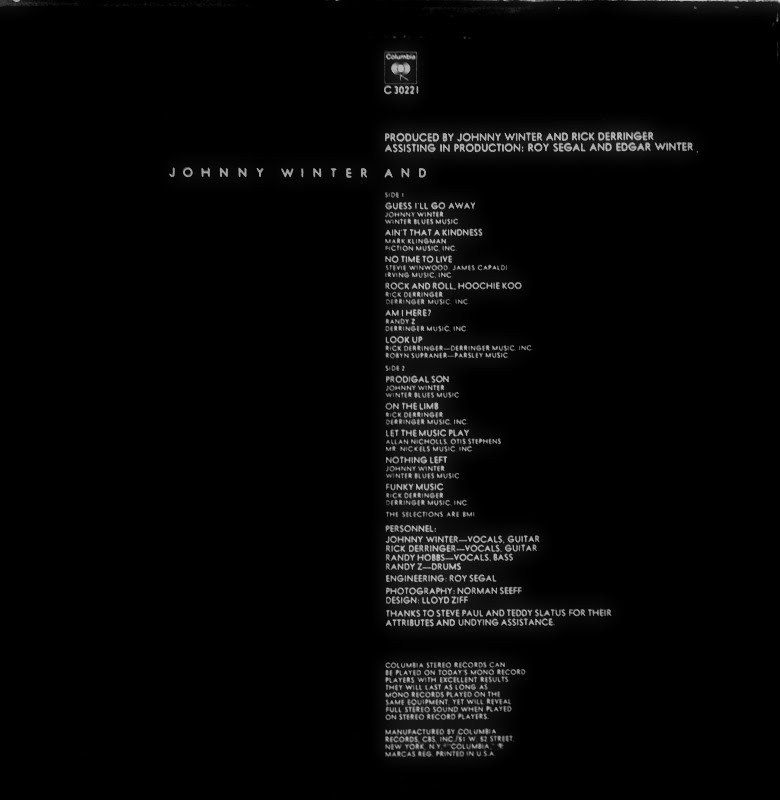
Johnny Winter And
Johnny Winter And
Columbia C 30221
1970
Here's a post for the late Johnny Winter. Winter started out playing the blues and finished his career as a bluesman, but for a little while in between he was a pretty fine rocker. I have some of his blues records and I like them fine. The guitar work is outstanding and the singing is, well, less than outstanding. This however is my favorite Winter record and it is pure 1970s hard rock. It resulted when Winter joined three of the four McCoys to form Johnny Winter And. I'm a big fan of the McCoys' two Mercury albums in the late 1960s and they bring a lot to this record both in terms of instrumental support and songwriting. The record kicks off with Winter's hard riffing "Guess I'll Go Away" driven by the dueling guitars of Winter and Rick Derringer who rock out big time. Fabulous! Mark "Moogy" Klingman's "Ain't That a Kindness" is less exciting being more in a laid-back southern rock vein. It is followed by an unlikely cover of Steve Winwood and Jim Capaldi's "No Time to Live" off of the second album by Traffic. Thanks to the guitar interplay between Derringer and Winter it is better than one might expect, although it sounds more like the McCoys to me than Winter. It is followed by Derringer's classic "Rock and Roll, Hoochie Koo" which would later be a hit single for Derringer when he released his own solo version of it in 1973. I think it is one of the best hard rock songs of its era and I love both versions although I think Derringer's is more forceful. Lots of great guitar riffing on this one and the crude lyrics are pure rock and roll. The band's drummer, Derringer's brother Randy Z (Zehringer), provided "Am I Here?" which is another track that sounds more like the McCoys than Winter with its quasi-existential romantic lyrics and its folk-rock style. I really like the song, it would have fit great on "Infinite McCoys" and it makes a nice change of pace for this record. Things return to normal with Derringer and Robyn Supraner's "Look Up" which is another riff-driven rocker with a southern rock sound to it. It is a bit generic but it rocks and features plenty of guitar action. Side two kicks off with Winter's "Prodigal Son" which is once again another riff-driven rocker with more of a rhythm and blues feel to it and some smoking hot guitar solos. Derringer's "On the Limb" is more southern rock with a nice dual vocal from Winter and Derringer. Allan Nicholls and Otis Stephens' "Let the Music Play" offers another respite from the relentless rock attack of the record. It is slow and soulful with more of a pop flavor than the rest of the record although it still boasts a killer guitar solo. Winter's "Nothing Left" is a generic blues rocker distinguished only by the quality of the playing which I have to admit is pretty high. The album concludes with Derringer's "Funky Music" which is not very funky, but rather another southern rock guitar workout. The song is ordinary but the guitar work is some of the best on the album and this is an album with a lot of great guitar on it. Unfortunately it fades out with the boys still jamming up a storm much to my annoyance. That's a minor complaint for an otherwise first rate record. The songwriting isn't quite strong enough for it to be a truly great record, but as far as hard rock goes in the 1970s, there are not a lot of albums better than this. The playing is fantastic, an aural orgy for connoisseurs of guitar noise. The partnership between Winter and the McCoys benefited both parties. The McCoys brought their pop sensibility and a strong second guitarist for Winter to engage with and Winter gave them a grittier sound and a stronger rock identity. Winter was one of the greatest guitarists in rock history and this album is a magnificent example of the talent we have lost with his passing. Recommended to fans of Lynyrd Skynyrd.
Beatles VI
The Beatles
Capitol ST 2358
1965
My 300th post. After more than three and a half years of blogging I expected to be farther along than this. I have not made much of a dent in my collection. I've probably bought close to 300 albums since I started this blog. Even if I blog for another 40 years I'll probably never get around to all the albums I want to write about. I am determined to get through all of my Beatles albums though. They've been my favorite band for most of my life and they were the reason I started collecting records in the first place. I've done more than half of their albums already so I should be able to get to all of them in the next couple of years. So for post number 300, I give you "Beatles VI." It is another one of those phony albums that Capitol Records cobbled together with singles and tracks they left off of their versions of the Beatles' albums for Parlophone in England. This one takes "Kansas City/Hey-Hey-Hey-Hey!," "Eight Days a Week," "Words of Love," "I Don't Want to Spoil the Party," "What You're Doing," and "Every Little Thing" from "Beatles for Sale." It lifts "You Like Me Too Much," "Dizzy Miss Lizzie" and "Tell Me What You See" off of "Help!" which hadn't even been released yet. "Yes It Is" was the b-side of the "Ticket to Ride" single. "Bad Boy" was an unreleased track that would not appear in England until it was stuck on the compilation album "A Collection of Beatles Oldies" in late 1966. Despite the hodge podge construction of its tracks, it is a fairly cohesive and enjoyable record, mostly on the strength of the covers though. The only first rate Lennon/McCartney composition on the record is "Eight Days a Week" which was a chart-topping single. From the faded up jangly guitar intro to the hand claps to the way they string out the word "love" the song is full of those inspired touches that made the Beatles so special. "I Don't Want to Spoil the Party" shows the influence of folk-rock on the Beatles which would be more pronounced on "Help!" and "Rubber Soul." The lyrics are a bit whiny but I admire the personal quality of the songwriting. "What You're Doing" is also a folk-rock song but the only distinctive thing about it is the guitar riff. "Yes It Is" is an old fashioned romantic ballad mostly notable for Lennon's heartfelt vocal and the strong harmony vocals. "Tell Me What You See" is among the least distinguished songs Lennon and McCartney ever wrote. It sounds nice though, courtesy of McCartney's electric piano playing and some Latin-flavored percussion. "Every Little Thing" is banal and I consider its celebration of female subservience to be distasteful, but the music is appealing, particularly the timpani in the chorus. George Harrison's contribution to the record is "You Like Me Too Much" which is inane lyrically but I like the piano lines (courtesy of John, Paul and George Martin) and it has a catchy melody. The Beatles' songs may be pedestrian (by Beatles standards) but the four cover songs are first rate. Their version of Buddy Holly's "Words of Love" sticks very close to the original but the other three covers are fantastic. "Kansas City/Hey-Hey-Hey-Hey!," is sung by Paul McCartney in full rocker mode. Lieber and Stoller's "Kansas City" was originally a hit for Wilbert Harrison and Little Richard recorded a version adding his song "Hey-Hey-Hey-Hey!" which was the model for the Beatles' cover (Capitol omitted Little Richard's song from the listing on the album sleeve and the inner label.) McCartney trounces Harrison's version and I prefer his version to Little Richard's as well. Lennon takes on Larry Williams with "Bad Boy" and "Dizzy Miss Lizzie" and absolutely shreds the originals. I think both rank with "Twist and Shout," "Rock and Roll Music" and "You've Really Got a Hold On Me" as being among the best covers Lennon recorded with the Beatles. "Bad Boy" in particular is outstanding, Lennon obviously connected with the song and sings it with great gusto and feeling. In addition to being the greatest rock band in the history of the universe, the Beatles were also the best rock and rollers to come out of England, nobody else comes close including the Rolling Stones. This record is relatively minor in the Beatles' catalogue, but even a minor Beatles record is essential. I would say that this music ought to be heard on "Beatles for Sale" and "Help!" where it belongs, but this album is worth having for "Bad Boy" by itself. Plus the cover picture is great. Recommended to fans of "Beatles '65."
Music Emporium
Music Emporium
Sundazed LP 5078
2001
This is a reissue of Music Emporium's sole album originally released on Sentinel Records in 1969. I adore Sundazed Music, they are one of my favorite record labels. I generally prefer to buy original pressings but I have no qualms about buying Sundazed's reissues, they are always high quality. Anyway there is no chance I'm ever getting an original of this album. Only 300 copies were ever issued and they cost a small fortune if you are able to even find one. Judging from their name, album cover and the pictures of the band I figured them for sunshine pop, but this album could not be farther from that. It is a complex mixture of psychedelic, hard rock and folk-rock with generally dark and poetic lyrics. It proves you can't judge an album by its cover. The band shows they are not a typical pop band with the opening track, "Nam Myo Renge Kyo" which is based on a Buddhist chant. This is my favorite cut on the album. The song features quasi-mystical lyrics that contribute to its hallucinatory feel. It is a hard rocking song driven by Casey Cosby on organ and the guitar riffs of Dave Padwin who has an excellent solo. Dora Wahl's frenzied drumming gives the song a lot of force as well. It was written by Cosby and Thom Wade who had been together in an earlier group prior to the formation of Music Emporium. Cosby and Wade also wrote "Velvet Sunsets" which is a quieter song dominated by Cosby's liturgical organ work. The liner notes mention that the band was influenced by Iron Butterfly and the Doors and I think that is most evident in the prominence of Cosby's organ in their sound. The song is sung as a duet with Cosby and the band's bassist and second keyboard player, Carolyn Lee. The enigmatic romantic lyrics have a mildly psychedelic flavor to them. Cosby's "Prelude" is a return to the supercharged sound of "Nam Myo Renge Kyo" highlighted by Wahl's hyper-active drumming, I even enjoy her brief solo. Cosby also wrote "Catatonic Variations" which is a somnolent dirge with a religious flavor. The philosopical lyrics are full of weariness and gloom. "Times Like This" is the most conventional song on the album. It is a mix of garage and country-rock that reminds me of Mike Nesmith's work with the Monkees. The lyrics express an aspiration for a middle-class ordinary existence that is in sharp contrast to the rest of the album. It is the only non-original composition on the record. It was written by Milt Bulian who had been in a band at Cal State Long Beach with Lee and Wahl. Cosby and Wade's "Gentle Thursday" is delicately sung by Lee. It is a slow, melancholy ballad that borders on soft rock and is notable for Cosby's evocative organ work. Side two kicks off with Cosby and Wade's "Winds Have Changed" which is melodic folk-rock that sounds a bit like early Jefferson Airplane. Like many of the songs on the album this song uses nature imagery to reflect on life and love. Cosby's "Cage" is the heaviest song on the album driven by a big guitar and bass riff and Wahl's thunderous drumming. Padwin composed "Sun Never Shines" which continues in a heavy vein with Padwin growling out the vocal in a gritty, get-down style. Wahl and Lee lay down a pounding rhythm for Padwin and Cosby to build their searing solos upon. It is my other favorite track on the album. Cosby's "Day of Wrath" is overtly religious at the beginning before segueing into a psychedelic mystical jam and then returning to the religious theme at the end. Sundazed has added instrumental versions of "Nam Myo Renge Kyo" and "Gentle Thursday" as bonus tracks to end each side. Even by bonus track standards these are pretty minor, but I don't mind their inclusion. I greatly admire this record. I like that the band can rock out hard and heavy but also play with grace and sensitivity. The eclecticism of the music is very appealing to me as is its intelligence. All four band members could really play and I'm especially impressed by Wahl's powerful drumming. The lyrics are a bit pretentious perhaps, but I like their trippiness and consistency. This is one of the more interesting albums of the late 1960s and it deserved a better fate. Kudos to Sundazed for rescuing it from obscurity. Recommended to fans of Haymarket Square and the United States of America (the 1960s band not the country.)
The End of Things
Bachelorette
Drag City DC 445
2010
This is the American issue of Bachelorette's debut album originally released by Arch Hill Recordings in New Zealand in 2005. Given that it only has 7 tracks it is more of a mini-album or EP than a full-length album I suppose, but the music is weighty enough that it makes for a challenging and fulfilling listening experience akin to listening to an album. I first encountered Bachelorette when she opened for the Magnetic Fields at the Orpheum a couple of years ago. I was expecting an actual group but instead a small woman walked out carrying a guitar and went up to a table full of electronic gadgets, laptops and sequencers and the like. She proceeded to create a series of loops with her voice and guitar layering them over and over creating a rich mesmerizing sound. I was very impressed and after seeing the show I started buying her records. Bachelorette is the nom de disque of a New Zealander, Annabel Alpers. She produced and composed the album and played all the instruments aside from a drummer on one track and a second guitarist on another. The album opens with "My Electric Husband." The song is an ode to a husband who fulfills the role of all her appliances - "he's my blender, he's my juicer, my happiness producer." The electronic subject of the song is echoed by the extremely processed sound of the music. The song is driven by layer upon layer of simple electronic riffs and multi-tracked vocals. It is like a cross between Eno and Devo. "Down in the Street" is more pop oriented in its structure although the sound is still heavily synthesized with lots of multi-tracking again. The song is minimalist in nature with the simplicity of its riffs but the richness of sound makes it sound ornate and lovely. "Love is a Drug" features a human drummer but the song is otherwise heavily processed including the multi-tracked vocal. It is a gorgeous dream pop extravaganza with a majestic synth solo in the instrumental break. This is my favorite cut on the album. In contrast "Pebbles and Dirt" is sparer. It is guitar-driven and uses reverb to expand the sound as well as backward recordings. The vocal is extremely complex with many layers, it reminds me of Bjork. The song sounds like a trippy folk song and is another one of my favorite cuts. Side two opens with "Song For a Boy" which is surprisingly countryish. It is also guitar-driven (she uses a second guitarist to play lead guitar on this cut) and aside from the ubiquitous reverb it features little processing. It is a charming love song reminiscent of Syd Barrett. "On the Four" is a slow synth driven tune that uses extensive multi-tracking to create a whirlwind of sound to support Alpers' seductive description of a hypnotic evening at a dance club. It is another impressive track that illustrates her remarkable ability to create a wall of sound all on her own. The album concludes with "The End of Things" which is a simple folky song about the transcience of human existence in contrast to the more enduring character of the world we live in. The song slowly builds in strength as Alpers adds synths to the song creating a satisfying gravity that reinforces the philosophical lyrics and gives the record a strong finish. I really enjoy this record but it isn't for everybody. I imagine many synth-pop fans will think it is too slow and alt-rock fans may find it cold and repetitious. I'm drawn to ethereal pop and shoegaze type music so this record pushes a lot of my buttons. Recommended to Bjork fans who like Lorde.